
Good Riddance, Pattern Day Trade Rule
Submitted by QTR’s Fringe Finance
The Pattern Day Trader rule was one of those regulations that managed to sound official, responsible, and protective while being, in practice, deeply confusing and almost comically out of touch with how people actually learn to trade. And now, it looks like it’s finally on its way out the exit. Crypto News wrote today:
The U.S. Securities and Exchange Commission on Tuesday approved FINRA’s proposed rule change eliminating the Pattern Day Trader designation, the $25,000 minimum equity requirement, and all related day-trading buying power provisions under FINRA Rule 4210. The accelerated approval removes longstanding restrictions that have governed retail day trading for decades.
The SEC simultaneously approved new intraday margin standards requiring broker-dealers to monitor and address real-time risk exposure in customer margin accounts. The regulatory shift represents a substantial change to day-trading accessibility and compliance frameworks for retail investors in U.S. equity markets.
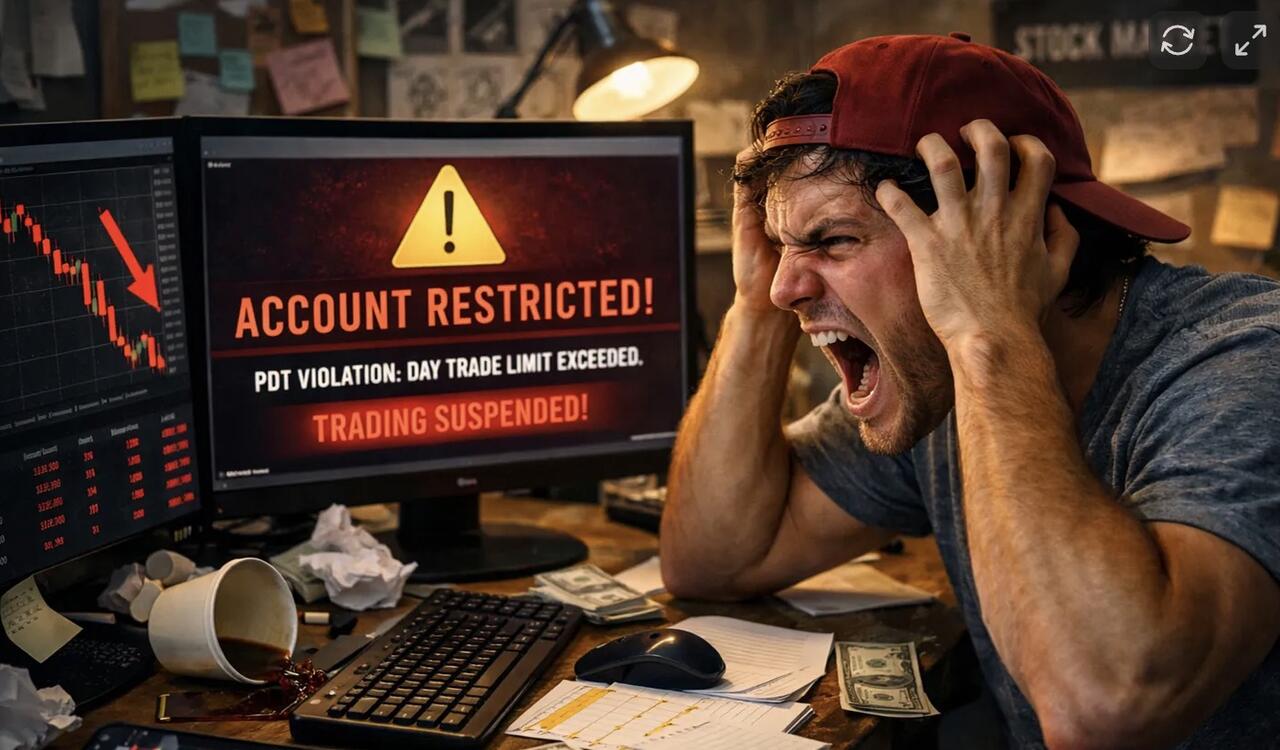
At its core, the PDT rule, at one point designed to save people from themselves, declared that if you made four or more day trades within a rolling five-business-day window, you would be labeled a “pattern day trader.”
This meant you got hit with a requirement to maintain a minimum account balance of $25,000. If you didn’t have that amount sitting in your account, you were effectively benched. Your ability to trade frequently was restricted, your account functionality clipped, and your participation in the market suddenly conditional on whether you had what, for many people, is a significant chunk of savings just casually lying around.
I could see the rule’s purpose in 1957, when you had to walk your orders to a live broker chain smoking cigars on Wall Street to make them — the idea of placing more than one trade a year must have looked like high-speed Roulette on crack cocaine doing 120mph doing I-95 in a modified golf cart. But for f*ck’s sake…it’s 2026. People daytrade on the toilet. I saw someone daytrading mid-roll at jiu jitsu the other day. 18 year old kids are trading cow dung futures at 11pm on Friday nights from their college town bars. Like it or not, daytrading and 0DTE are the markets now.
When I first started trading, this rule felt like a trap I kept stepping into over and over again. I was doing what anyone new to markets does: experimenting, entering and exiting positions, trying to understand price movement in real time instead of just reading about it. And then, without fail, I’d hit the invisible tripwire. Suddenly my account would be flagged, and I’d be locked out of making additional trades. It didn’t feel like protection; it felt like being told you’re allowed to learn how to swim, but only if you already own a boat.
The cycle repeated itself enough times that it stopped being frustrating and started being absurd. You weren’t being guided away from risk, you were being arbitrarily stopped from participating in the very process that teaches you how to manage it.
What makes the whole thing even harder to take seriously is the broader context of what modern “markets” have become today. During the same time brokerages have been carefully counting how many intraday stock trades you make, entire platforms have emerged where you could effectively bet on outcomes so specific and bizarre they sound like satire.
We are talking about markets where people can take positions on things like how many times Eric Swalwell will fart on MSNBC during his next appearance, or whether a sports announcer will use the word “toboggan” during an NBA broadcast. These are barely satire, and close examples of the kind of hyper-niche, almost performance-art-level speculation that is now perfectly acceptable. And yet, somehow, the line of responsibility was drawn at a small retail trader buying and selling Microsoft too many times during a day. That was the danger. That was what needed controlling.
Then there’s crypto, which exists in a parallel universe where the concept of trading hours, regulatory guardrails, and frankly even clear definitions of value often feel optional. You can trade crypto assets 24 hours a day, seven days a week, from anywhere, at any time, with price swings that make traditional equities look like Yo Gabba Gabba. You can make dozens of trades in a single night if you feel like it, driven by momentum, panic, excitement, drunkenness, a tweet you saw five minutes ago or all of the above.
There is no equivalent mechanism that steps in and says, “Hold on, you’ve been a bit too active for your account size.” There is no $25,000 gatekeeper deciding whether you are worthy of participation. And yet, despite all of that volatility and freedom, the system somehow survives without collapsing under the weight of small traders clicking buttons too frequently. Which raises the obvious question: if that environment can exist, why exactly was the traditional equities market so concerned with rationing out trades like they were a scarce resource reserved for the financially initiated?
🔥 50% OFF FOR LIFE: Using this coupon entitles you to 50% off an annual subscription to Fringe Finance for life: Get 50% off forever
The underlying logic of the PDT rule always rested on a premise that doesn’t hold up under scrutiny, which is that frequent trading is inherently dangerous, but only if you are not already wealthy. If you have $25,000 in your account, you are presumed capable of handling the risks of rapid trading, as though the act of having that money confers discipline, knowledge, or emotional control. If you don’t, then the exact same behavior suddenly becomes irresponsible and in need of restriction.
It’s a framework that quietly equates capital with competence, ignoring the reality that someone can have a large account and no strategy, or a small account and a careful, methodical approach to learning. Instead of addressing risk through education, transparency, or better tools, the rule defaulted to a blunt instrument: a hard cutoff that didn’t adapt to individual behavior or intent.
In practice, what it did was create friction at the wrong point in a trader’s journey. Beginners, who arguably benefit the most from being able to engage, test ideas, and learn from quick feedback loops, were the ones most likely to be restricted. Meanwhile, more experienced or better-funded participants operated without those same constraints, not because they were necessarily making better decisions, but because they had already crossed an arbitrary financial threshold.
The result was a system that didn’t eliminate risk so much as redistribute opportunity, favoring those who least needed the protection while limiting those who were still figuring things out.
The strange part is how long something so mismatched with modern market behavior managed to stick around, especially as everything else changed. Trading became commission-free, access expanded through apps, information moved at the speed of social media, and entirely new asset classes blurred the lines between investing, speculation, and entertainment. In that environment, the idea that the number of trades you could make in a week should be capped unless you met a fixed dollar requirement started to feel less like prudent regulation and more like a relic that had outlived the world it was designed for.
So yes, the Pattern Day Trader rule deserves every bit of the criticism it gets, and then some. It wasn’t just inconvenient; it was conceptually flawed, inconsistently applied in a broader financial ecosystem, and oddly patronizing in the assumptions it made about who should be allowed to participate and how.
And if it is finally fading into irrelevance, replaced by systems that trust individuals a bit more and gatekeep a bit less, then it’s hard to feel anything but satisfaction. Not relief exactly, because most people just learned to work around it or avoid it, but a kind of quiet acknowledgment that one of the more nonsensical speed bumps in modern finance is no longer pretending to be a necessary feature.
Good riddance, indeed.
—
QTR’s Disclaimer: Please read my full legal disclaimer on my About page here. This post represents my opinions only. In addition, please understand I am an idiot and often get things wrong and lose money. I may own or transact in any names mentioned in this piece at any time without warning. Contributor posts and aggregated posts have been hand selected by me, have not been fact checked and are the opinions of their authors. They are either submitted to QTR by their author, reprinted under a Creative Commons license with my best effort to uphold what the license asks, or with the permission of the author.
This is not a recommendation to buy or sell any stocks or securities, just my opinions. I often lose money on positions I trade/invest in. I may add any name mentioned in this article and sell any name mentioned in this piece at any time, without further warning. None of this is a solicitation to buy or sell securities. I may or may not own names I write about and are watching. Sometimes I’m bullish without owning things, sometimes I’m bearish and do own things. Just assume my positions could be exactly the opposite of what you think they are just in case. If I’m long I could quickly be short and vice versa. I won’t update my positions. All positions can change immediately as soon as I publish this, with or without notice and at any point I can be long, short or neutral on any position. You are on your own. Do not make decisions based on my blog. I exist on the fringe. If you see numbers and calculations of any sort, assume they are wrong and double check them. I failed Algebra in 8th grade and topped off my high school math accolades by getting a D- in remedial Calculus my senior year, before becoming an English major in college so I could bullshit my way through things easier.
The publisher does not guarantee the accuracy or completeness of the information provided in this page. These are not the opinions of any of my employers, partners, or associates. I did my best to be honest about my disclosures but can’t guarantee I am right; I write these posts after a couple beers sometimes. I edit after my posts are published because I’m impatient and lazy, so if you see a typo, check back in a half hour. Also, I just straight up get shit wrong a lot. I mention it twice because it’s that important.
Tyler Durden
Wed, 04/15/2026 – 10:25