
SpaceX-Tesla Merger Speculation Grows As Decade Of Cross-Company Deals Reveal Deeper Integration
Wedbush Securities’ Dan Ives has pointed out for months the potential for a SpaceX-Tesla merger, discussing the possibility with Bloomberg in February and, more recently, on a podcast where he said the probability is 80% by 2027. Polymarket odds of a merger by the end of the year stand at 32%.
Now, CNBC has joined the growing speculation that Musk may eventually merge Tesla and SpaceX into one mega-company.
The report said:
The two companies already have a laundry list of shared resources, and Musk has discussed with colleagues the possibility of folding the companies together, according to people familiar with the talks who asked not to be named due to the sensitivity of the topic.
A current Tesla employee told CNBC that many workers at the electric vehicle company have long expected such a transaction to eventually take place and that the topic is openly discussed internally.
Another person close to the company said that shared challenges tied to power and compute constraints have led to regular collaborations.
Both companies already overlap across AI, compute, power, batteries, materials, engineering, suppliers, board members, and personnel. SpaceX now includes Starlink and xAI, while Tesla is increasingly becoming an AI and robotics company, in addition to remaining one of the leading EV makers.
BREAKING: ELON MUSK CONSIDERS MERGING $TSLA AND SPACEX AFTER IPO, per CNBC 👀
It’s happening ! pic.twitter.com/BD7g4zDd1Z
— TheSonOfWalkley (@TheSonOfWalkley) May 26, 2026
Financial ties between the two companies are already well known: Tesla invested $2 billion in xAI, which became part of SpaceX after the merger. SpaceX bought $697 million worth of Tesla Megapack systems for xAI data centers and $131 million worth of Cybertrucks. Past transactions also included Tesla selling solar equipment and parts to SpaceX, Tesla using SpaceX jets, and SpaceX helping with Cybertruck materials.
Tejpaul Bhatia, a longtime SpaceX investor and CEO of Nebex, told CNBC that “Parallel entrepreneurship seems to work for him [Elon Musk].”
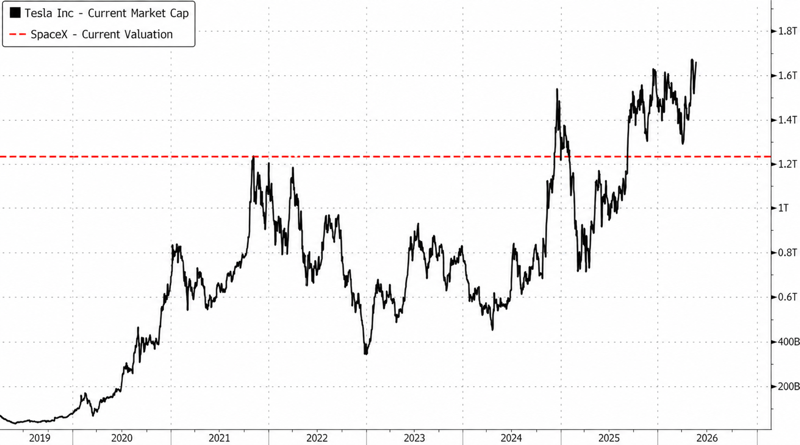
Tesla’s market cap currently sits at around $1.6 trillion, while SpaceX is expected to start trading on Nasdaq in about two weeks, after achieving a private market valuation of $1.25 trillion earlier this year.
Wedbush Securities’ Dan Ives recently told Anthony Pompliano that he has a high-conviction view (80-85% chance) that SpaceX will merge with Tesla in 2027, post-IPO.
Dan Ives: 80% probability of a Tesla-SpaceX merger by 2027. Polymarket: 20% by end of 2026.
One of those is dramatically wrong.
The structural argument for Ives: the IPO gives Elon a public-market currency for the first time at merger scale. Before the IPO, the mechanics did… pic.twitter.com/r7RXRIqiQj
— podcast alpha (@podcast_alpha_x) May 26, 2026
Musk sits on both company boards and holds 85% voting power at SpaceX, which would mean limited resistance when the time comes for a merger.
EV blog Electrek laid out Musk’s creative engineering of billion-dollar self-dealings over the years:
1. SolarCity — $2.6 billion (2016): Tesla acquired SolarCity, a money-losing solar installer where Musk served as chairman and was the largest shareholder, for $2.6 billion in an all-stock deal. Shareholders sued, alleging it was a bailout of a company that was running out of cash. Musk sat on both boards. A Delaware court ultimately ruled the deal was “fair,” but other Tesla directors settled for $60 million without admitting fault. Musk argued that SolarCity’s solar business had become an integral part of Tesla’s own business, but shortly after winning the lawsuit, Tesla shut down parts of its solar operations and stopped reporting quarterly solar deployment.
2. Twitter/X — $44 billion (2022): Musk acquired Twitter for $44 billion, a price he himself tried to back out of after realizing he overpaid. Within a year, Fidelity had revalued its stake as down 65%. By October 2024, the platform was valued at roughly $9-10 billion. Then, in March 2025, Musk had xAI acquire X for $33 billion ($45 billion including $12 billion in debt) — effectively bailing out his private investors by magically restoring a platform worth $9 billion to a $33 billion valuation on the back of xAI.
3. xAI — Tesla’s $2 billion investment, then SpaceX absorption (2025-2026): Tesla disclosed a $2 billion investment in Musk’s xAI in January 2026, despite shareholders having previously rejected a proposal. Days later, Musk was rumored to be floating a three-way merger. Within weeks, SpaceX acquired xAI in a deal worth roughly $250 billion. Weeks after that, Musk admitted xAI was “not built right” and needed to be rebuilt — after Tesla shareholders’ money was already in and SpaceX shareholders had swallowed the dilution.
4. Tesla-SpaceX merger (2026-2027?): Now Musk wants to combine the whole thing. If this happens, Tesla shareholders will be merging their $1.6 trillion company with an entity that Musk controls with 85% voting power — an entity that now includes the wreckage of Twitter, a money-losing AI company he admitted was built wrong, and a rocket business with an insane valuation that rests on ever-delayed Mars dreams and “data centers in space.”
Polymarket odds of a SpaceX-Tesla merger by the end of the year stand at 32%.
Yes 33% · No 67%
View full market & trade on Polymarket
With Musk owning about 20% of Tesla and controlling 85% of SpaceX’s voting power, and with both companies already operating like an integrated AI, energy, and transportation company, with many overlaps, the pathway of least resistance for Musk in the evolution of his creative engineering increasingly appears to be a mega-merger after the SpaceX IPO.
Tyler Durden
Wed, 05/27/2026 – 10:40