US Govt. Lab Launches Advanced Battery Lab To Help Power Grid
Authored by Georgina Jedikovska via Interesting Engineering,
The US has recently launched a new battery production line, which is expected to help researchers develop safer and cheaper energy storage technologies for the electric grid.
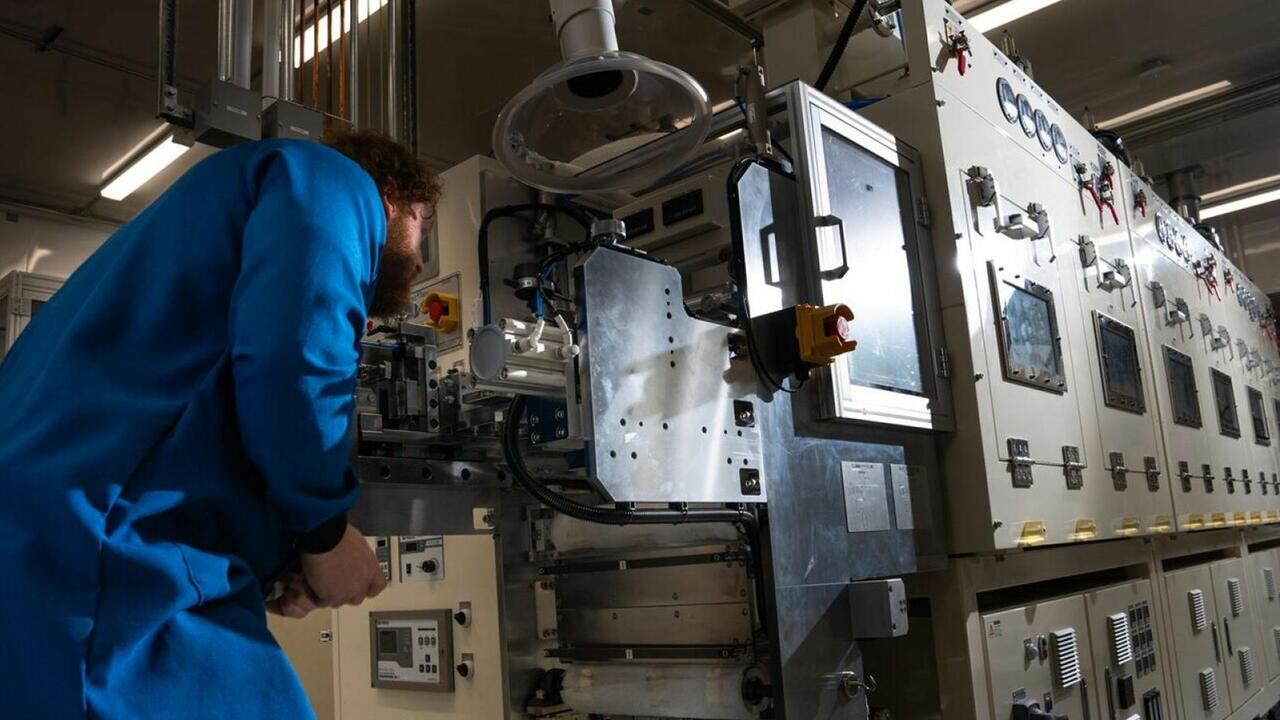
The new line is housed at the Grid Storage Launchpad (GSL), a 93,000-square-foot research facility. It is run by the Department of Energy’s (DOE) Pacific Northwest National Laboratory (PNNL) in Richland, Washington State.
According to PNNL, the newly commissioned production line features a total of 16 pieces of equipment inside a 1,400-square-foot laboratory. It is reportedly the first prismatic battery cell production line at a US national laboratory.
Researchers at PNNL pointed out that it will allow them to manufacture, test, and validate advanced battery designs at an industrially relevant scale. “This helps our researchers bridge the gap between science and industry,” Adam Jivelekas, GSL operations manager, said.
A New Grid Storage Hub
The line will produce prismatic battery cells. These are rectangular and larger than cylindrical cells, and shaped like a nine-volt battery (9V). As a result, they contain more energy per cell. Developed with a heavier metal casing, they are less prone to overheating, which makes them increasingly popular for storing energy on the electric grid.
Mark Weller, PhD, a PNNL materials scientist and the principal investigator of the project, explained that metal transfers heat more efficiently than most materials. This allows these batteries to cool more easily. “If you have better heat transport, if the cells are more mechanically uniform, if they’re packed more efficiently, all those things can translate to not just higher safety, but lower cost,” he added.
In addition, their rectangular shape means they can be stacked neatly together. This reduces wasted space compared to cylindrical alternatives. Efficient packing helps boost energy density at the pack level.
As per Jivelekas, the facility will help speed up the transition from battery research to production. “We can help external researchers or industry partners test and validate their prismatic cell designs,” he pointed out.
Start Of Operations
PNNL noted that the facility is located inside a specialized dry laboratory, where humidity levels are kept lower than those found in some of the driest places on the planet. Maintaining these conditions is critical, as trace levels of moisture can degrade the sensitive battery components.
The facility wrapped up testing earlier this year. The scientists are now preparing validation projects intended to demonstrate its capabilities. Weller emphasized that the real test is proving it can be used to consistently manufacture high-quality prismatic cells.
“Making a coin cell takes a few milligrams of material; making a prismatic cell takes at least a kilogram,” he elaborated in a press release. “When you scale up like that, you can’t assume that a chemistry that worked well in a coin cell will work just as well in a prismatic cell.”
To demonstrate the approach, the research team will produce and evaluate two promising battery chemistries to use in prismatic cells. These include sodium-ion and lithium-iron-phosphate (LFP).
Following production, the researchers will submit these two prismatic cell types to a number of tests to evaluate their performance and safety. “With this capability, we can do the research and development and pilot-scale testing that is difficult for companies to justify and help facilitate a smoother handoff to get advanced battery concepts to market,” Weller concluded.
Tyler Durden
Wed, 06/03/2026 – 22:35