
Power Transformer Lead Times Hit Record Highs As US Grid Equipment Shortage Deepens
By West Garrett of Industrial Sage
Summary:
- Power transformer lead times now average 128 weeks — nearly 2.5 years — with generator step-up transformers averaging 144 weeks
- Prices for power transformers have risen 77% since 2019, driven by surging demand and constrained raw material supply
- Cleveland-Cliffs is the only domestic producer of grain-oriented electrical steel, the specialized material transformers require
- Demand for generator step-up transformers has grown 274% since 2019, outpacing any increase in manufacturing capacity
- For industrial developers, equipment availability has replaced capital and permitting as the primary constraint on project timelines
- Roughly 80% of large power transformers used in the U.S. are imported, exposing critical infrastructure to global supply chain pressures
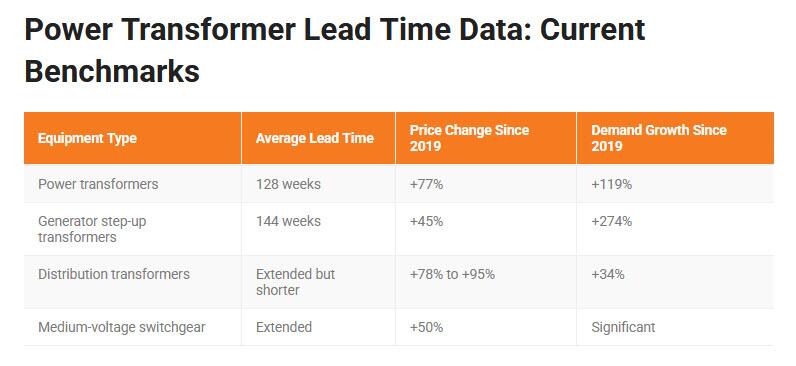
Power transformer lead times have reached levels that are now dictating the pace of industrial expansion across the United States. According to Wood Mackenzie’s second quarter 2025 survey, standard power transformers average 128 weeks for delivery. Generator step-up transformers, which connect large power generation assets to the grid, average 144 weeks. Some orders extend to four years.
For plant operators, energy developers, and infrastructure planners, that math has a direct consequence: a facility that breaks ground today cannot energize its electrical systems on a standard timeline. Equipment availability has become the gating factor for industrial growth, replacing capital availability and permitting as the primary project constraint.
Power Transformer Lead Times: What the Numbers Actually Mean
128 weeks is nearly two and a half years of wait time before a transformer ships. That figure comes from actual utility and developer order data, not theoretical capacity projections. Generator step-up transformers, which are larger and more specialized, run even longer at 144 weeks. The North American Electric Reliability Corporation reported lead times crossing 120 weeks in 2024, and the trend has continued upward into 2025.
The cost pressure is equally significant. Power transformer prices have risen 77% since 2019, according to industry sourcing data. Distribution transformer prices have climbed 78% to 95% over the same period. The underlying material drivers are straightforward: grain-oriented electrical steel prices have roughly doubled since 2020, and copper prices have risen more than 50%. Both materials are core inputs in every transformer manufactured.
The demand surge is not temporary. Generator step-up transformer demand has grown 274% since 2019. Power transformer demand has grown 119% over the same period. AI data center construction, large-scale electrification of industrial processes, and grid modernization programs are all pulling from the same constrained supplier base simultaneously.
The Cleveland-Cliffs Bottleneck: One Domestic Supplier for Critical Steel
The transformer shortage is not simply a volume problem. It has a structural bottleneck at the material level. Transformer cores require grain-oriented electrical steel, a highly engineered material that gives the steel specific magnetic properties needed for efficient power transformation. In the United States, Cleveland-Cliffs is the only domestic producer of this material, operating plants in Pennsylvania and Ohio.
That concentration means that every U.S. transformer manufacturer drawing on domestic steel supply draws from a single source. When that source faces capacity constraints, pricing pressure, or supply disruptions, the effect ripples through the entire domestic transformer manufacturing base immediately. Roughly 80% of large power transformers used in the U.S. are imported, primarily from Mexico, South Korea, and other international manufacturers, creating additional exposure to global trade conditions.
The Biden administration awarded Cleveland-Cliffs $500 million to upgrade its electrical steel plants under the CHIPS and Infrastructure framework. Key elements of that grant have since been reviewed under the current administration, adding uncertainty to the domestic steel expansion timeline.
Who Is Driving the Demand Surge
Three distinct demand categories are converging on the same equipment market at the same time:
- AI data centers: Hyperscale data center construction requires massive electrical infrastructure. A single large AI training cluster can require hundreds of megawatts of power delivery, each requiring transformers at multiple points in the distribution chain.
- Industrial electrification: Manufacturing facilities converting from fossil-fuel-powered processes to electric systems require new transformer capacity at the facility level, compounding grid-level demand.
- Grid modernization: Aging transmission infrastructure across the U.S. requires transformer replacement at a scale that was already behind schedule before the AI and electrification waves arrived.
These three demand categories do not share a common peak cycle. They are all active simultaneously, and none shows signs of near-term deceleration.
What Industrial Leaders Should Do Now
The strategic implication for any organization with capital projects in the pipeline is straightforward: equipment procurement planning must now precede, not follow, project financial approval. Waiting until a project clears its budget and permitting phase to begin transformer sourcing can add two to four years to a project timeline before the first piece of steel is bent on site.
Long-term supply agreements with transformer manufacturers are becoming a competitive tool. Organizations that lock in delivery slots years in advance gain a scheduling advantage that cannot be bought at spot pricing once a project is ready to execute. Similarly, projects with flexibility on grid interconnect timing may benefit from engaging utilities earlier in the planning process to understand equipment delivery realities.
The domestic manufacturing response is underway: nearly $2 billion has been directed toward North American transformer production expansion, with new capacity from Hitachi Energy, Siemens Energy, and others projected to come online by 2028. However, that capacity does not solve the current shortage. Projects executing between now and 2028 face the current market as it exists today.
IndustrialSage tracks domestic infrastructure investment and supply chain constraints through the US Manufacturing Investment Tracker. For additional context on grid infrastructure and industrial power, visit the IndustrialSage news section. This story was covered on IndustrialSage Headlines Episode 23.
Frequently Asked Questions: U.S. Power Transformer Shortage
How long are power transformer lead times right now?
As of the second quarter of 2025, standard power transformers average 128 weeks for delivery. Generator step-up transformers average 144 weeks. Some specialized orders are extending to four years. These are verified order-based averages from Wood Mackenzie’s industry survey, not theoretical estimates.
Why are transformer lead times so long?
Demand has outpaced manufacturing capacity across all transformer categories simultaneously. Generator step-up transformer demand grew 274% since 2019. Power transformer demand grew 119%. Meanwhile, domestic manufacturing capacity has not scaled proportionally, and the sole U.S. producer of the required grain-oriented electrical steel faces its own capacity limits.
How much have transformer prices increased?
Power transformer prices have risen 77% since 2019. Distribution transformer prices have risen 78% to 95%. Generator step-up transformer prices have risen 45%. The increases reflect both raw material cost inflation and the pricing power that comes with constrained supply against surging demand.
Who makes grain-oriented electrical steel in the United States?
Cleveland-Cliffs is the only domestic producer of grain-oriented electrical steel, operating facilities in Pennsylvania and Ohio. This concentration creates a single point of supply constraint for all U.S. transformer manufacturers relying on domestic steel. Approximately 80% of large power transformers used in the U.S. are imported, reflecting the limited domestic manufacturing base.
What is driving the surge in transformer demand?
Three concurrent demand waves are driving the surge: AI data center construction requiring massive power delivery infrastructure, industrial electrification converting fossil-fuel processes to electric systems, and grid modernization replacing aging transmission infrastructure. These three categories do not share a common peak cycle, and all are active simultaneously.
What should industrial planners do about transformer lead times?
Equipment procurement planning must precede project financial approval. Waiting until a project clears budget and permitting to begin transformer sourcing can add two to four years to the execution timeline. Long-term supply agreements and early utility engagement on grid interconnect timing are the two most effective tools available in the current market.
Tyler Durden
Mon, 06/15/2026 – 18:25