
Inside America’s Drone Arms Race: What Industry Experts See Ahead Of Procurement Supercycle
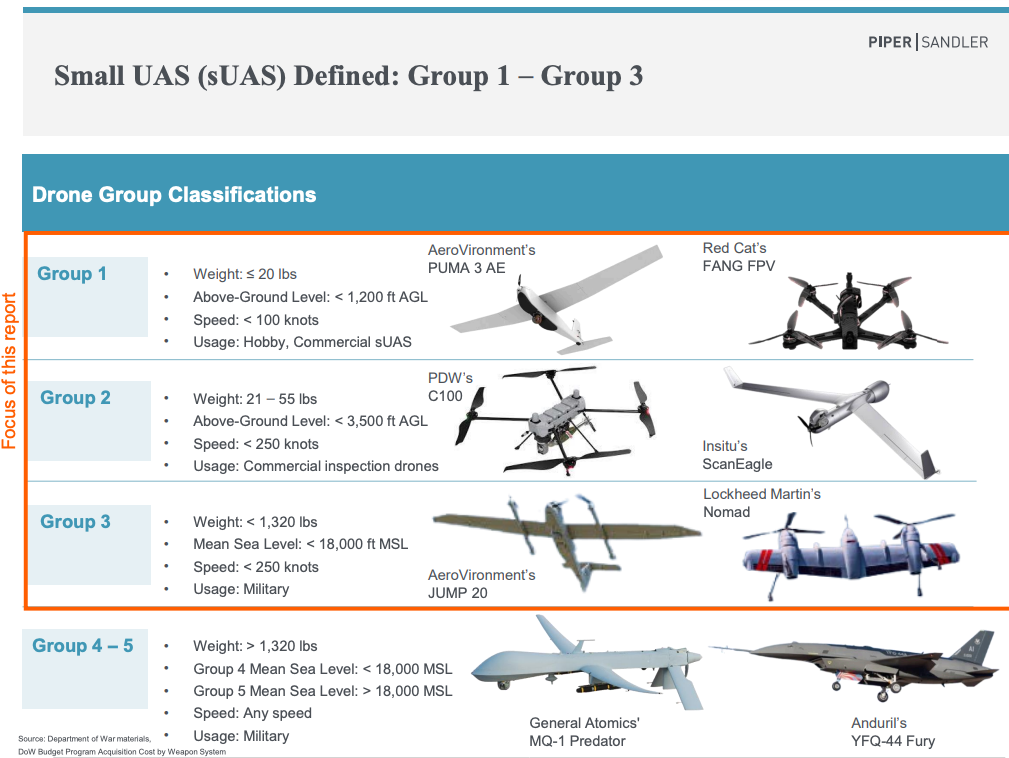
Our coverage of America’s Group 1 to Group 3 drone industry has centered on Unusual Machines and Ondas, two companies positioned to reap the benefits from what could become a historic procurement cycle next year. The catalyst is the Department of War’s Defense Autonomous Warfare Group, which is preparing to direct $55 billion toward autonomous systems. If that spending materializes as planned, companies offering NDAA-compliant drones and drone components, scalable manufacturing capacity, and field-ready platforms should be best positioned to capture the coming flood of orders.
For more clarity on the drone space, Canaccord Genuity recently hosted the “Drone Dominion” panel, which included executives from AeroVironment, Leonardo DRS, Unusual Machines, Codan Tactical Communications, and Juno Industries.
“The panel opened with a consensus that drone warfare has shifted from individual aircraft for intelligence, surveillance, and reconnaissance applications to massed, expendable strike systems with growing remote autonomy,” Austin Moeller, Canaccord Genuity’s senior aerospace and defense technology equity-research analyst, wrote in a note Thursday.
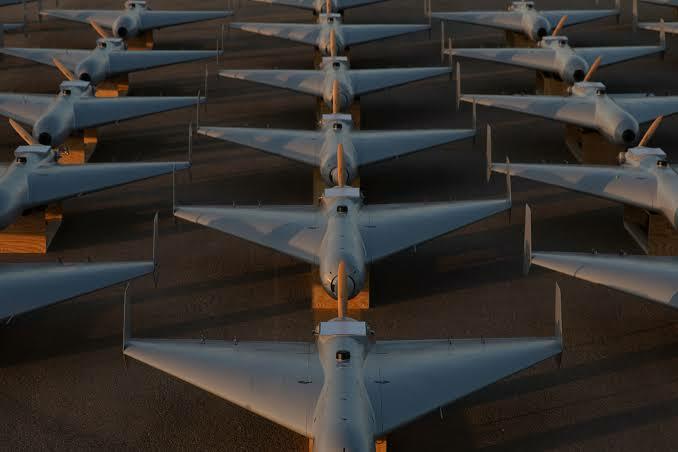
Moeller’s summary of the panel discussion provides investors with a useful framework for understanding the drone space and identifying the companies best positioned to benefit from a potential procurement supercycle, as demand for Group 1 to Group 3 drones, counter-UAS systems, and domestically sourced NDAA-compliant parts is poised to accelerate.
Drone dominion
We hosted management of Leonardo DRS (DRS), AeroVironment (AVAV), Unusual Machines (UMAC), Codan DTC, and Juno Industries at the 46th Annual Canaccord Genuity Growth Conference in Boston for a Drone/C-UAS panel discussion. Our panel included Leonardo DRS CEO John Baylouny, AeroVironment COO Dr. Robert Smith, Unusual Machines COO Drew Camden, Codan Tactical Communications President and Executive General Manager Paul Sangster, and former Canadian Minister of National Defense and Juno Industries Executive Chairman, Harjit Sajjan. The panel discussed how drone warfare has evolved from being primarily an ISR platform to widespread adoption as autonomous and expendable/attritable tactical and one-way attack systems, along with the corresponding urgent need for counter-UAS layered air defenses, secure supply chains, and integrated battlefield C2 systems and AI edge compute.
The panel opened with a consensus that drone warfare has shifted from individual aircraft for intelligence, surveillance, and reconnaissance applications to massed, expendable strike systems with growing remote autonomy. John Baylouny stated that drones are now weapons that must make sense of the battlefield, and Harjit Sajjan emphasized that integrating sensors into battle management systems to enable fusion/processing of data is central to making those strike capabilities practical and useful. The panel agreed this transition changes not only platform design but also how forces employ drones; for instance, moving from a handful of high-end assets to large numbers of lower-cost munitions used en masse (swarms) to saturate and overwhelm air defenses and targets. This dynamic forces the industry to prioritize rapid iteration and high-volume manufacturing, modular payloads, and mission-tailored autonomy so systems can be adopted and modified quickly as tactics and countermeasures evolve in the field.
The panel agreed that battlefield advantage now depends on resilient, secure command-and-control (C2) networks that connect drones, sensors, weapons platforms, and operators into rapid decision-making workflows. Paul Sangster explained that today’s battlefield is far more networked, requiring secure mesh communications that tie drones, sensors, and vehicles into rapid decision loops. Dr. Rob Smith and the others noted that the tactical advantage now comes from how quickly collected sensor data can be communicated to warfighters and platforms and acted upon, which has elevated architecture, encryption, and waveform design to operational-level priorities. The panel emphasized that interoperability is a prerequisite for scaling effective multi-platform operations. Speakers warned that contested-spectrum environments and adversary cyber-attack tactics could quickly degrade the benefits of massed drone operations unless resilience and redundancy are built into C2 designs.
Counter-UAS defenses being layered and multi-modal were stressed by the panel. Mr. Baylouny described systems combining radar, IR identification, and multiple effectors (e.g., DRS’ Sgt. Stout Stryker air artillery Mission Equipment Package). Dr. Smith outlined a layered approach beginning with Radio Frequency (RF) detection and Electronic Warfare (EW) at standoff ranges, then lasers for cost-effective engagement within line-of-sight, and kinetic interceptors when necessary. Speakers emphasized mobility and integrated C2 so that different defeat mechanisms can be applied as threats evolve, reflecting a pragmatic view that no single technology will defeat every class of drone. As a result, the defense tech market is making investments in software/AI platforms, sensors (radar, RF, EO, IR/thermal), directed energy, and affordable kinetic interceptors to create adaptable defense mechanisms for various defensive scenarios for both point-defense and on-the-move.
Drew Camden and Rob Smith argued that expanding domestic production capacity requires predictable govt. demand and long-term procurement commitments. Manufacturers depend on these factors so that they can invest in facilities, automation, and long-term supplier relationships.
They stated that US systems will likely differ in capability from mass-produced foreign drones (Ukrainian drones are using Chinese Raspberry Pis and motors, for example) and that programs like Drone Dominance must create steady, multi-year volume procurement plans such as IDIQs/OTAs to make rapid scaling feasible without stopping and restarting fragile supply chains. Firms are already redirecting R&D and IRAD into domestic tooling and manufacturing readiness to shorten the timeline from prototype to fielded production and advance-purchasing materials inventory for when multi-year contracts are in place, and demand is present. In practice, policymakers must align procurement, financing, and industrial policy to reduce production ramp-up time, reduce lead times for critical components, and stabilize the supply chain.
Speakers raised concerns about deep supply chain and security/espionage concerns. The panel discussed challenges in removing Chinese-made components and subcomponents, as well as securing rare earth materials, noting that compliance requires tracing multiple layers down the supply chain. Many A&D primes have found Chinese materials or components as they investigate deeper into their supply chains. Mr. Sajjan cautioned against focusing on a single supplier or country and urged comprehensive evaluation with trusted national agencies, while Mr. Baylouny described efforts internally to look five or six layers deep to discover where materials and components truly originate from. Mr. Camden explained his company’s strategy of bringing parts, and eventually, chips and motors onshore. He added that while Unusual Machines had initially been sourcing drone motors from China, the company is now doing its own winding with machines in a similar production process to Chinese drone company T-MOTOR. Dr. Smith emphasized the importance of firmware screening, cyber red-teaming, and holistic assurance practices. Addressing these challenges will require sustained funding, clearer regulatory standards (e.g., NDAA and ITAR), and closer public-private partnerships to create resilience and chain of custody among supply chains.
Finally, the panel emphasized that training and acquisition practices must be reformed to keep pace with evolving drone tactics and technologies. Mr. Baylouny argued that the old “design, build, and buy thousands” government PoR model is too slow and called for experiment-driven acquisition. Mr. Sajjan highlighted the importance of close user-developer feedback so deployed troops can refine and optimize systems with their designers for real-world missions. Mr. Camden pointed to improvised civilian and government innovations seen in Ukraine as evidence that militaries must be able to adapt new concepts and strategies quickly. Dr. Smith reinforced that predictable demand signals will also enable investment in the training, sustainment, and industrial pipelines needed to scale manufacturing capabilities. To turn technological advances into enduring operational advantage, the panel concluded that reforms across procurement and training must move forward along with technical, military, and industrial initiatives.
Our mid-June initiation report, “How To Profit From the Asymmetric Warfare Boom” …
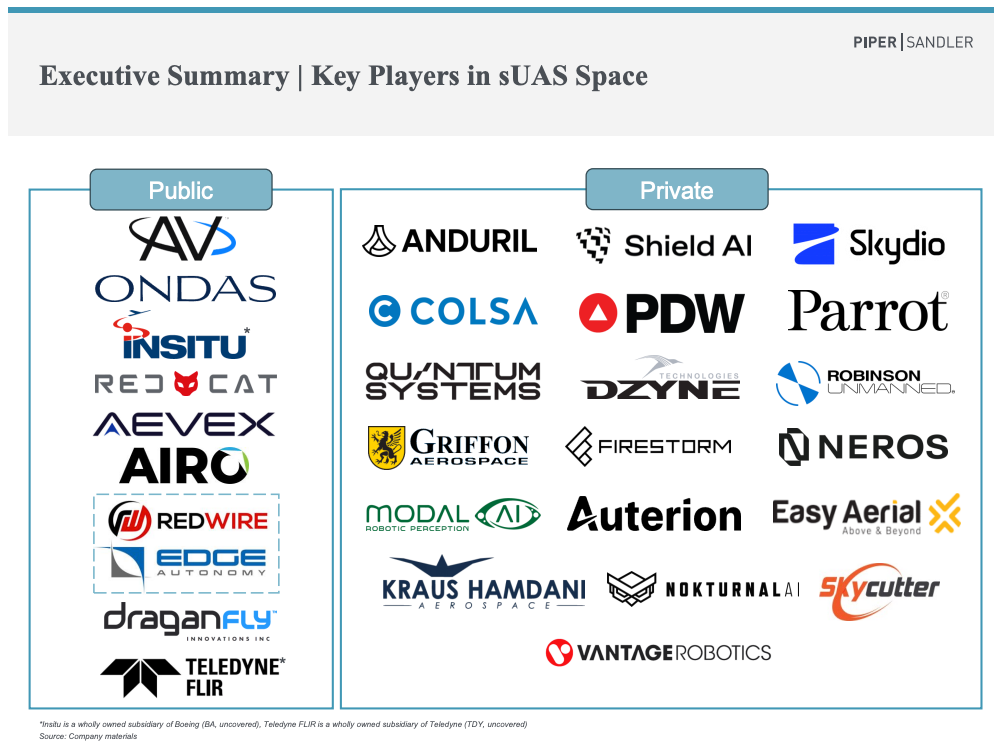
… first identified the leading public and private companies positioned across the drone and counter-drone space.
Tyler Durden
Sat, 08/22/2026 – 21:35