
MAGA, The DSA, & The Politics Of No Competition
Authored by Katherine Gehl via RealClearPolitics,
Despite the narrow loss by Democratic Socialist Francesca Hong in the Wisconsin Democratic gubernatorial primary last week, DSA candidates have prevailed in primaries this year from Maine to California. The Democratic Party establishment believed it dodged a bullet in Wisconsin, but this threat is not going away any time soon.
The roots of the radical left’s success were seeded almost a decade ago. In 2017, a writer in a Democratic Socialists of America publication laid out a strategy under a plain title: “Want to Elect Socialists? Run Them in Democratic Primaries.” The Democratic Party, the article conceded, was deeply flawed – but it was the easiest available path for socialists to win elections and build power. Nearly a decade later, that strategy is bearing fruit. Democratic Socialist and allied candidates are winning Democratic primaries, and with them, safe Democratic seats – maybe even some competitive seats.
We have seen this before, on the right side of the political spectrum. Donald Trump – who sought the Reform Party’s presidential nomination in 2000 and registered as an independent in 2011 – ultimately abandoned the outsider path. His nationalist-populist movement could not realistically win elections as a third party – under our rules it would only split conservative votes and hand elections to Democrats. So Trump and his MAGA movement didn’t build. They captured. Trump fought inside the Republican Party, where a committed faction could dominate low-turnout primaries, threaten incumbents, and seize the party’s brand. Today MAGA owns that brand, the infrastructure, the finances, and the power of the GOP.
These two stories are usually told as ideological earthquakes – the radicalization of the right, the leftward lurch of the left. They are better understood as the same structural event, produced by the same underlying cause. The cause is the century-long determination of America’s two dominant political parties to retain their power at all costs.
To retain their stranglehold on the levers of power they employ a dozen different strategies, ranging from restricting ballot access to manipulating political primaries. But the single rule allowing Democrats and Republicans to keep control is one most of us never even notice – and one that sounds perfectly reasonable: In most U.S. elections, the winner is the candidate with the most votes. The technical term is plurality winners.
This seems simple and fair on its face, but it turns out to be wildly consequential – and not in a good way. You see, if the winner is only required to have “the most votes,” that means in any race with more than two candidates, a candidate can win with less than a majority. For example, a candidate can win with 34% in a three-way race, meaning two-thirds of voters preferred someone else. In a five-way race, the winner could emerge with 21%. This dynamic creates the “spoiler” or the “wasted vote.”
In plurality winner elections, we often don’t feel free to vote for the candidate we like best, out of fear our vote will inadvertently help elect the candidate we like least. For example, in the 2016 presidential race, if you liked Green Party candidate Jill Stein, you knew you probably shouldn’t vote for her because that would take votes from Hillary Clinton and help elect Donald Trump. The mirror on the right: You may have wanted to vote for Libertarian Gary Johnson, but you knew that would take votes from Trump and help elect Clinton.
Plurality winners aren’t just a problem for “fringe” views. They’re the reason so many voters experience November general elections as a choice between the “lesser of two evils.”
Consider 2024. Numerous polls found that most Americans didn’t want a rematch between Donald Trump and Joe Biden – roughly two-thirds said they were tired of the same candidates and wanted someone new. Clear majorities of Americans said neither man should run at all.
Into that vacuum stepped the group No Labels, whose founder and chief executive, Nancy Jacobson, reached out to some 30 potential candidates for a centrist “unity” ticket. The names were serious people – Joe Manchin, Larry Hogan, Kyrsten Sinema, Liz Cheney, Chris Christie, and Nikki Haley among them. Not one would run.
Manchin said the quiet part out loud – he ruled it out publicly stating he refused to be a spoiler. There is the whole trap, in a single word. Under plurality winners, a credible independent – or third-party candidate – doesn’t enter the race as an equal competitor; he enters as a spoiler. The spoiler problem means no votes, no votes means no chance, no chance means no money, no money means no messaging, no messaging means no chance, and no chance means no votes. It is a vicious cycle, and it shuts out new competition before a single ballot is cast. No Labels went looking, in its own words, “for a hero,” and a hero never emerged. The system disqualified them before the starting line.
So why do we do it this way? Because in the early days of our Republic, we made a mistake.
At the time, democratic elections barely existed anywhere on earth, so Americans copied the one working model, Great Britain’s. For centuries, the freeholders of each English county gathered at the county court – a public assembly summoned by the sheriff – to choose the “knights of the shire” who would sit for them in the House of Commons, and the town boroughs did the same. The rule was identical and unquestioned: The most votes won, majority or not. There was no mathematical science of voting yet, no menu of alternatives to weigh. So, we reached for the only template in existence and carried it across the Atlantic. We didn’t carefully design our rule for who wins. We backed into it.
Today, the plurality winner system is the greatest barrier to entry in American politics. Consider this: In any other industry as large and thriving as the politics industry, with 86% customer dissatisfaction (the public disapproval of Congress per Gallup’s most recent data), some entrepreneur would see a phenomenal business opportunity and enter the market to give the customers what they want. One would think that a marketplace of ideas so vastly underserved would produce third – or fourth, fifth, and sixth – alternatives. But American politics doesn’t work this way. The cause: plurality elections.
Political scientists call this phenomenon Duverger’s law, the tendency of plurality winners to produce exactly two parties. No new major party has emerged in American politics since the Republicans in 1854.
Economists also have a name for this kind of system: a non-clearing marketplace. In a healthy market, competition keeps working until supply rises to meet demand and the market “clears.” Our political market never clears. Economists know why a market gets stuck like this: It’s rarely nature; it’s almost always an artificial barrier. Housing is the textbook case – demand for homes in a thriving city dwarfs supply, yet zoning, permitting, and other government requirements choke off new construction.
Plurality winners are the corollary in American politics: the rule that keeps new supply from ever reaching the voters clamoring for it. The demand for a real alternative is enormous and unmistakable. Poll after poll finds a majority of Americans want a third choice. When a market is barred from clearing, the built-up pressure doesn’t vanish – it escapes into the black market. That is precisely what the hostile takeovers are: the black market of a rigged political economy, demand forcing its way in where honest competition is blocked.
End plurality winners and let the market clear, and that same energy would flow where it belongs – into new candidates, new ideas, and politicians who must satisfy their general elections customers to survive.
Modern attempts to crack the market only prove the rule. Predating No Labels’ effort, in 2012 the financier Peter Ackerman poured his own fortune and energy into Americans Elect, an audacious bid to put a bipartisan “unity” ticket on the ballot through the first-ever national online primary – its nominee required to choose a running mate from the opposing party. Ackerman’s team did something almost unimaginable, winning ballot access in 29 states before a single vote was cast. Then it collapsed, in large part because no credible candidate would step forward. The serious contenders all understood what Ross Perot’s example in the 1990s and, later, Joe Manchin would confirm: Under plurality rules an independent cannot win, only spoil. Americans Elect built the doorway. The spoiler problem meant no one dared walk through it.
Even more contemporaneously, a disillusioned Elon Musk vowed only last summer to launch a third party. Within a month, he’d pumped the brakes on it. Money wasn’t the issue – he’s the richest man in the world. The barrier is plurality voting and the dreaded “spoiler” label. This summer, Tucker Carlson merely floated a third party trial balloon, Within days, the chattering class was handicapping how Carlson’s fantasy might spoil Marco Rubio’s chance at the 2028 presidential nomination – and Republican chances generally.
Changing the status quo
The most devastating cost of a market with no real competition is not dissatisfying candidates. The true devastation: We don’t get results.
Ask a simple question: When did this country last balance its federal budget? The answer is 1998-2001. President Bill Clinton and his working relationship with House Speaker Newt Gingrich are generally credited with this accomplishment. But most analysts have missed an essential driver: The last time we had balanced budgets followed soon after the last time we had genuine competition in the presidential general election. In 1992, billionaire Texan Ross Perot used his own fortune to do what our system almost never permits: Compete nationally as an independent because he didn’t mind investing his own money in a spoiler race. His message was blunt – America was drowning in debt – and he delivered it himself, buying up half‑hour blocks of network television for folksy “infomercials” in which he stood before hand‑drawn charts and walked the country through the federal balance sheet. The first edition drew more than 16 million viewers.
On the first Tuesday of November, Perot won not a single electoral vote but nearly one-fifth of the popular vote. He lost, but citizens won. Before Perot’s candidacy, neither the Republicans nor the Democrats had balanced budgets on their party platforms. He proved that deficit reduction had a constituency neither party could afford to ignore, or to cede to his nascent Reform Party. Competitive pressure persuaded Clinton and Gingrich that they had to tackle it. In the years that followed, Washington produced four consecutive balanced budgets, the first since 1969. Paul Begala confirmed the theory from the inside, writing in the Washington Post at Perot’s death, “I am not sure we would have ever balanced the budget without the pressure Perot and his voters brought to the issue.” Multiple factors contributed to the balanced budgets, but Perot delivered the otherwise never-existent “political will.”
Here’s the point: Competition changes results even when it doesn’t change who wins. In Silicon Valley when a breakthrough technology emerges, if it benefits customers it will eventually make it to market. The new company will succeed in the marketplace on its own or it will be acquired or copied. Either way, consumers win. That’s the alchemic brilliance of competition.
We desperately need dynamic competition in politics too – not just among candidates but for innovative policy ideas, and competition “to get shit done,” to quote Joe Manchin in a recent interview making the case for independent candidates. In the political marketplace with only two competitors, neither of our two parties are incentivized to tell voters a hard truth or, more importantly, to do hard things like casting votes they know will help the country but perhaps put their political career at risk.
Add a third candidate who can, and the truth suddenly has a market. That is why there will never be a real candidate of fiscal sanity – on the debt, or on anything else that demands shared sacrifice or requires dealing powerfully with tradeoffs – until we eliminate plurality winners. In a marketplace with only two competitors, neither wins reelection if they do a hard thing – balancing the budget, reaching a bipartisan compromise on immigration, rethinking health care. So, they don’t.
Healthy competition, in any human endeavor, delivers innovation, results, and accountability – all of which are sorely missing in our current politics. If we want the benefits of free market politics, we must tear down the barrier to entry that plurality winners create. The fix is simple: To win, you must earn a majority.
A preference for majority winners is neither radical nor new. The Constitution built in a safeguard for the Electoral College: If no candidate wins a majority there, the U.S. House picks the president in a “contingent” election. Massachusetts required a majority to elect its governor from 1780 until 1855. When no one won a majority outright, the choice fell not to the voters but to the state legislature.
A few states still use majority requirements today. Alabama, Arkansas, Georgia, Mississippi, North Carolina, Oklahoma, South Carolina, South Dakota, California, and Texas require majority winners in various races and use two-person runoffs to deliver those. The instinct is right. The mechanisms are the problem. Polarized legislatures breaking ties aren’t acceptable today; that method does nothing to eliminate the deterrent effect of spoiler and wasted votes. Traditional runoffs are expensive, they demand a whole second election, and turnout collapses the second time around. Worse, a two-person runoff coming out of a crowded field can simply recreate the spoiler problem, as California’s top-two primary has done – vote-splitting knocking out the majority’s real choice before the final round.
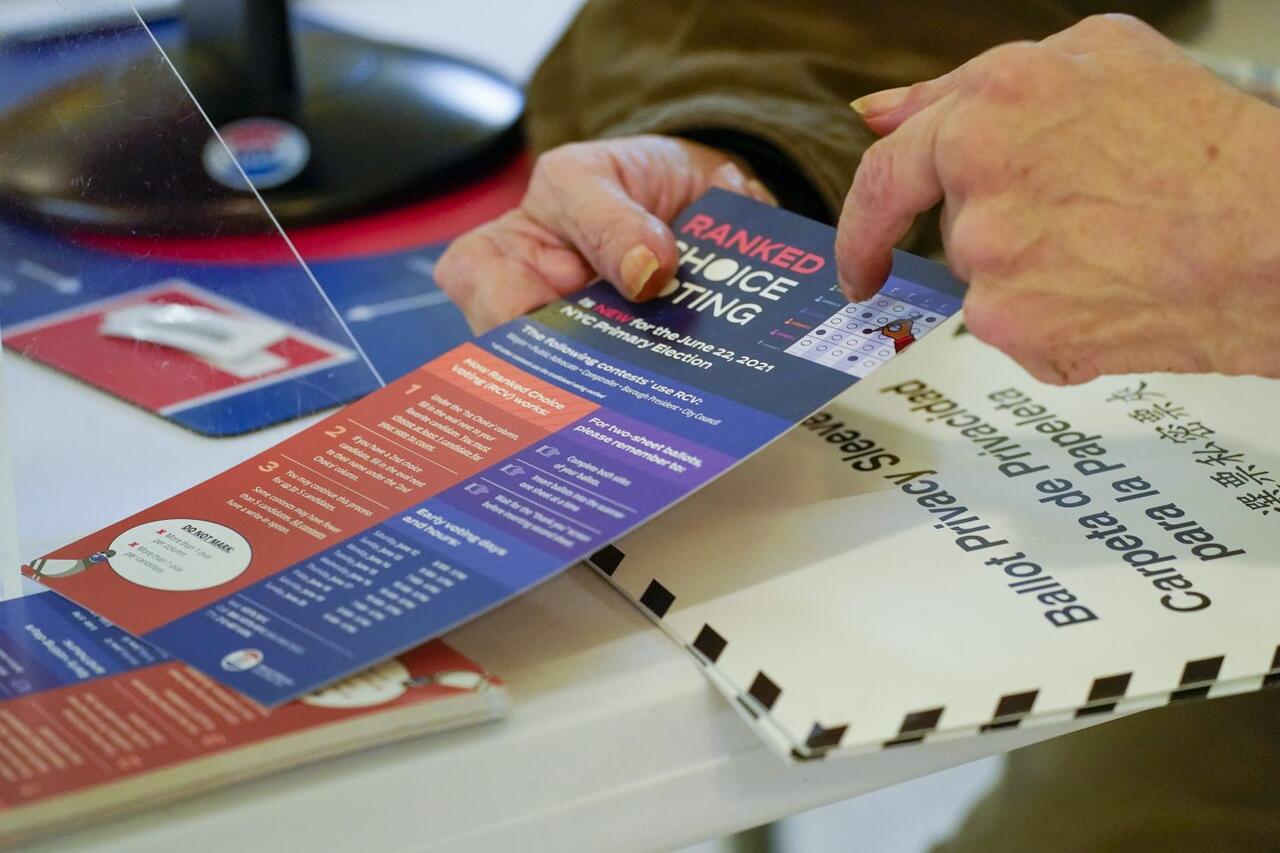
The elegant answer is to hold runoffs instantly. Instant runoffs are mostly new to America, but they’re time tested by other established democracies. The Australians and Irish have used them in various elections for more than a century. And, of course the idea of runoffs isn’t foreign at all given their use in nine states. An instant runoff is exactly the same, except you don’t have to come back to the polls for each new round. Instead, you rank the candidates from your first to last choice all at once (ideally on Election Day or in a mail-in ballot arriving by Election Day) using a ranked ballot.
After the polls close, assuming a dynamic five-person race, there are four runoff rounds.
- In Round One, your vote is cast for your favorite candidate (i.e., the one you ranked first on your ballot) just like always. At the end of the round, the candidate who came in fifth/last place is eliminated.
- In Round Two with four candidates remaining, your vote is cast for your favorite among the remaining four. At the end of the round, the candidate in fourth/last place is eliminated.
- In Rounds Three and Four, the process repeats, narrowing the four to three and then three to the final two, at which point, of course, majority wins.
Here’s the part people worry about, so let’s be plain: In every round, your vote goes to your favorite candidate still in the race. As long as your first choice is standing, that’s who you’re voting for – round after round. Your lower rankings are just backups. They come into play only if your favorite is knocked out, and then your vote moves to the next name on your list who’s still running. It’s exactly what you’d do in a Georgia or Texas or Louisiana runoff: Your candidate didn’t make it, so you pick your favorite among those who did. The difference is only that you expressed your preference in advance, so you didn’t have to make the trip back to the polling place.
One election. Five candidates. Four instant runoff rounds. One vote for each voter in each round. A majority winner. No spoiler.
‘Frenemies’ of reform
Those of us pushing for “Final Five Elections” (FFE) know what the ranked ballot conjures in those who are unconvinced. In no small part this is because liberal reformers have spent years giving it a bad name. They’ve deployed it in sleepy, low-turnout, low-information municipal races, and in cities like San Francisco they asked voters to rank long rosters of little-known candidates.
Democratic Party reformers added ranked ballots to party primaries in New York City, but they deliberately didn’t install it in the general election because the Democrats didn’t want real competition in November. They prefer knowing who to call “Mr. Mayor” after the Democratic primary in July. Reformers also like to pair a ranked ballot with proportional representation. The first is basically sabotage; the second is just a terrible idea. In both cases, they’re using a tool for the wrong job. The instant runoff has one narrow use case for which it is tailor-made: a November general election with a manageable field of up to five candidates. Used there, it does exactly one job impeccably – it guarantees a majority winner with no spoiler. It’s the key that unlocks healthy competition.
That is precisely how we use it in Final Five Elections. FFE is the combination of two simple changes to our election system: First, a single-ballot primary open to every candidate and voter regardless of party, and out of which the top five advance regardless of party; and second, an instant-runoff general election resulting in a majority winner. Open the market; require a majority. That is the whole design, and it is not just theory.
In 2017, I published my politics-industry theory out of Harvard Business School with my co-author, economist Michael E. Porter. Our work made its way to Alaska, where prominent Anchorage attorney Scott Kendall used it to design a ballot initiative built around these new rules. In November 2020 Alaska voters passed Final Four Elections (an earlier version of Final Five Elections in which four candidates advance to the general). Alaska became the first state in the nation to choose healthy competition in its elections for Congress and its entire state government. It won’t be the last.
You could be forgiven for thinking Final Five Elections are about electing more moderates. They will certainly make that more likely – the market for moderate dealmakers doesn’t clear today, and moderates are essential for delivering consensus solutions to tough policy challenges. But unlike the reformers who imagine that’s the whole point, I don’t see it that way. Reforms that provide artificially disproportionate advantages for moderates (e.g., Condorcet winners) are a bad idea. Innovation in any human endeavor usually emerges from what might be considered fringes or extremes. It’s the same for public policy where innovation rarely arises at the current midpoint of public opinion. As Porter and I wrote in 2017, “transformational changes in the U.S. have often begun at the fringes – in decidedly non-moderate camps.” Think civil rights. We need moderates and we need “extremes.” We need a competition of ideas. What Final Five Elections really does is let both markets clear at once – the market for dealmakers and the market for leaders and new ideas.
To envision what Final Five Elections would change, watch what’s happening right now – then imagine the same candidates, the same voters, the same political mood, under different rules. This season, Democratic socialists won a string of Democratic primaries in places where the primary is the only election that matters. In Denver’s safe-blue 1st District, 29-year-old Melat Kiros, backed by Bernie Sanders and the DSA, ousted 15-term Rep. Diana DeGette by more than 13 percentage points. In Upper Manhattan, Darializa Avila Chevalier knocked off five-term Rep. Adriano Espaillat. Because these are overwhelmingly Democratic seats, that small, committed primary electorate didn’t merely choose a nominee – it chose the member of Congress even though the general election is still months away. General election voters who might have preferred the non-DSA Democrats will never get a say.
Now run those same races under Final Five Elections. The socialists would still claim a spot on the November ballot but they could no longer back into the seat as the only Democrat on offer, or as the lesser of two evils. To win, the socialist would have to assemble an actual majority of the entire district. The same logic runs on the right – which is why MAGA would still exist under Final Five Elections but would likely not have rendered establishment Republicans extinct. In Texas, John Cornyn led the first round of the Senate primary and still lost to Ken Paxton in a low-turnout runoff decided by the base – even as analysts judged Cornyn the stronger November candidate. In Louisiana, Bill Cassidy was eliminated by his own party’s primary voters, punished for a vote of conscience against Donald Trump. Under Final Five Elections, Cornyn and Cassidy would each have stood on the November ballot beside their Trump-endorsed challenger (and the leading Democrat) and the whole electorate – not a closed-primary faction – would decide the race. If MAGA earns a majority, MAGA wins. If it doesn’t, the establishment Republican, or an over-achieving Democrat, prevails.
To be clear, while I am no fan of the Democratic Socialists’ platform, my objection is not that they might win, it’s that we could back into their agenda – not because a majority of Americans chose it, but because a structural error in our democracy routinely distorts our elections. When and if DSA candidates win and their policies are tried in a laboratory of democracy (as in Mamdani’s grand New York City experiment), I bet voters will discover what history has already shown: Socialism doesn’t work.
Under Final Five Elections, voters would have a way back, because traditional Democrats wouldn’t be extinct or new alternatives to the DSA would be able to enter. Under Final Five Elections, Mike Pence Republicans would have market access to compete for the post-Trump right-of-center vote. And for ideas that do work from any of these competitors, they can be adopted by other parties. I do this work because I believe in the value of competition. Even if certain candidates don’t win, some of their good ideas might be adopted by those who do, a la Perot. That’s as it should be.
In evaluating Final Five Elections, it’s essential to see that it is not the sum of its parts. It is one machine whose several precision components work only in combination, engineered to deliver a single result: a majority winner drawn from a field of up to five credible candidates in November. Adopt just one component – ranked ballots, say, or some version of an “open” primary – and nothing structural moves. The piece that does the real work is the one most reformers omit: advancing five candidates from a single open primary into the general, so that the decisive, competitive election is November and not a low-turnout party primary.
Washington, D.C., shows what happens when that piece is missing. There, reformer Lisa Rice led an impressive campaign to pass Initiative 83, which put ranked ballots in both the primaries and the general and even opened those primaries to the District’s independents – several of the “parts,” adopted at once, with real skill and the best of intentions. But Rice’s hands were tied by D.C.’s Home Rule Act which bars an essential piece – the top-five primary that would carry five candidates into a contested November – and so the dynamics of the election didn’t change in Final Five style because party primaries still exist and each advance only one candidate to the general.
As a result, we saw a campaign similar to other DSA races: In June 2026, Councilmember Janeese Lewis George, a democratic socialist, won the Democratic mayoral primary and, in a city this blue, is all but certain to become mayor, with no credible contender waiting in the general. The primary still crowned the winner. Notice, too, what this reveals about the ranked ballot: In a low-turnout, low-information primary, ranking is an unnecessary complication. In Final Five Elections the primary is a simple “pick-one.” You choose your single favorite, as always, and the top five advance; ranking does its real work later, in the general, where it forges a majority from genuine competition.
Opening the primary as a stand-alone reform, which is currently advocated by many major reform organizations, is not the missing piece either. The impulse behind it is understandable: If the party primary is the election that truly decides, then shutting independents out of it really is unfair. But the best cure for that unfairness is not to usher outsiders into a party’s nomination; it is to make the general election the contest that matters, so that everyone is finally voting in the election that counts. Making a broken election system “fairer” is not the same as making it work, and we must not let the fix for a real unfairness talk us into a reform that leaves us just as unlikely, or more so, to get results.
Many reformers who have adopted my prescription for Final Five Elections nonetheless incorrectly suggest that FFE will weaken parties and describe that as a benefit. I believe those reformers are wrong on both counts. I am a fan of political parties, and, like esteemed political writer Jonathan Rauch, I want them strong – because in the industries that serve us best, you always find strong players. The trouble with our parties isn’t that they’re strong. It’s that their strength is artificial. They are powerful in the one way no healthy competitor should ever be: They have demonstrated a nefarious talent for keeping rivals out of the market altogether. In the one place they ought to be strong – choosing the candidates who can actually win a November majority and deliver on the party’s agenda – they’ve grown weak, even too weak for their own good or ours. The current system is why Mitch McConnell lamented “candidate quality” in 2022 when he didn’t get the strongest general election candidates out of the Republican primaries. Separate the public function of the election from the parties’ private one of choosing nominees, and we can finally afford to let the parties truly control their candidates, because the voters keep ultimate control at the ballot box. FFE is a win for (well-run) parties and for voters.
Now to the critics of Final Five Elections – and I have heard from a lot of you: You say it’s a liberal plot. It isn’t. Final Five forces every candidate, left and right, to win an honest majority. (For a strong proof point, in 2022 Nevada Democrats hired famed partisan lawyer Marc Elias to try to shut down FFE ballot initiatives, and defeating Final Five Elections was about the only thing the D and R parties agreed on in 2022 and 2024. Neither of them wants new competition.)
Critics also say it’s too confusing. But surely Americans are as capable as the Australians and the Irish? And mainlanders as capable as Alaskans? You say it delays results. It doesn’t. As long as the ballots are required to be submitted by Election Day and election authorities release the cast-vote record data, AP can call races on election night just like they do today. You say it’s an incomprehensible algorithm. It isn’t; you can use paper ballots, count manually and conduct a manual recount on any race if you want (though if you want results on Election Day, I’d suggest a computer). Used as a tool to support the emergence of the majority winner in a five-way general election, FFE is none of the things you say it is.
So here is my challenge. Don’t just tell me what’s wrong with Final Five Elections. Show me another plan that produces healthy competition of both candidates and ideas and the resulting benefits to customers, a.k.a. American citizens. If you do find a better one, I’ll happily get on board with yours. But assuming you can’t, it means that what the critics of FFE are really defending, whether they admit it or not, is the failed status quo – intense polarization, division and dysfunction, gridlock, party capture, and dismal policy results – over dynamic competition to solve problems. The United States became the most powerful and prosperous nation in human history for a reason we ignore at our peril: We unleashed free market-style competition and let it do its work. Competition is what drives our innovation. Competition is what lifted American life to a standard the world had never seen. America deserves the same exemplary results from free market politics.
And a special note to my conservative critics, chief among them the Wall Street Journal editorial page. You should be the last to need convincing. No entity has taught American readers more faithfully than you that market competition positively motivates incumbents and serves customers, and that artificial protectionist barriers to entry are the enemy of both.
Yet, you have been consistently hostile to Final Four Elections adopted by Alaska in 2020. Don’t let the ranked ballot’s abuse in the wrong hands blind you to its one indispensable use. Confined to a five- (or four-) candidate general election, the instant runoff does exactly one job: It demolishes the single greatest barrier to entry in American politics – the spoiler – and forces every candidate to win real competition on the merits. That is not a left-wing scheme (or a right-wing one). It is free markets for our republic, and it is the purest application of your own creed I can offer arriving, at last, in the one market where you have been strangely content to let a protectionist market thrive.
Our call to action goes out to all governors and state legislators. The Founders anticipated this moment and, in Article I, handed the power over the machinery of elections to the states. The Constitution provides that “the Times, Places and Manner of holding Elections… shall be prescribed in each State by the Legislature thereof.” The rules of the game, for both state and congressional elections, are yours to write. Final Five Elections is not a pie-in-the-sky idea; it’s actionable now, by any governor or legislature willing to lead. I can’t imagine a better test case for laboratories of democracy than Final Five Elections in a handful of states. Over time, the results will create demand for expansionor – they won’t. I’m betting on FFE.
But of course, governors and legislators can only do what their citizens ask of them. So here’s to you citizens: It is crazy, when you actually stop and think, that we accept our current state of affairs as if we’re powerless. The most detrimental driver of American politics is sitting in plain sight, and almost no one names it. Turn on the news and you’ll hear endless coverage of the DSA’s rise or MAGA’s takeover treated as ideological weather and never as what they actually are: structural, the predictable product of party primaries and plurality rules.
Here’s to you, journalists: It is crazy that the people whose whole job is to explain the world keep missing the one explanation that ties it together – that there are barriers to entry, and that those barriers, not the passions of the moment, are why we can no longer solve problems.
Here’s to you, business leaders: You of all people should see this instantly, because it is your world exactly – a market, protected incumbents, competition strangled, customers ignored – and yet even you look right past it.
Here’s to you, editorial boards, forever demanding better behavior from politicians while ignoring the rules that guarantee the behavior you claim to deplore: We do not need more outrage at the symptoms. We need people to finally understand the cause and then to do something about it. Because the extraordinary thing, once you see it, is that this is not rocket science. In the scheme of political challenges, it’s not overwhelmingly hard. The fix is not a constitutional amendment. It does not require an act of Congress, or the consent of 50 states, or even two. A single state can adopt Final Five Elections on its own, through its legislature or by ballot initiative, at no cost to its neighbors and enormous benefit to its own citizens. As hard as our politics feels, this part is not that hard.
And to the frustrated business titans who keep circling this problem without solving it, this one is for you. Elon Musk, enraged at both parties, floated an “America Party.” Howard Schultz, disgusted with the duopoly, explored an independent run. Mark Cuban tells all who will listen that both parties have failed us. Gentlemen: You are brilliant innovators, and you are misdiagnosing the problem. If this were your company, you would never pour a fortune into a doomed product line inside a rigged market. You would fix the market. That is the move here. Stop trying to win the broken game and start championing the rule change that ends its rigging for good. Put the same relentless, systems-level thinking that built your fortunes behind Final Five Elections in a few states, and you will do more for this country than any third-party campaign ever could. At the very least, Mr. Musk, don’t fund the effort to repeal Final Four Voting in Alaska, the one state in which you could launch your new party without undue barriers. Give me a call. I think you’ve received bad counsel.
This has been a long argument. So let me reduce it to its essence – two images. In Image A, our current system, there is virtually no connection – no overlap at all – between our politicians solving problems in the public interest and the likelihood that they get reelected. Sit with that, because it is the whole tragedy in a single sentence: If America’s elected representatives did their jobs the way we actually need them to, they would be more likely to lose those jobs (in their next low-turnout party primary) than to keep them. Congress doesn’t solve problems because, under the current rules, solving problems is not a good way to win an election. In fact, it’s a good way to lose one. No one would ever design a hiring-and-firing system like that on purpose. And yet here we are.
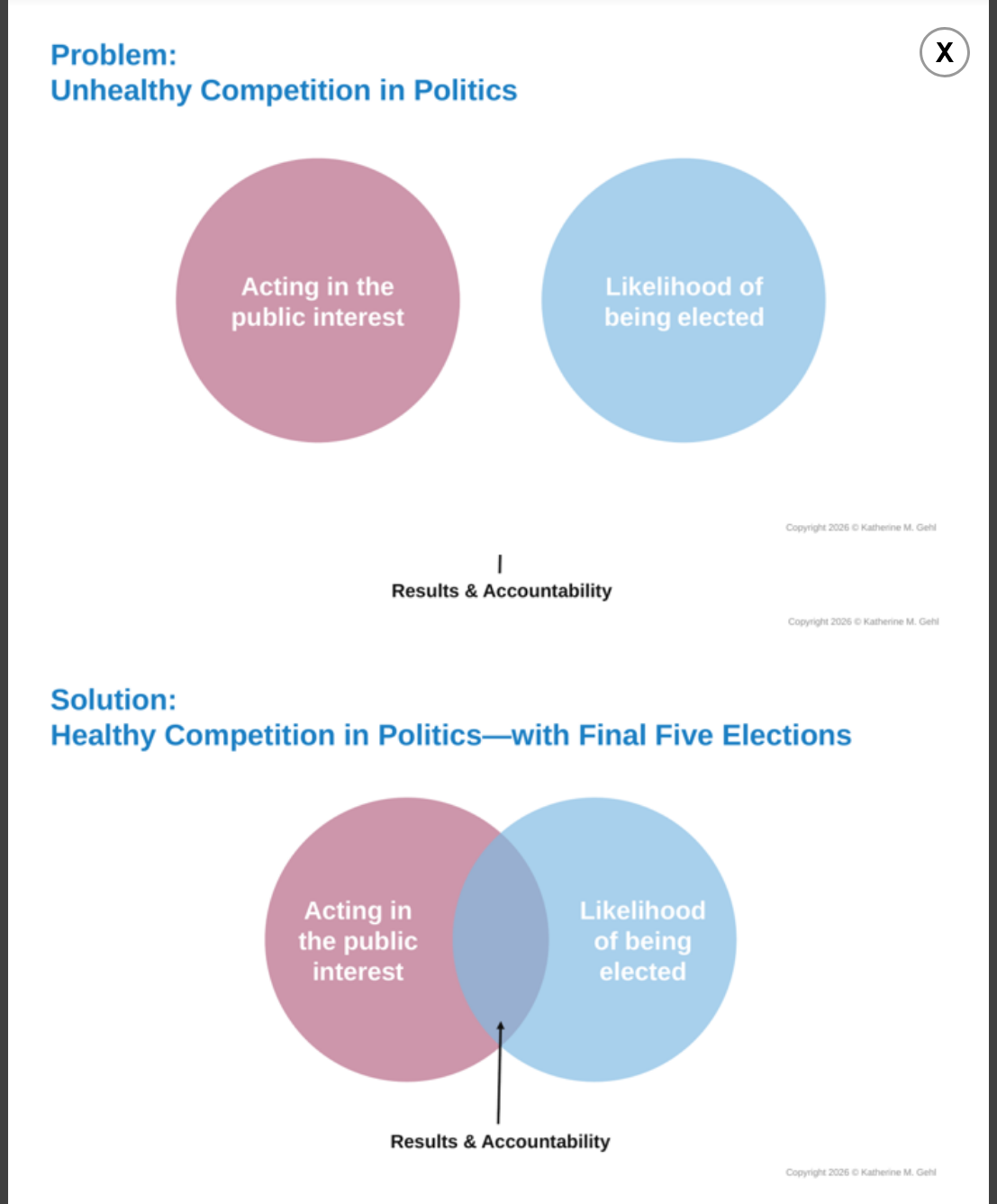
Final Five Elections does one essential thing: it creates the connection in Image B. It makes solving problems a good way to win – and to win again. Under these rules, what it takes to get elected finally overlaps with what it takes to serve the public interest, and in that overlap sits everything we have been missing: results and accountability. That overlap is the whole secret. Everything else in this essay – the open primary, the instant runoff, the majority winner, the end of the spoiler – is simply the machinery that produces it.
My passion may inadvertently suggest I’m presenting Final Five Elections as the gateway to a political utopia. It’s not. I agree with Winston Churchill that “democracy is the worst form of government, except for all those other forms that have been tried from time to time…” Democracy is messy. It is hard. What we have now messy, hard, and bad results. With Final Five Elections, we’d still have messy and hard – but with some good results to show for it. That is utopia for democracy.
Katherine Gehl, former CEO of Gehl Foods, is the author of “The Politics Industry: How Political Innovation Can Break Partisan Gridlock and Save Our Democracy” and the architect of Final Five Elections.
Tyler Durden
Sun, 08/23/2026 – 23:20