
Zinc Hits Four-Year High As “Extremely Thin” Physical Supply Fuels Squeeze
Zinc futures in London are headed for their largest monthly close since January, with prices hitting four-year highs this week amid tightening physical supplies.
London futures for the industrial metal initially gained as much as 1% before reversing course. Zinc fell .8% to $3,861 a ton as of 11:40 a.m. local time, halting a seven-day rally.
Despite the pullback, zinc’s physical market remains extremely tight.
“Supply constraints boosting zinc: Zinc price has risen 31% since March to $3,966, driven by declining mine output, operational disruptions (fires, delays, and lower grades), and limited project development outside China,” Jefferies analyst Sagar Sahu wrote in a note on Tuesday.
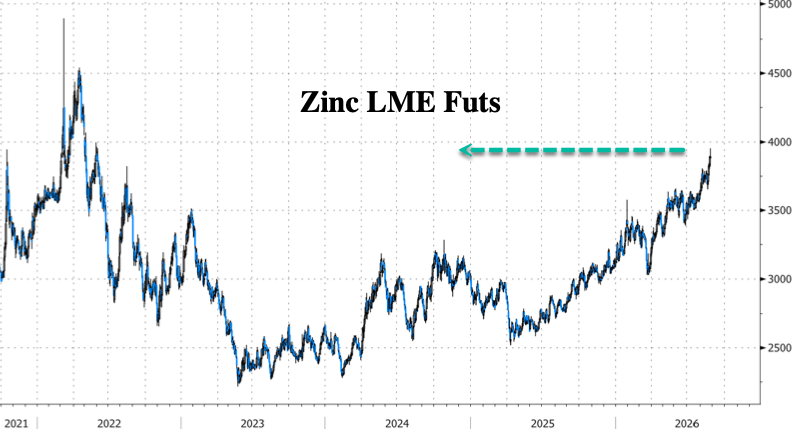
Sahu added, “ILZSG, international association for zinc & lead, has revised its 2026 global zinc market forecast to a 19kt deficit vs a 271kt surplus earlier. We raise our FY27-28E zinc price assumptions to $3,615-3,700, still 7-9% below spot prices.”
Guangzhou Futures analysts separately noted, “Available physical liquidity is at extremely thin levels” on the LME, adding, “Before mine output recovers materially, smelting costs will provide a strong floor for zinc prices.”
Zinc’s cash-to-three-month spread widened into backwardation of more than $190 per ton on Thursday, after approaching $200 per ton on Wednesday, the steepest since December.
According to Fastmarkets, treatment charges, the fees miners pay smelters to process ore into zinc metal, have fallen as low as minus $110 a ton. This comes as ore shortages force smelters to compete for concentrate. Persistent negative fees could pressure smelter margins, trigger production cuts and deepen the supply squeeze.
Similarly, copper futures in London are showing signs of supply stress, including widening short-term spreads, low inventories, and negative treatment charges. Potential US import tariffs have been among the main drivers, forcing traders to redirect shipments toward the US and reducing availability elsewhere.
Last week, veteran commodities strategist Jeff Currie warned in a series of X posts:
Wake up, folks. Commodities are telling you something, and yesterday the Treasury confirmed it.
Scarcity in the physical world. Repression in the financial one. Scarcity pushes prices up. Repression holds yields down. The gap between them is the debasement.
Commodities are the only asset class that wins on both sides. The structural case for commodities has been turbocharged.
Read more about what Currie had to say about commodities here.
Tyler Durden
Thu, 08/27/2026 – 12:40