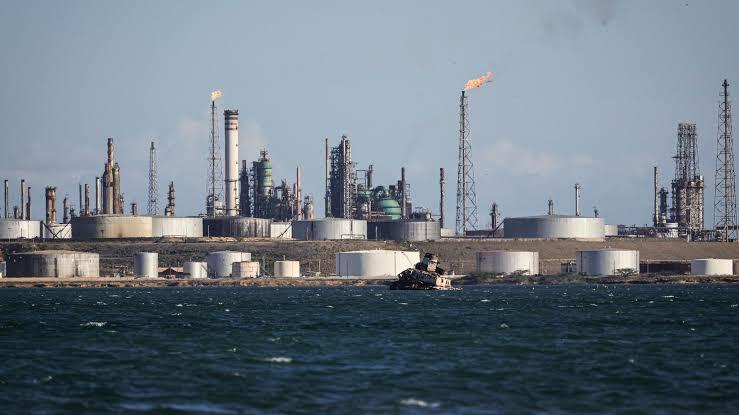
Pentagon Grabs 35% Equity Stake In Venezuelan Oil As Trump Vows To “Fill Up” The SPR
Venezuelan President Delcy Rodriguez on Saturday evening unveiled further details of the grand US oil deal that was announced by President Trump on Friday, detailing that her country will receive about $19 per barrel of oil produced under the long-term energy deal.
Rodriguez, who was Maduro’s #2 as VP before the former president’s overthrow by invading US forces less than a year ago, hailed the “historic” agreement as an avenue for boosting crude output while bringing economic benefits. “The agreement is based on a very simple premise,” she said. “Each party contributes what it does best. Venezuela contributes oil, its industry and the experience of its workers accumulated over more than 100 years. The United States contributes the capital and technology needed to recover and develop those assets.”
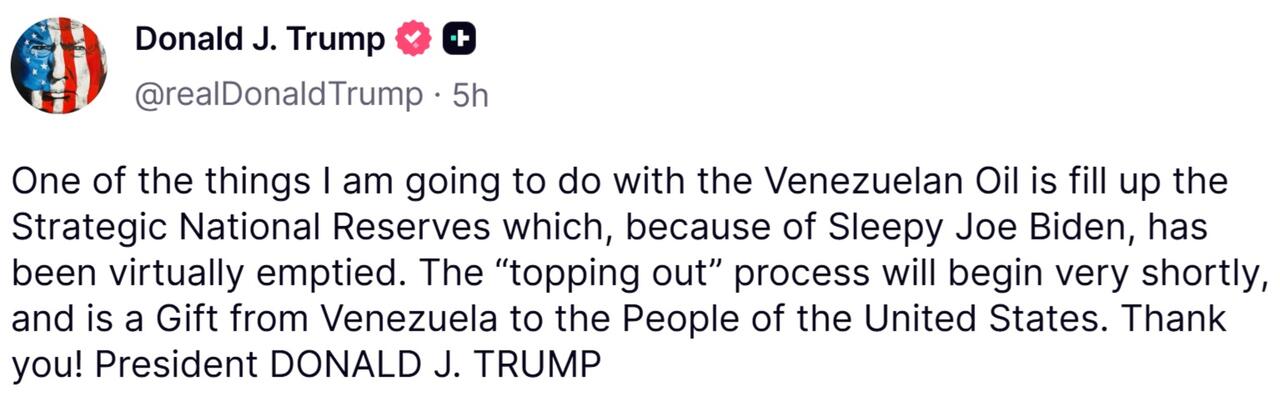
Trump on Sunday: a “Gift from Venezuela to the People of the United States.“
Rodríguez additionally said that in return, “Venezuela receives production, jobs, investment in infrastructure, increased revenue for the government and productive linkages for domestic industry.” On top of this she assessed the deal would eventually grant Venezuela some $209 billion in taxes.
Her comments attempted to preempt discontent over the US deal from sectors of her own citizenry. Ironically, she’s obviously playing the role of a pliant Washington figurehead, and there’s local concern that the deal simply siphons off national resources and puts it into Uncle Sam’s pocket, which is a long-running experience of a number of Latin American populations especially related to CIA action there in the context of the 20th century Cold War.
President Rodriguez stated that she wants to “make something absolutely clear”… she insisted that “Venezuela retains ownership and sovereignty over its resources, while utilizing capital, technology and operational capacity to leverage the recovery of a strategic industry that has been severely hit by sanctions.”
In parallel to some of the details that Rodriguez filled in, The Wall Street Journal over the weekend has its own lengthy report on some of the deal’s ins and outs. Below are a few highlights of that WSJ report…
* * *
The Pentagon will take a 35% passive stake in a private company holding Venezuelan oil rights:
Although it was negotiated by senior officials in both governments, the structure would make the U.S. an investor in a private company rather than a direct counterparty to the Venezuelan government.
The U.S. plans to take a 35% passive stake in Betancourt’s North American Blue Energy Partners and would secure preferential rights to purchase 20% of its production at cost, according to people involved in negotiating the agreement.
Venezuelan businessman Alejandro Betancourt is being offered development of some seventeen oil fields:
It would give Washington a direct financial stake in a private company that would be granted centurylong rights to some of the world’s largest proven oil reserves—and tie the U.S. more closely to the unelected government that is granting those rights.
The private company, led by controversial Venezuelan businessman Alejandro Betancourt, would have the opportunity to develop 17 oil fields said to contain 65 billion barrels of oil, or one-fifth of the country’s reserves. The Pentagon, in a striking expansion of its remit, would help finance the oil venture and reap the rewards of its future output.
Pentagon’s strategic capital office was brought in late in the process to create a financing mechanism:
The Pentagon’s Office of Strategic Capital plans to structure the investment through penny warrants that would yield the U.S. an equity ownership in the business without a significant capital investment, the people said. The Pentagon office has limited statutory authority to strike deals designed to support U.S. national-security interests, typically through loans and guarantees.
Betancourt has served as a broker in Venezuela’s energy deals and has close ties to Rodríguez. He faced criminal investigations of alleged money laundering in Spain and Switzerland, though no formal charges have emerged. His NABEP has become the second-largest private oil producer in Venezuela, after Chevron, over the past two years.
Future governments in Caracas could potentially challenge the agreement (though Washington is unlikely to ever cease asserting its direct influence):
For American oil companies pursuing potential investments in Venezuela, the idea of competing with a U.S.-backed private company with a stake in huge swaths of the country’s oil fields is daunting, people close to the companies said. U.S. officials said the state-backed company would be the second-largest corporate holder of proven reserves after Saudi Aramco.
The deal is also raising alarms within the industry about whether a new Venezuelan government could mount a successful legal challenge, and whether it might undercut new entrants’ confidence in making investments, the people said.
…The substance of the agreement appears to be in direct conflict with Venezuela’s 1999 constitution, which states that the country’s oil reserves belong to the Bolivarian Republic of Venezuela and can’t be sold. Critics say Venezuela’s current government, populated by unelected officials kept in power by the Trump administration, has no legal authority to sell the country’s oil rights.
There remain an additional array of problems facing translating the deal into additional supply at a moment America’s Strategic Petroleum Reserve hits decades lows.
Though sitting atop the world’s biggest proven oil reserves, Venezuela has long been known for its derelict and largely defunct infrastructure for getting crude out of the ground and refining. There’s also the question of security, which has been a source of discussion between the US admin and American oil companies being courted. The oil majors must be convinced that they can operate in enough safety to be successful, not just for the coming months, but for years down the line. And yet, they will now be forced to essentially ‘compete’ with the US government, ironically enough.
There are also lingering transparency and accountability questions concerning the Venezuelan oil exports that Washington already took over since Maduro’s ouster.
Tyler Durden
Sun, 08/30/2026 – 18:05