
Visualizing Canada’s Biggest Export Partners
More than two-thirds of Canada’s merchandise exports flow to the United States – its most significant trading partner, which makes the ongoing tit-for-tat tariff spat with the Trump administration a serious threat to their economy.
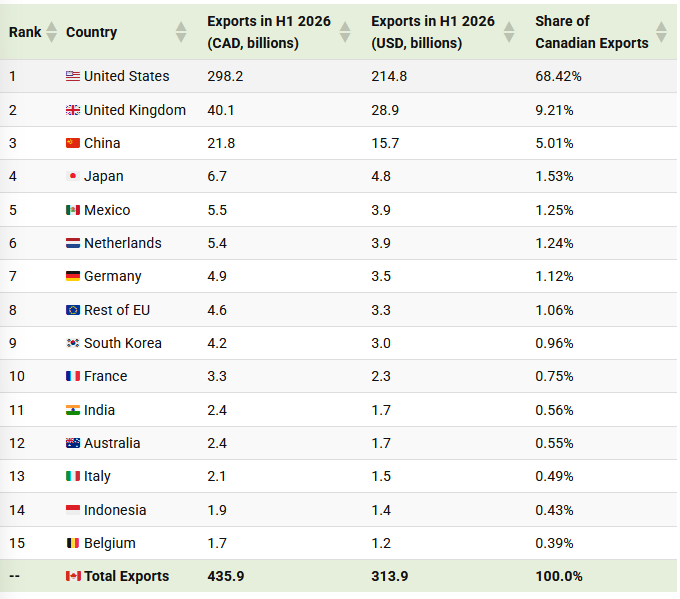
In the first half of 2026, Canada sent $214.8 billion (C$298.2 billion) in goods to the U.S. – roughly 68% of its total merchandise exports. The UK came in second at 9.2%, which was heavily influenced by precious metals transactions. China came in third at 5%.
Or, as visualized by Visual Capitalist‘s Sofie Gilbert:
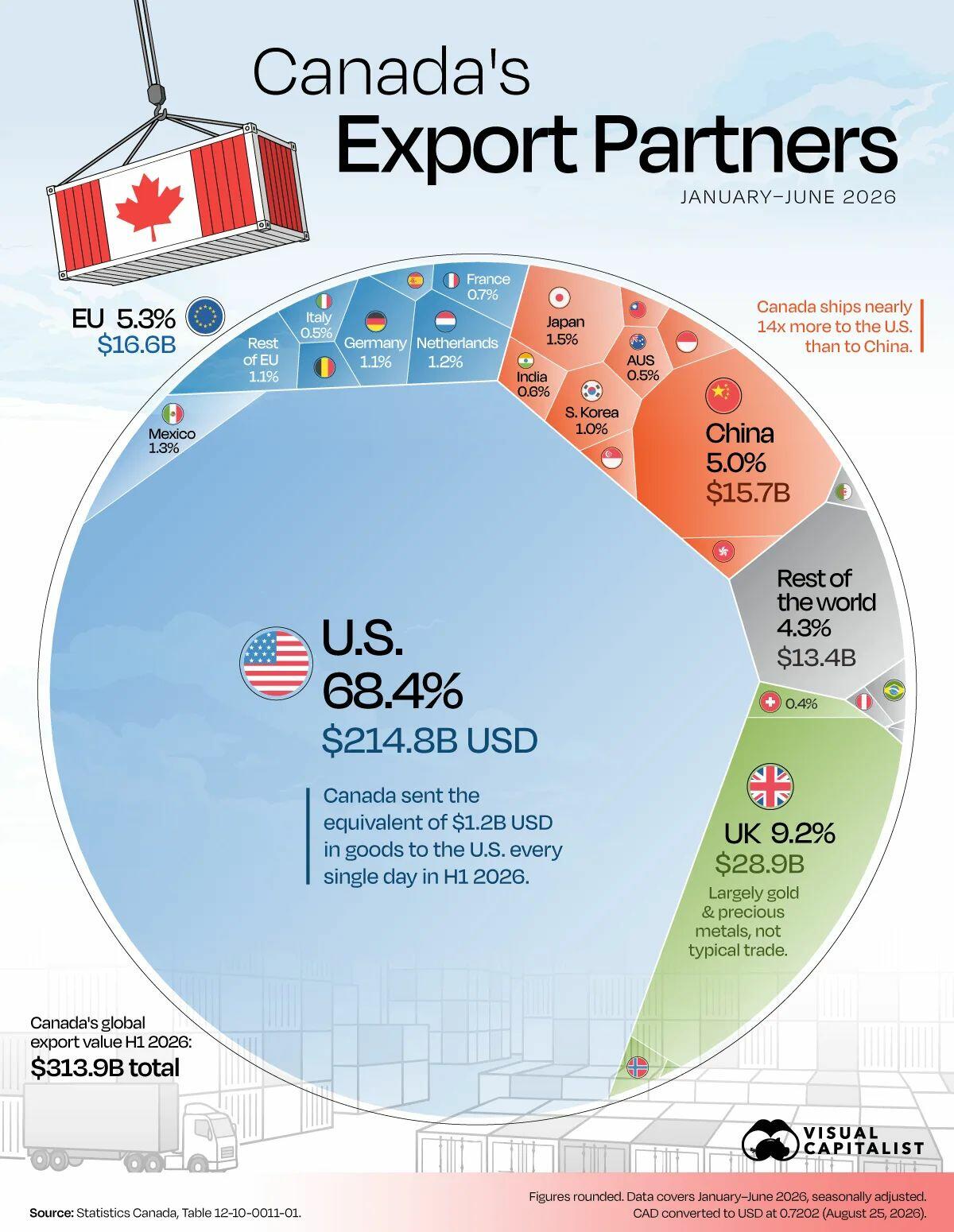
As Gilbert notes further; Japan, Mexico, and South Korea followed at 1.5%, 1.2%, and under 1%, respectively. Together, those five markets received $45.8 billion (C$63.6 billion) over six months, roughly 21 cents for every dollar shipped to the U.S.
The United Kingdom Number Needs a Caveat
The dataset places the United Kingdom second overall at 9.2%, or $28.9 billion (C$40.1 billion).
Statistics Canada notes that the UK figure includes significant precious metals transactions, a pattern confirmed by Global Affairs Canada’s State of Trade 2025 report, which identifies gold exports as the primary driver of Canada’s UK shipment growth.
This helps explain why the UK’s 9.2% share is so high relative to Canada’s broader trade relationship with the country. Excluding precious metals, the EU and China are larger destinations for Canadian exports.
Why Tariffs Matter Despite Covering Just 5% of Exports
Canada-U.S. trade negotiations broke down in August 2026, with 50% tariffs now in effect on a range of Canadian goods. Canada’s reliance on a single dominant export market limits how quickly affected trade can be redirected elsewhere.
The new duties cover roughly C$28 billion worth of Canadian exports, about 5% of what Canada ships to the U.S. annually, according to BMO senior economist Robert Kavcic. BMO estimates the tariffs could cut half a percentage point from Canada’s GDP growth.
That estimate highlights the broader risk of trade concentration. The EU and China each absorb only about 5% of Canadian exports, meaning even substantial growth in those markets would replace only a fraction of the volume currently sent south.
Canada is the largest export partner of 25 states, so the trade exposure runs both ways. However, with more than two-thirds of Canadian exports destined for the U.S., Canada has considerably more at stake in any disruption to cross-border trade.
Tyler Durden
Wed, 09/02/2026 – 04:15