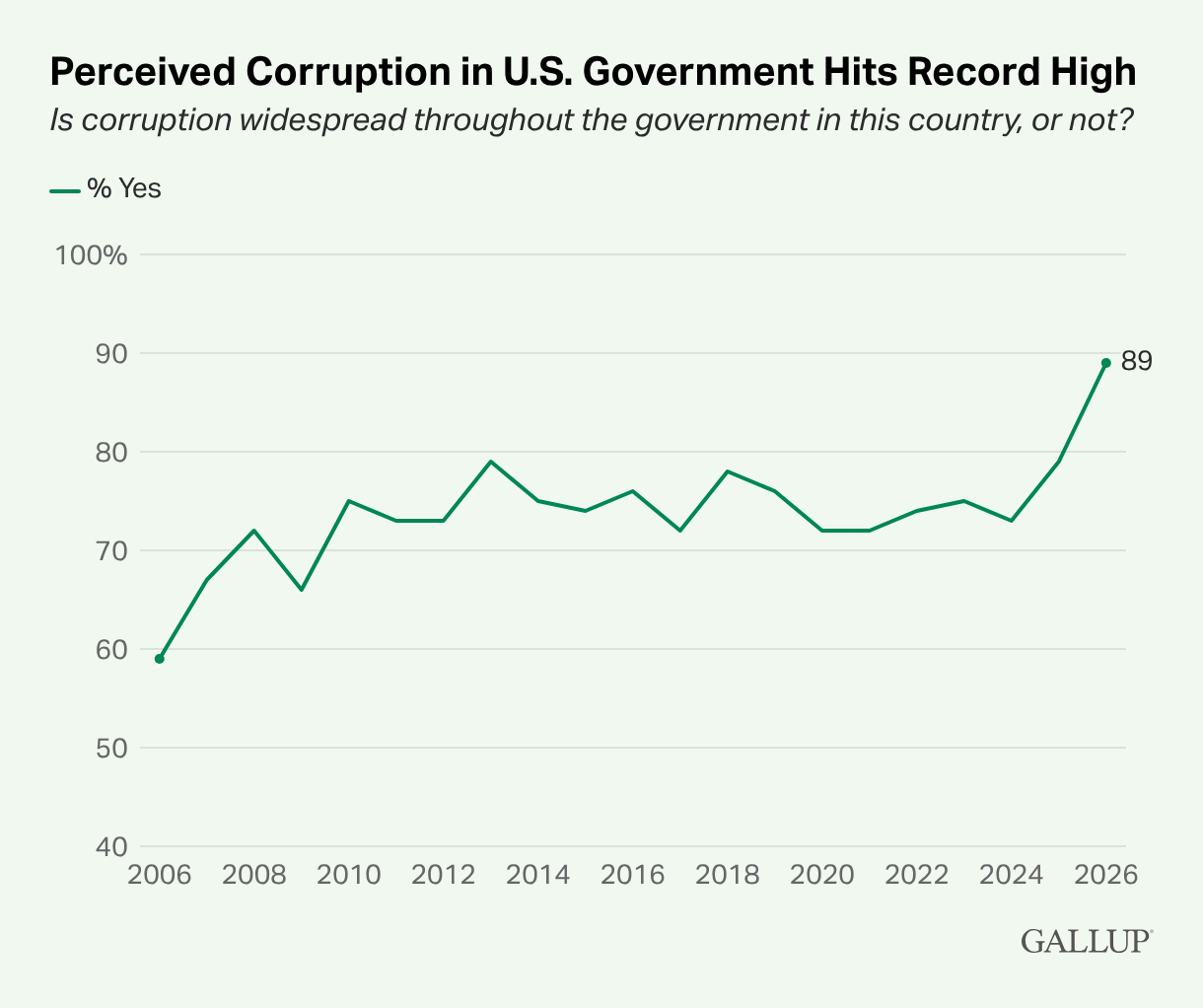
Record 89% Of Americans Say Government Corruption Widespread
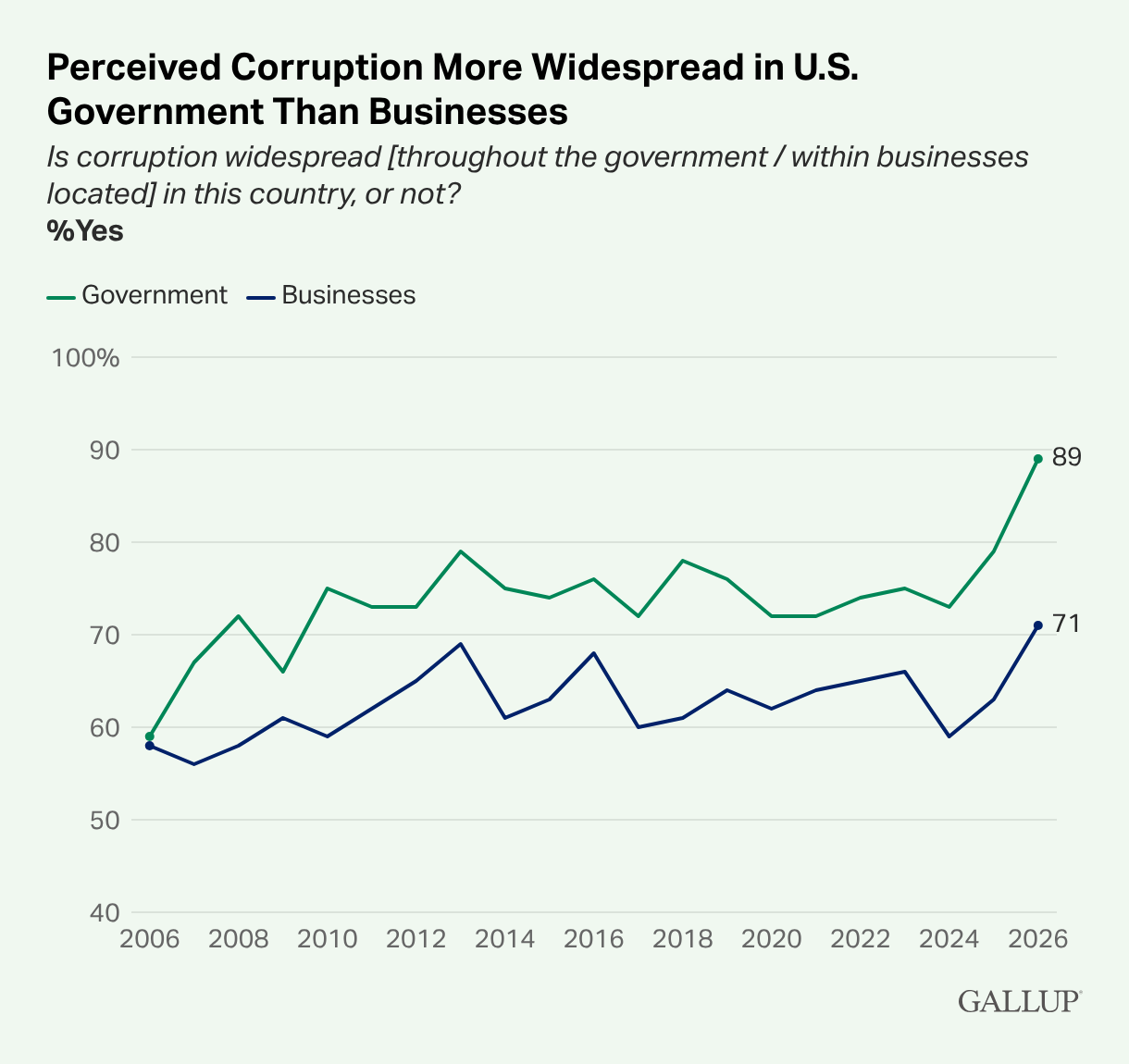
A record 89% of US adults say government corruption is widespread – which is up 10% from last year, and far above the average 72%-79% between 2010 and 2025, according to a new Gallup poll.
Unsurprisingly, Democrats’ perceptions of government corruption spiked the most since 2024 – going from 57% to 91% this year, while independents also feel this way at 90%. Republicans at 83% are up 12 points since 2024.
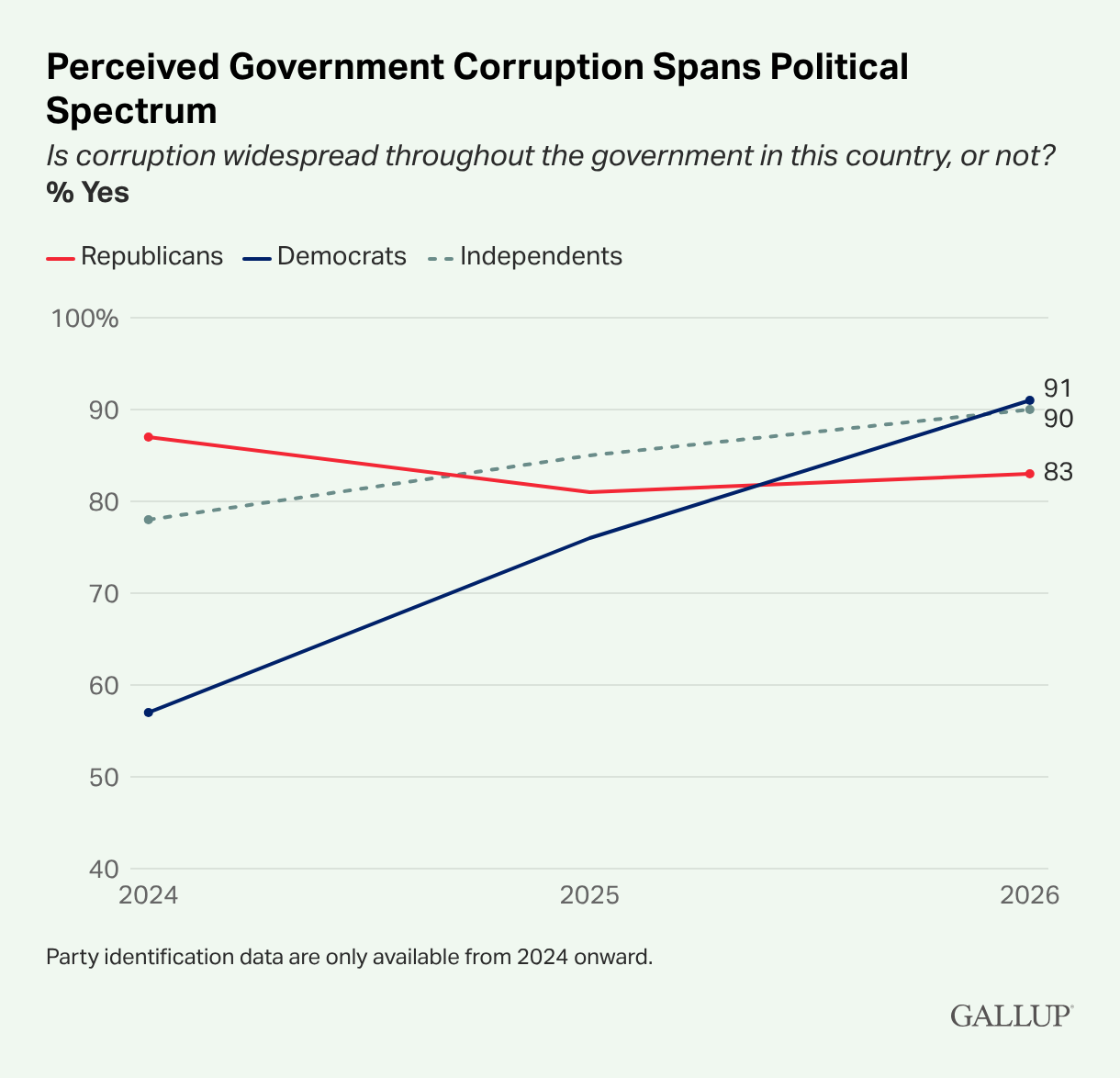
According to Gallup, the reasons are different between Republicans and Democrats – with Dems’ perceptions appearing closely linked with whatever party is in power, while Republicans have much greater consistency on the topic – which “suggests a more underlying view of government corruption that depends less on the party in power.”
Gallup also notes that before the recent increase, the US already outranked other advanced economies in corruption perceptions. Continued:
The U.S. has increasingly diverged from other advanced economies in perceptions of government corruption, based on Gallup polling across the 38 member countries of the Organisation for Economic Co-operation and Development. The median level of perceived corruption among OECD countries has fallen from 69% in 2009 to below 60% since 2022.
Full data collection for 2026 is not yet complete in all countries, so the closest comparison across the OECD is from 2025, when a median of 59% said corruption is widespread in their government.
In the early years of this trend, countries such as Greece, Hungary and the Czech Republic all saw scores above 90%. But over time, the highest levels of perceived corruption across the bloc have gradually fallen, reaching 79% in 2025 — placing the U.S. atop the OECD rankings for the first time, even before the additional 10-point increase within the past year.
By 2024, there was already a 15-point gap between the U.S. and OECD countries on this metric, but that rose to 20 points in 2025 as U.S. perceptions of corruption increased six points to 79%, compared with 59% across the OECD. The gap between the U.S. and the OECD median could potentially be even wider this year.
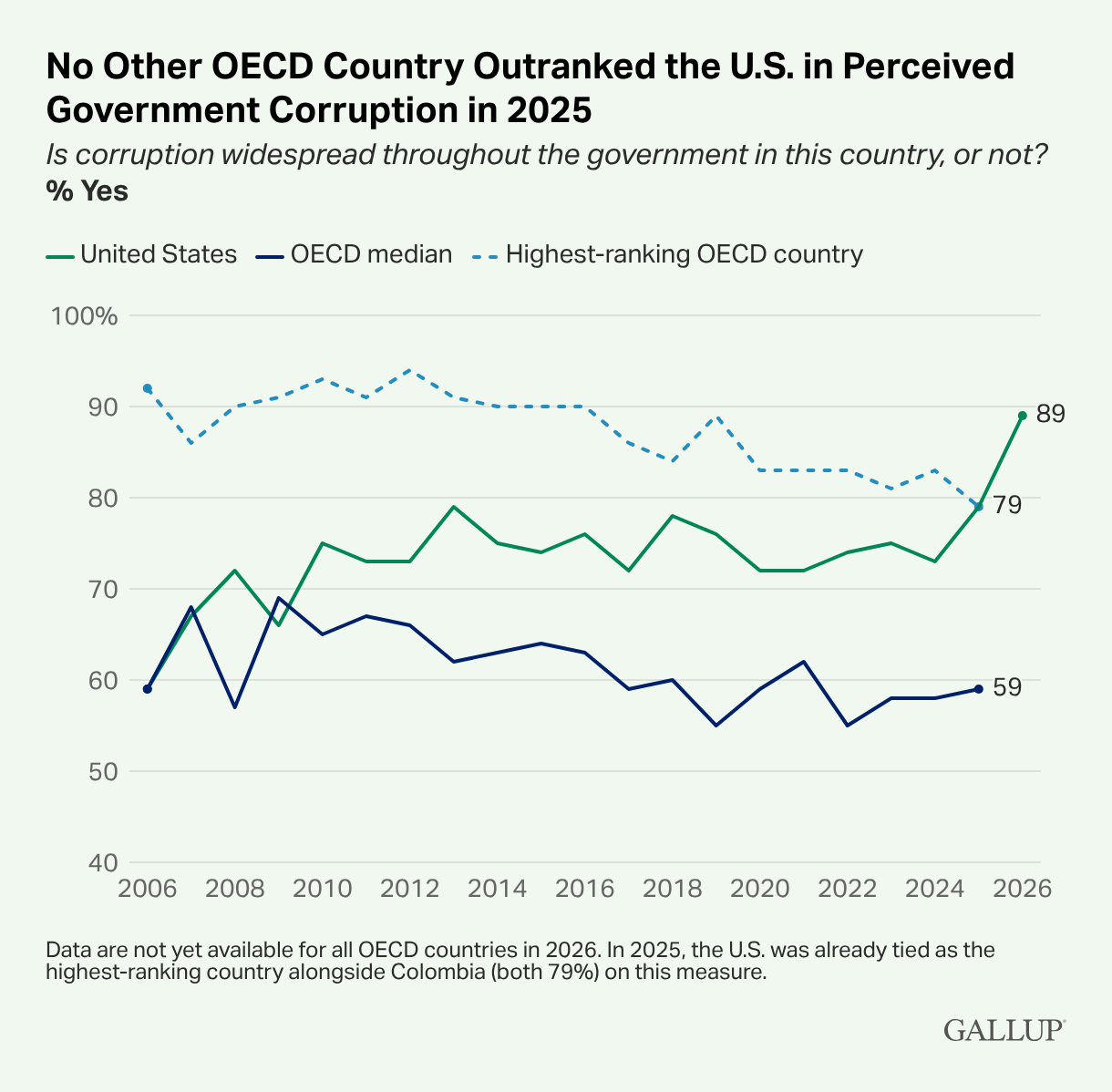
Since 2023, only four countries out of the 132 in which Gallup has posed this question annually have scored nominally above the 89% recorded in the U.S. this year: Lebanon in 2024 (92%), Peru in 2025 (92%), and Ghana and Nigeria in 2024 (both 90%).
Perceptions of Corruption in Government Outstrip Those in Businesses
Each year, Gallup asks the world about corruption in two contexts: government and business. The two are typically strongly related. If people think corruption is widespread in their national government, it is likely that they think the same about businesses in their country. But the U.S. increasingly bucks this trend.
Americans’ perceptions of business corruption have also increased this year, by eight points to 71%. That is 18 points lower than perceptions of corruption in government, the largest gap between the two types of corruption seen in the U.S. trend. By contrast, between 2006 and 2025, perceptions of government corruption averaged 11 points higher than business corruption. Across Gallup’s trend since 2006, few countries have recorded larger gaps than the current U.S. gap in relative perceptions of government versus business corruption.
Bottom Line
Perceptions of government corruption are now higher in the U.S. than at any point in the past two decades and outpace most other countries, including advanced economies. While perceptions of corruption in business are also elevated, government corruption is seen as significantly more widespread.
In a country where many are polarized across a wide range of issues, this is one case where bipartisanship reflects shared alarm as much as shared consensus. In fact, it is the near convergence of U.S. partisans on the issue — with Democrats’ concern about government corruption now only marginally higher than Republicans’ — that has lifted the U.S. figure to its record high.
Tyler Durden
Thu, 09/03/2026 – 08:05