
Germany Braces For AfD Election Breakthrough In Saxony-Anhalt
Voters in Saxony-Anhalt head to the polls on Sunday, followed two weeks later by elections in Mecklenburg-Western Pomerania and Berlin. With the right-wing Alternative for Germany leading the national polls, the elections could be the opening act of an 18-month period in which Europe “lurches to the right,” as Nomura analysts explained last month.
UniCredit’s chief German economist, Dr. Andreas Rees, told clients on Friday: “Three state elections in just 14 days will test Germany’s government coalition and its reform plans. While political noise is likely to increase, we expect the push for structural reform to remain on track.“
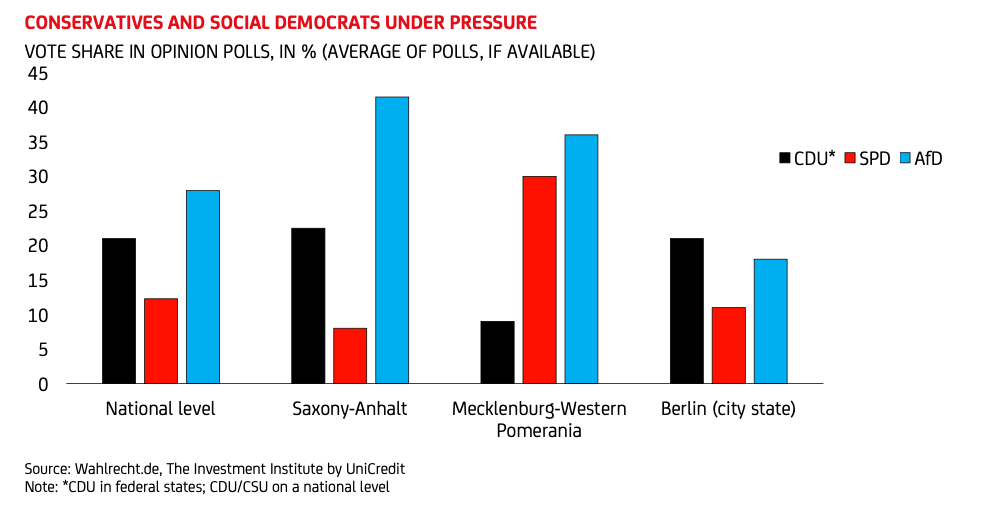
The polling chart compiled by Rees’ team shows the rising popularity of the AfD and the pressure facing Germany’s establishment parties. The AfD leads nationally at roughly 28%, compared with 21% for the CDU/CSU and 12% for the SPD. In Saxony-Anhalt, the gap is far wider, with the AfD polling near 41%, versus 23% for the CDU and just 8% for the SPD. However, CDU/CSU leads over AfD in Berlin.
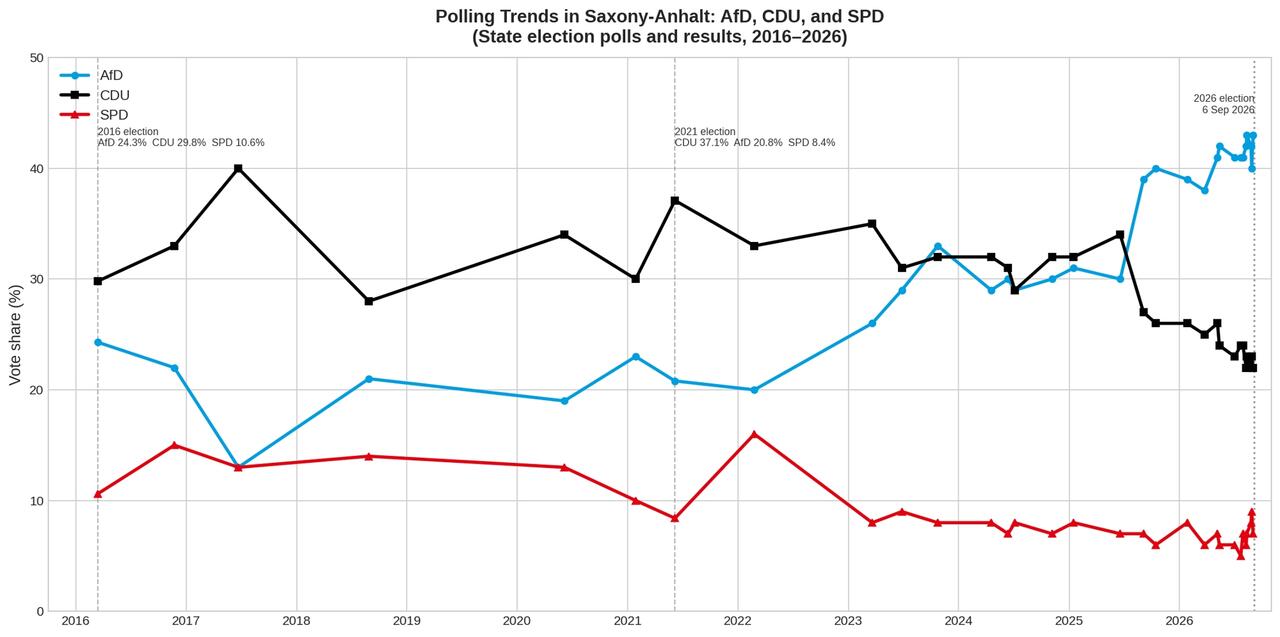
Rees touched on this Sunday’s big election in Saxony-Anhalt, which could quite possibly usher in AfD leadership:
On Sunday, voters in Saxony-Anhalt will head to the polls; two weeks later, Mecklenburg-Western Pomerania and the city-state of Berlin will follow. Formally, these are state elections with regional specifics and differences. Politically, however, three elections within 14 days will probably be viewed as a report card for Chancellor Friedrich Merz’s CDU/CSU-SPD coalition, at a time when the government is trying to move from fiscal firepower towards structural reforms of the pension system, the labour market and bureaucracy.
THE DATA
The starting point is uncomfortable for the conservative CDU/CSU alliance and the Social Democratic Party (SPD). In the latest nationwide opinion polls, the right-wing AfD stood at about 28%, ahead of the CDU/CSU with around 21%, while the SPD came in at just 12%. Recent polls for the state of Saxony-Anhalt, the election federal policymakers may watch most nervously, even put the AfD at around 41%, far ahead of the CDU, which is polling at 23%. The SPD is currently only at around 8%. In Mecklenburg-Western Pomerania, the AfD also leads clearly, while the SPD is holding up considerably better. In Berlin, the race is highly fragmented, according to opinion polls.
OUR VIEW
Sunday’s election outcome in Saxony-Anhalt could grab most of the headlines. At current polling levels, the AfD does not have an outright majority. But with several parties, including the SPD, hovering around the 5% threshold, relatively small shifts in votes could translate into larger changes in seats and potentially open the path to an AfD-led government, the first one in a federal state. However, from an investor perspective, there is one question that matters more: what does this all mean for the federal government in Berlin?
- The CDU/CSU-SPD coalition will continue. Even poor results would give neither the conservatives nor the Social Democrats a good reason to leave the government. A weak CDU performance could strengthen demands within the Union for a tougher profile on migration, security and economic competitiveness. A poor SPD result in Mecklenburg-Western Pomerania, where the prime minister is a Social Democrat, however, would intensify pressure on the party to defend its social-policy priorities.
- The structural reform agenda remains (largely) intact. At the beginning of July, the CDU/CSU and the SPD agreed on a 34-measure reform package spanning pensions, labour-market rules, competitiveness, taxation and bureaucracy reduction, with key measures intended to pass the Bundestag by the end of this year. Politically, abandoning these reforms after strong AfD results would be difficult for either party to defend. Mr. Merz could argue that voters are punishing weak growth and insufficient change, while the SPD needs to demonstrate that reforms can be combined with social protection.
- A more-fragmented Bundesrat could not block large parts of the reforms. Saxony-Anhalt, Mecklenburg-Western Pomerania and Berlin together hold 11 of the Bundesrat’s 69 votes. However, the federal states’ leverage differs substantially across individual reforms. For instance, the envisaged tax cuts for low- and middle-income households, financed by tax hikes on top-income earners, require the Bundesrat’s consent. Core pension and labour-market reforms, meanwhile, are generally not dependent on Bundesrat approval.
Overall, we expect more political noise in the next few weeks, but not political paralysis in Berlin. A few reform measures may be diluted or delayed beyond year-end 2026, but the broader reform push is likely to remain on track.
The rise of the AfD in the polling data is not a surprise. It is a closely watched political theme we have been tracking, and one that has quite clearly terrified German Chancellor Friedrich Merz, who has fear-mongered about the potential for AfD victories.
The problem with Merz’s AfD fear angle is that Nomura counters it, arguing that markets are welcoming populist right-wing political parties and are more concerned about left-wing regimes that “desire to increase spending, often paid for through higher borrowing or higher taxes, which are likely to shut the engine off of already stuttering economies.”
Here’s the EU election roadmap over the next 18 months, according to Nomura:
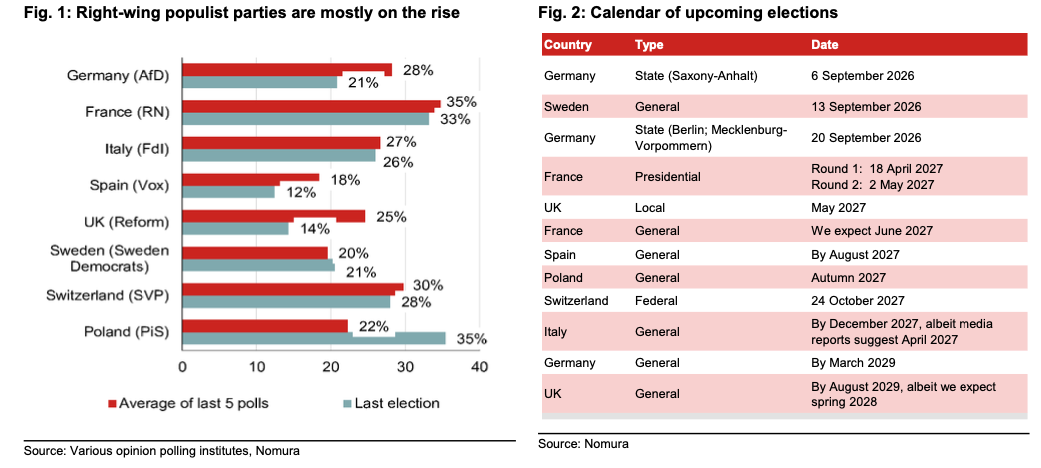
The shift to the right is happening across the West.
Brazilian socialist President Luiz Inácio Lula da Silva’s lead over right-wing Sen. Flávio Bolsonaro has imploded. If Bolsonaro can pull off a victory next month, that would cement the continent’s shift from nation-killing left-wing socialism to right-wing common sense.
Tyler Durden
Sat, 09/05/2026 – 07:35