
“More Signaling, Less Substance”: Barclays Pours Cold Water On Trump-Xi Summit
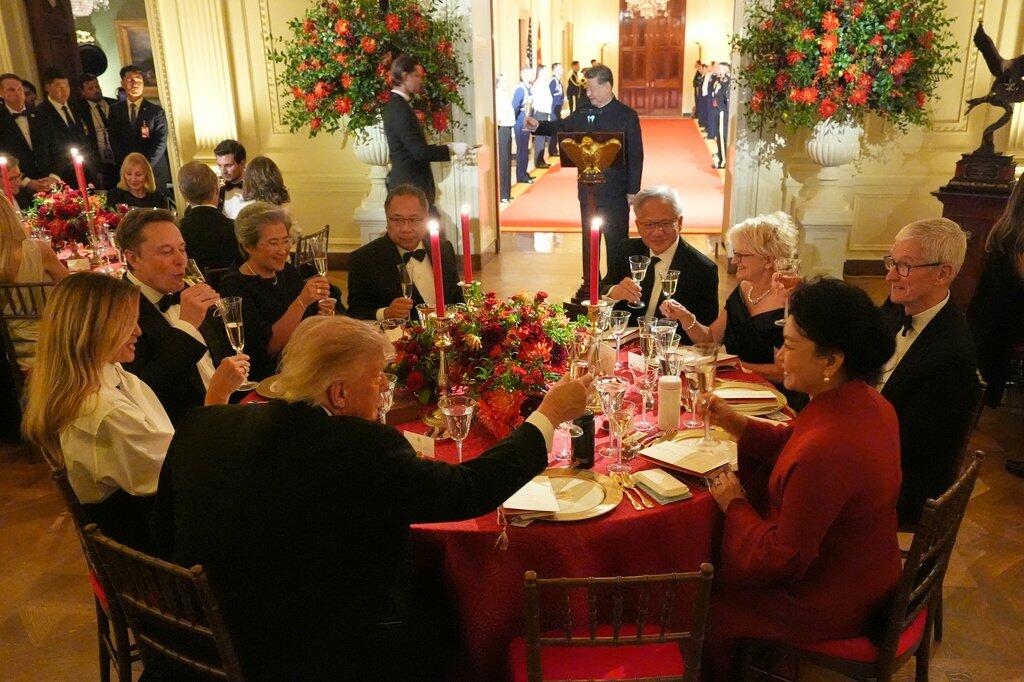
President Donald Trump hosted Chinese President Xi Jinping for a White House state dinner late Thursday, calling for closer ties while offering limited details on progress in addressing trade and geopolitical disputes. This was Xi’s first White House visit in over a decade.
Trump praised Xi and his wife as “truly outstanding, amazing people” and said the two superpowers should “continue to build a relationship that promotes prosperity and security.”
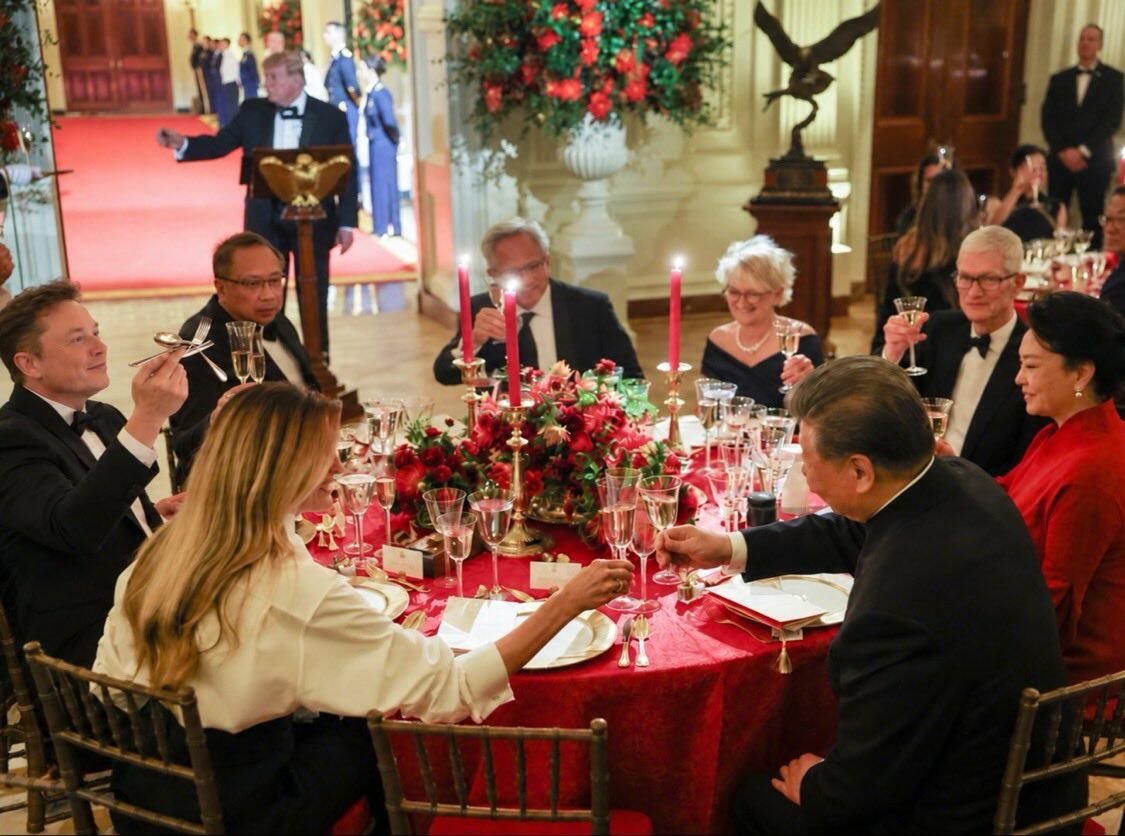
Xi called for a relationship defined by “strategic stability” and urged both sides to “act as responsible major countries.”
Earlier on Thursday, the two leaders held bilateral talks in the Oval Office. Trump described the discussions as a “great meeting” but did not elaborate on what was said. Xi told dinner guests that the two leaders had “reached common understanding on many issues,” without providing further details.
Barclays senior China economist Yingke Zhou provided clients with his first take on the Trump-Xi state visit and said it was “more signaling, less substance.”
“The Trump-Xi summit was primarily about stabilizing relations rather than resolving disputes. Beyond a short trade-truce extension, progress was limited. The absence of Chinese CEOs suggests China viewed the summit as a strategic dialogue, not a deal-making exercise,” Zhou said.
Zhou added more color:
What was the key message?
The Trump-Xi summit’s main achievement was symbolic rather than substantive. The two sides projected a constructive tone and a willingness to keep talking, but delivered little concrete progress on the core issues, including trade, AI and geopolitics. We think the summit was primarily about stabilizing the relationship, rather than resolving core disputes.
Speaking at the arrival ceremony at the White House, President Xi repeatedly emphasized building a “constructive China-US relationship of strategic stability.” Overall, we think President Xi’s speech was less about concessions and more about signaling predictability, stability, and openness to continued economic engagement, despite the competition in technology, trade, and geopolitics.
For comparison, President Trump repeatedly emphasized his personal relationship with Xi and the value of engagement. The summit’s key message, we think, is that both sides want to lower escalation risks and maintain dialogue, even as strategic competition remains firmly intact.
What was the most concrete deliverable?
The main deliverable was a two-month extension of the existing trade truce to 10 January 2027, removing an immediate source of policy uncertainty. However, the extension was shorter than the 3-6 month rollover many market participants had expected, and shorter than indications from Jamieson Greer ahead of the Trump-Xi meeting.
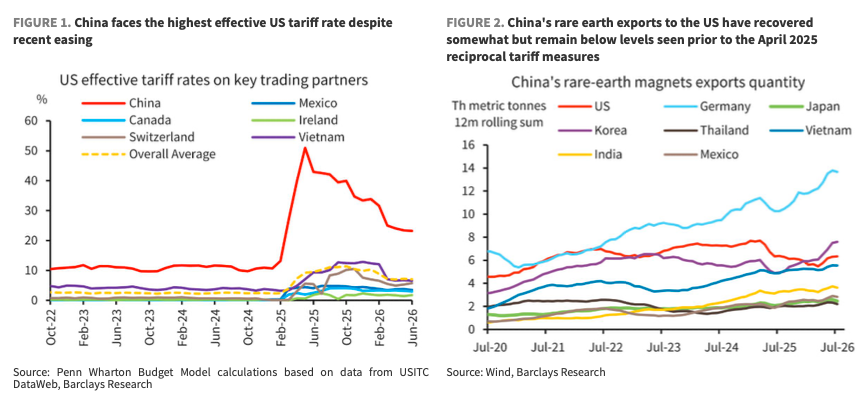
For context, China continues to face the highest effective US tariff rates among major trading partners, with an effective tariff rate of roughly 23%, compared with an average US effective tariff rate of around 7% for the rest of the world. The lack of progress on tariff reductions suggests that both sides are prioritizing stability and continued dialogue rather than pursuing a meaningful trade reset.
Board of Trade: Ahead of the summit, reports¹ suggested the US and China were considering reciprocal tariff cuts on around USD30bn of goods under the proposed Board of Trade framework. USTR said on 21 September that establishing a stable ‘Board of Trade’ is a key goal for the summit, with aims to secure a stable subset of goods, including agricultural and medical products, away from active trade disputes. So far, few concrete announcements have emerged. We await the details post the summit.
What the delegations tell us?
The summit delivered few concrete policy outcomes, but the composition of the delegations sent an important signal. The US side prominently featured leaders from AI and semiconductors (e.g. Nvidia, AMD, OpenAI, Google, Microsoft, Amazon, Meta), other technology (Apple, Tesla, and Dell), and finance (Citi, JPM, Blackstone, GS, and Mastercard), underscoring that technology, capital, and investment ties remain at the center of the US-China relationship.
In contrast, President Xi’s delegation consisted almost entirely of senior government officials and policymakers, including economic, trade, and foreign-affairs officials. No major Chinese entrepreneurs, technology leaders, or corporate executives were part of the official delegation. In our view, the absence of Chinese CEOs suggests China wanted to frame the summit primarily as a state-to-state diplomatic engagement, rather than a platform for commercial deal-making.
What are the key takeaways on geopolitics?
The summit built guardrails, not solutions. On geopolitics, the focus was on managing risks rather than resolving disputes.
On Taiwan, Chinese state media reported² that President Xi urged the US to “adhere to the correct position of opposing Taiwan independence,” underscoring that Taiwan remains Beijing’s foremost geopolitical red line and the most sensitive issue in US-China relations.
On Iran, President Xi expressed support for the US and Iran returning to the June memorandum of understanding aimed at ending the conflict and reopening the Strait of Hormuz³. More broadly, China appears relatively insulated from the energy shock. Kepler data suggest that China’s crude oil inventories have declined by less than 5% since the Middle East conflict began. At the current pace of drawdown, China has ample energy buffers and could sustain supply disruptions for at least 10 years.
The Trump-Xi meeting comes amid uncertainty over two conflicts raging across Eurasia, from Russia-Ukraine to the Gulf conflict, alongside intensifying resource nationalism and competition for technological leadership. The world is on an uncertain glide path into 2027 amid a global refining crisis.
Tyler Durden
Fri, 09/25/2026 – 06:55