
Australia’s Tobacco Taxes Have Fueled A Massive Black Market For Cigarettes
One lesson governments never seem to learn is that when taxes push the legal price of something high enough, a black market will eventually show up to collect the difference.
Australia is now getting a particularly ugly demonstration of that principle. After more than a decade of relentlessly increasing tobacco taxes in an effort to crush smoking, the country has created an enormous price gap between legal and illegal cigarettes, and organized crime has rushed in to fill it, according to the Financial Times.
A legal pack of cigarettes now costs close to A$60, or roughly US$42, making Australian cigarettes the most expensive in the world. Excise taxes account for more than 70% of that price, and the cost of legally purchased tobacco has roughly tripled since the end of 2016. Meanwhile, contraband cigarettes can be bought for around one-fifth of the legal price.
Not surprisingly, smokers have migrated to the underground market. Australia’s tobacco regulator estimated that illegal cigarettes accounted for roughly 55% of the market last year, although other government estimates suggest illicit tobacco’s share of consumption may be considerably higher.
Criminology professor James Martin estimates Australians spend about A$8.5 billion each year on illegal cigarettes and vaping products, roughly twice what the country spends on cannabis, cocaine, ecstasy and heroin combined. In practical terms, criminal organizations have become major tobacco distributors.
FT writes that the consequences are no longer limited to lost tax revenue or smokers buying cheap cigarettes under the table. The business has become lucrative enough to produce violent competition between criminal groups, including extortion, robberies and a wave of firebombings in Melbourne and Sydney. A recent Senate report cited three deaths connected to the violence, while the convenience-store industry says there have been roughly 300 arson attacks associated with the tobacco trade.
The Senate report described the situation as reaching a breaking point and recommended halting further excise increases while substantially reducing tobacco taxes. The government has resisted, maintaining that expensive cigarettes remain an effective deterrent. There is evidence for that argument: the smoking rate among Australians over 14 reportedly fell from 8.3% to 5.6% between 2023 and 2025.
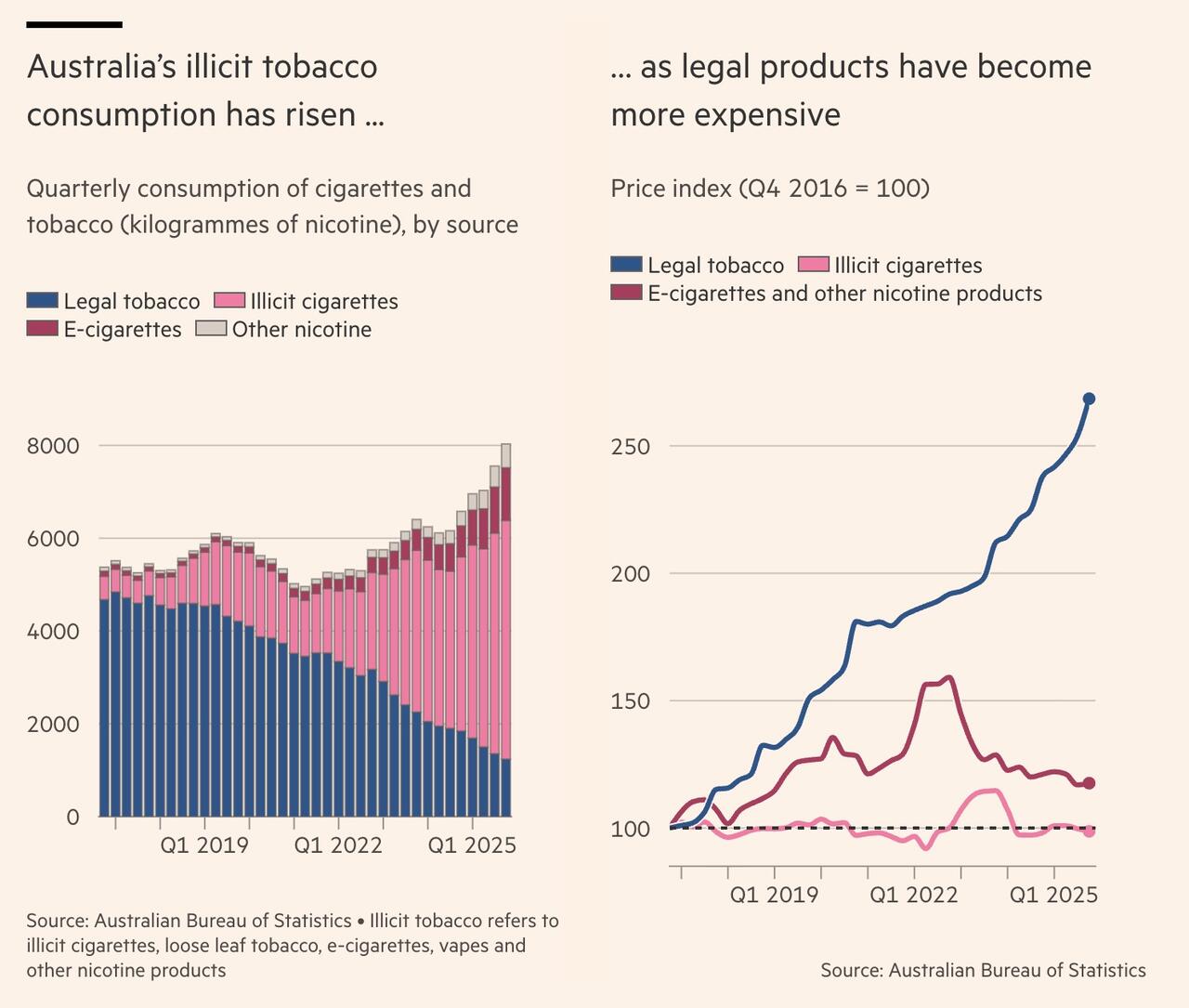
But nicotine consumption tells a less straightforward story. Wastewater measurements from the Australian Bureau of Statistics indicate that nicotine consumption increased by almost 40% between 2017 and 2025, with illicit tobacco driving much of the increase. Illegal vaping products have also captured an overwhelming share of their market.
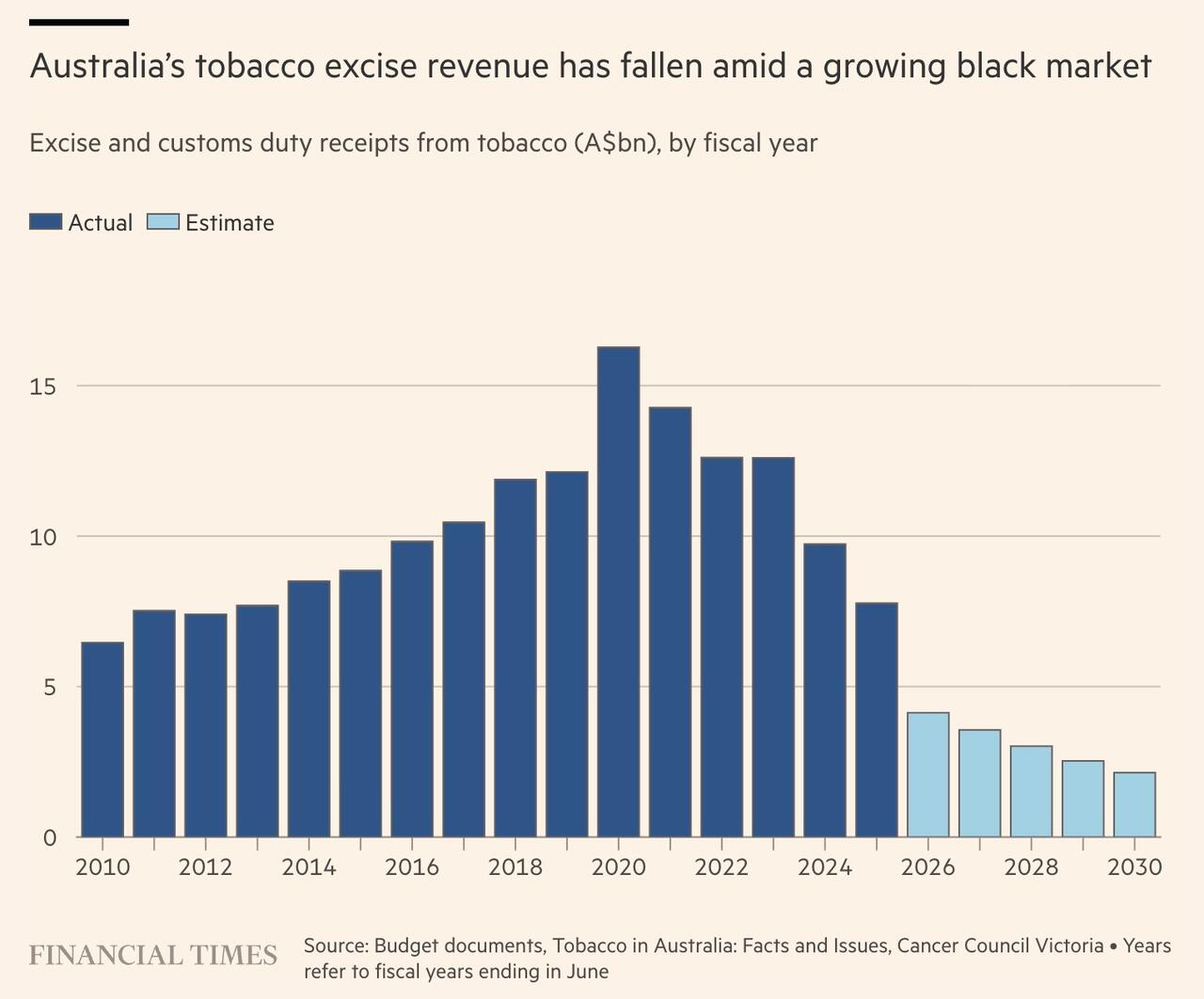
The fiscal side of the experiment has deteriorated just as dramatically. Tobacco excise revenue reached about A$16 billion in 2020, fell by more than half by 2025 and is projected to sink toward A$2 billion by 2030.
Authorities have committed A$365 million since 2024 to fighting the illicit trade, including efforts against smugglers and retailers. One recent joint operation with Chinese authorities intercepted roughly 60 million cigarettes shipped from Shanghai to Sydney, valued at about A$92 million. But the market continues to spread, with contraband reportedly sold online, from parking lots and through ordinary businesses such as barbers and fruit shops.
Australia’s tobacco experiment has therefore arrived at a strange destination. Legal cigarettes have been taxed to extraordinary prices, government revenue is collapsing, billions of dollars are flowing through an underground economy, and criminal groups are fighting over the proceeds. Whatever public health benefits higher taxes initially produced, policymakers are now confronting what happens when the legal price of a widely demanded product becomes disconnected enough from its black-market price to make breaking the law enormously profitable.
Tyler Durden
Thu, 10/01/2026 – 21:20