
Sayonara, OATs: After Treasuries, Japan Now Looms Over France’s Bond Rout
Last week, when 10Y Treasury yields kept grinding to multi-decade highs no matter if the data came in hot or cold (and have continued to do so this week), we pointed the finger east in “Focus Turns To Japan As Source Of Relentless Treasury Selling.” The logic was simple: with JGB yields at 30-year highs, the carry trade that let Western governments run giant deficits without paying for it was coming home to roost, and Japanese money with it.
Now it turns out the same culprit may have its fingerprints on the other bond crime scene of the moment: France.
According to Bloomberg, Japanese investors owned an estimated ¥23 trillion ($145 billion) of French bonds as of July, or 6.6% of their total overseas debt holdings, which makes France the most overweight euro-area position relative to the Bloomberg Global Aggregate Index. And just as French paper is suffering its worst stretch since the euro crisis, the reason Japan bought all those OATs in the first place (little to nothing to earn at home) is evaporating.
In other words, the most loyal foreign buyer of French debt is sitting on the biggest overweight in Europe, just as it finally has a reason to go home.
Below we walk through the size of Japan’s French bet, why the math for staying has broken down, what Goldman’s desks saw in Friday’s euro flows, and why the ECB’s cavalry is unlikely to ride to Paris’ rescue.
The Most Overweight Trade In The Euro Area
First, the backdrop. France’s 10Y yield has climbed to about 5%, the highest since 2002, and French government bonds have lost 4.9% this year, the fourth-worst performance globally, per Bloomberg. Last week the OAT-Bund spread blew out 32bps to 141bps, which Deutsche Bank’s Jim Reid called “the biggest weekly widening in available Bloomberg data back to 1990,” a stretch that took in German reunification, the euro crisis and Covid.
Naturally, we were right on top of it: as we wrote last Thursday in “Debt Crisis Back? European Bond Markets Crash, CDS Explode Amid France Budget Panic Contagion”, “It’s starting to smell awful sovereigny crisisy in Europe all over again.” Or, as we put it on X that afternoon:
it’s been a while since we had a European sovereign debt crisis *FRANCE-GERMANY 10-YEAR YIELD SPREAD WIDENS 8BPS TO 135BPS France CDS widest in 13 years https://t.co/9opJUmD2uS
— zerohedge (@zerohedge) October 1, 2026
Through all of it, and through every prior French political circus, Japanese investors have been “steadfast holders of French paper,” as Bloomberg puts it (maybe because Japan’s political circus is just as entertaining).
But that steadfastness is starting to crack. Japanese holdings of French bonds are down 2.5% since the end of last year, and some big names have already left the building: funds in Sumitomo Mitsui DS Asset Management’s global fixed income group, run by Shinji Kunibe, have sold their entire holdings of French debt on fiscal concerns.
Others are positioned for a lot more pain. Fivestar Asset Management’s Hideo Shimomura:
“This is just the beginning. If the European Central Bank just leaves things alone, there are concerns that, judging from the European debt crisis, France’s 10-year government bond yield could rise as high as 7%.”
To put the size of the potential problem in context, the chart below compares Japan’s French pile with the €340 billion (roughly $380 billion) of OATs, net of buybacks, that France’s debt agency plans to sell next year. Japanese holdings are equal to roughly 38% of France’s entire 2027 bond program, and the reported 2.5% drop works out to only about $4 billion of reduction so far (napkin math, and part of that may be price rather than selling).
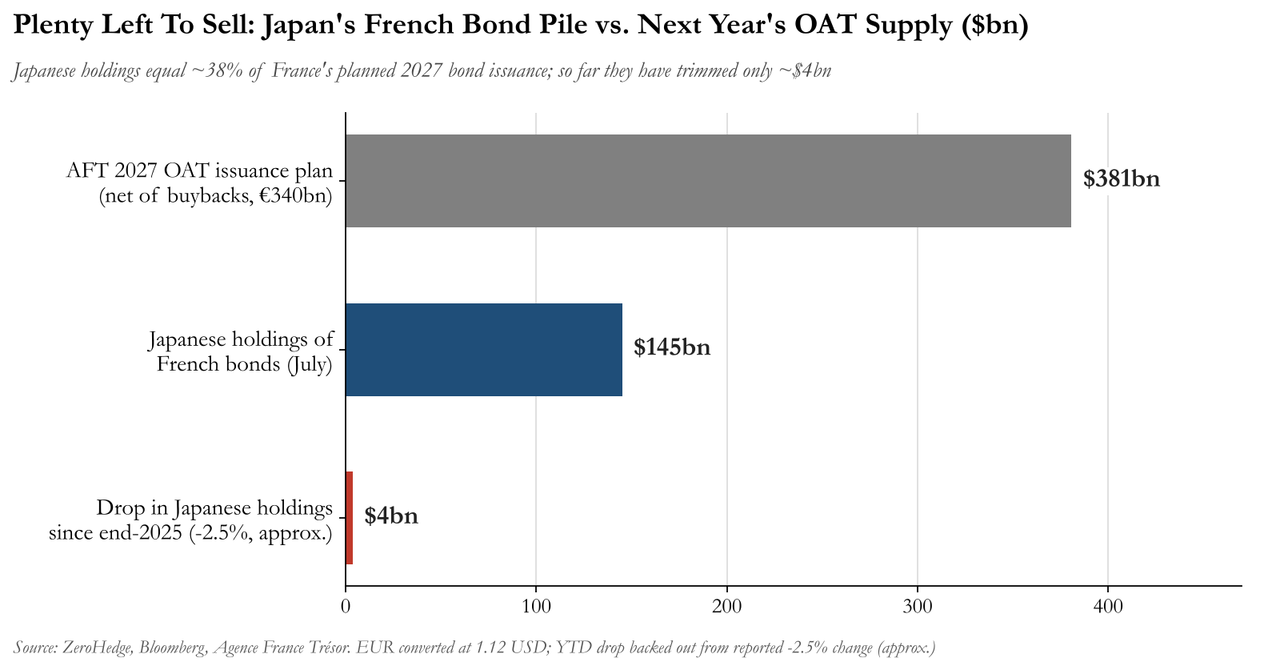
Translation: if Shimomura is right that this is “just the beginning,” there is a lot of beginning left.
Why Now: The Yen Carry Trade Comes Home
The reason this time may be different has nothing to do with Paris and everything to do with Tokyo. For two decades, Japanese lifers, banks and pension funds bought OATs, Treasuries and anything else with a coupon because JGBs paid nothing. That world is gone. Japan’s 10Y yield broke above 3% last month, a 30-year high, while the long end has gone vertical:
Japan 30-Year Bond Yield Rises 6bps to 4.2% Amid Global Selloff
— zerohedge (@zerohedge) October 1, 2026
We have been warning about where this ends since January, when we first noted that “The Japanese Bond Market Is Imploding”. And the same rout that makes JGBs attractive also blows holes in the balance sheets of the very institutions that own all those foreign bonds:
Unrealized losses at Japanese insurers and banks just hit #Ref! 40Y JGB bond yields surge 6bps to 4.27%, set to take out record high of 4.390% from May 19 https://t.co/R5er0H6roG
— zerohedge (@zerohedge) September 25, 2026
Here is the crux of Bloomberg’s piece: after the selloff, France’s 10Y yields only about 40 basis points more than JGBs on a currency-hedged basis. For a Japanese investor, that is the entire compensation for taking on Le Pen risk, deficit risk and the risk that hedging costs move against you. Mizuho’s Masayuki Nakajima:
“Combined with concerns over France’s fiscal trajectory and elevated foreign-exchange hedging costs, this reduces the incentive for Japanese investors to rebuild positions even if valuations appear cheaper.”
Put differently, 40bps is a decent pickup for a “clean core allocation.” It is not a decent pickup for a country that markets now trade alongside Italy. Which is exactly the risk Macro Hive’s Antonio Del Favero flagged: “If Japan is seen as cutting an overweight because France is no longer a clean core allocation, US, Asian and some European benchmark investors may re-assess too.” Japan rarely sells alone; it just tends to sell first.
Goldman: “Asia Investors Selling European FI Friday”
If you want evidence that this isn’t just a theoretical risk, look at Monday’s FX tape. The euro slid to its lowest since May 2025 against the dollar in Asian trading, and Goldman’s Jonathan Lightowler, in his London morning update (available to pro subs), listed the culprits behind EURUSD’s drop from around 1.1260 to a 1.1161 low. First on the list:
“We struggle to rationalise the extent of the move in full, but, talk of EUR selling from Asia investors selling European FI Friday; plus ongoing French fiscal focus; plus headlines around a snap election in Spain which has now been called; plus Italy’s Friday fiscal revisions all in focus.”
That squares with what Bloomberg’s Markets Live strategist Mark Cranfield said traders should watch: “the slide in EUR/JPY as a signal Japanese investors are trimming exposure to European debt.” Interestingly, when the OAT blowout first hit the euro last Wednesday, the yen cross actually held up better than Goldman’s FX model predicted (far right of the chart below), while the franc and the dollar did the heavy lifting. Japan wasn’t the marginal seller on day one; by Friday, according to Goldman’s desk, Asia had joined in.
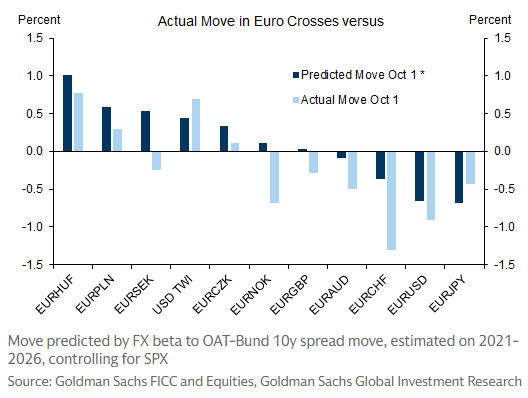
Goldman FX strategist Mike Cahill’s framework explains why the timing matters: the euro “depreciates roughly 4-5% per 100bp of spread widening on average, but in practice the response is near zero most of the time and spikes only in acute stress — spreads don’t matter for the currency until they’re the only thing that matters.” And his colleague Matt Atherton on the GS FX desk warned in Monday’s morning update that the strong-dollar backdrop still poses “some risk to residual positioning (especially amongst popular carry trades in both EM and DM – inclusive of European fixed income).”
Japanese real money holding $145 billion of OATs funded out of a zero-yield home market is about as “popular carry trade” as it gets.
More Supply, Fewer Buyers
The timing could hardly be worse, because France is about to ask the market for more money, not less. In a note out Monday “Euro Govies Supply Outlook – 2027 update” (available here for pro subs), Goldman’s rates strategists flagged that the AFT’s 2027 plan of €340 billion of OATs, net of buybacks, came in above the €325 billion they had pencilled in, adding that “risks are to the upside on the 5% 2027 deficit target that the AFT financing programme is based on, which means issuance could end up even higher.”
The bank now expects French net duration supply of around +95mn/bp in 2027, about 25% higher than this year’s +75mn/bp, matching Germany for the biggest increase in the euro area. The EU is the only issuer with materially less supply next year (chart source GS FICC):
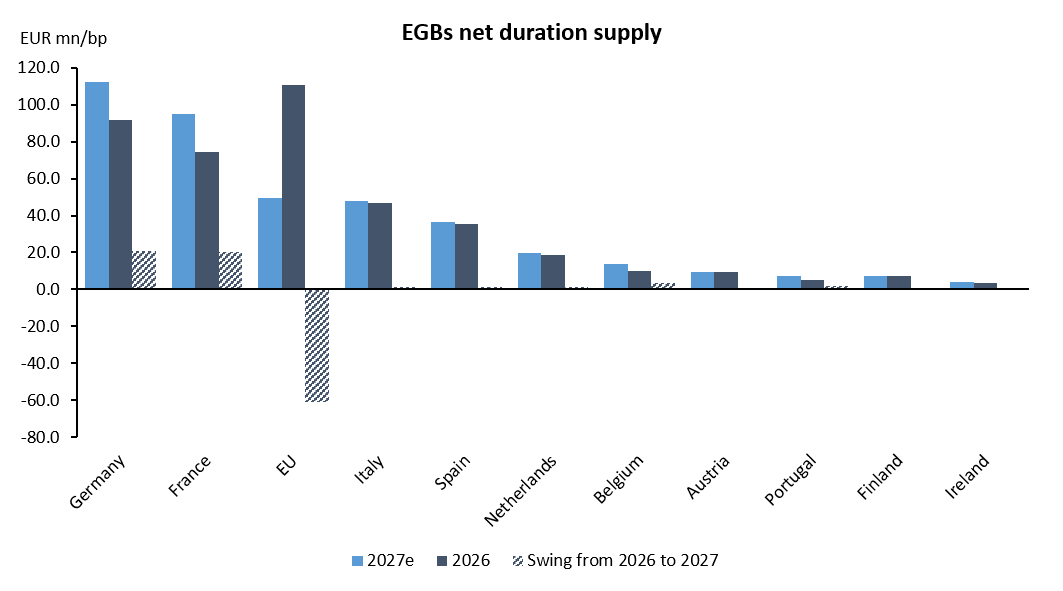
So: 25% more duration to sell, and the single biggest overweight foreign holder eyeing the exit. Someone will have to buy those OATs, and at 40bps of hedged pickup, it probably won’t be Tokyo.
Le Pen, Zero Growth, And The Cavalry That Isn’t Coming
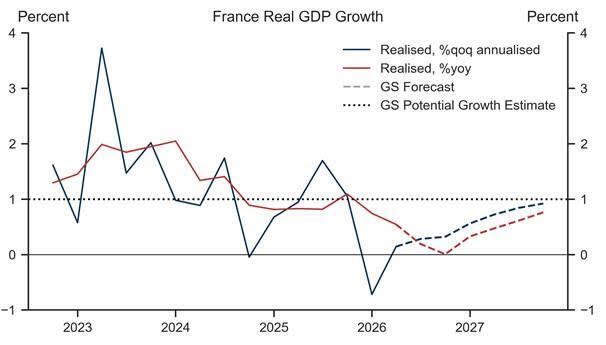
Bloomberg lists the usual reasons for France’s crisis: i) missed deficit targets, ii) policy gridlock and iii) next year’s presidential election “that could radically alter the country’s direction.” Goldman puts numbers on each. The bank’s poll-based model now gives Marine Le Pen a 68% probability of winning the presidency (up 3% in a week), versus 16% for Edouard Philippe and 6% for Mélenchon. Goldman’s economists expect deficits of 5.4% of GDP this year and 5.3% next, and just cut their 2027 French growth forecast to 0.6% from 0.7% “following the significant tightening in financial conditions,” below most other forecasters:
And for anyone counting on Frankfurt to make Japanese sellers whole, Goldman economists Sven Jari Stehn and Alexandre Stott have bad news in their latest ECB note (summarized in Monday’s GS MORNING, available to pro subs): anti-fragmentation tools are “the last resort, not the next step,” and “the bar is much lower for protecting ‘innocent bystanders‘ from contagion (e.g. Spain) than for intervening where current fiscal policy is inconsistent with debt stabilisation (e.g. France)… fundamental sovereign risk needs a fiscal solution, not an ECB one.” (We dug into what that means for Madrid earlier today in “Spain Joins The Party: Snap Election Adds Madrid To Europe’s “Red October” Bond Crisis”)
Worse, late on Monday, Emmanuel Moulin, the governor of the Banque de France poked the gushing wound with a salted 10 foot pole when he warned that the country risks being “strangled by interest rates” if it does not act to clean up its public finances. Spoiler alert: France won’t do a damn thing unless a bond crisis force it to.
Recall that Shimomura’s 7% call was explicitly conditional on the ECB “just leav[ing] things alone.” Goldman’s answer: that is precisely the plan.
Not everyone is quite as alarmed. In their latest Europe Economic Weekly (“Tight and tightening“, also available to pro subs), BofA economists argue that the idiosyncratic part of the OAT move “may be limited to c 20bp, ie the widening vs BTPs since July,” and that “the bigger problem in France today may be the global bond market repricing, helped by OAT-specific technical factors.” Their rates colleagues peg fair value for the spread at around 100bp:
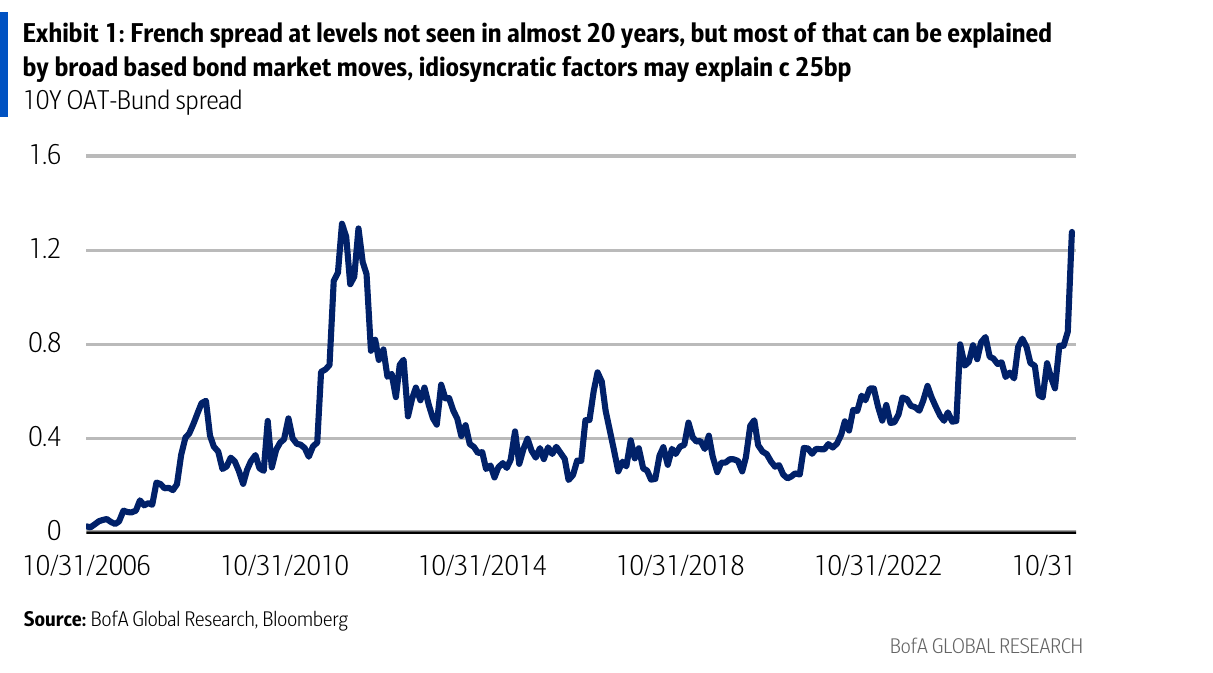
But even BofA, in a section titled (we kid you not) “Oh la la, le spread,” concedes the obvious: “if everyone is zoomed in on France, it means that market sentiment is very fragile and at risk of turning very sour even without any meaningful triggers.” And if the problem is “global bond market repricing,” well, global bond market repricing is exactly what happens when the world’s largest creditor nation decides its own bonds finally pay enough. Unfortunately for BofA, and France, that isn’t a mitigating factor – it’s the mechanism.
Bottom Line
Bloomberg’s closing quote from Mizuho sums it up: cheaper valuations alone won’t lure Japanese money back, not with France’s fiscal trajectory and hedging costs where they are. And as Shimomura put it, “this is just the beginning.”
We agree, and we would go further. The bull case for OATs (Japan has held through every French crisis before) relies on a world where Japanese investors had nowhere else to go. With 10Y JGBs above 3% and the 30Y above 4%, they do now. Last week we said Japan was the likely source of the relentless Treasury selling; this week the same repatriation trade is showing up in Paris, a market where Japan is far more overweight, the hedged pickup is a mere 40bps, supply is rising 25%, the front-runner for president is Le Pen, and the ECB has all but said France is on its own. Of the two, OATs look like the far more vulnerable target, especially since Japanese holdings are down just 2.5% so far. Either the AFT finds a new marginal buyer for €340 billion of paper in 2027, or – more likely – it finds the price at which one shows up. Shimomura thinks that price is 7%. With the ECB on the sidelines, that no longer sounds crazy.
Then again, every euro crisis eventually ends with Frankfurt blinking. The only question is how many trillion yen walk out the door before it does.
We’ll be watching Japan’s weekly MoF portfolio flow data on Thursday, and EUR/JPY every night in between, for signs the exit is getting crowded.
Much more in the full GS “Euro Govies Supply Outlook – 2027 update“, the “GS MORNING” note and BofA’s “Tight and tightening” note, all available to pro subs.
Tyler Durden
Mon, 10/05/2026 – 22:21