Rubio Says US & Europe “Belong Together”, Urges Alignment With Trump’s Vision For Western Revival
Authored by Tom Ozimek via The Epoch Times,
U.S. Secretary of State Marco Rubio told European leaders on Feb. 14 that Washington is not walking away from the transatlantic alliance—but called for a renewed partnership that aligns with President Donald Trump’s push for national revival, tougher border control, and a return to industrial and military strength.
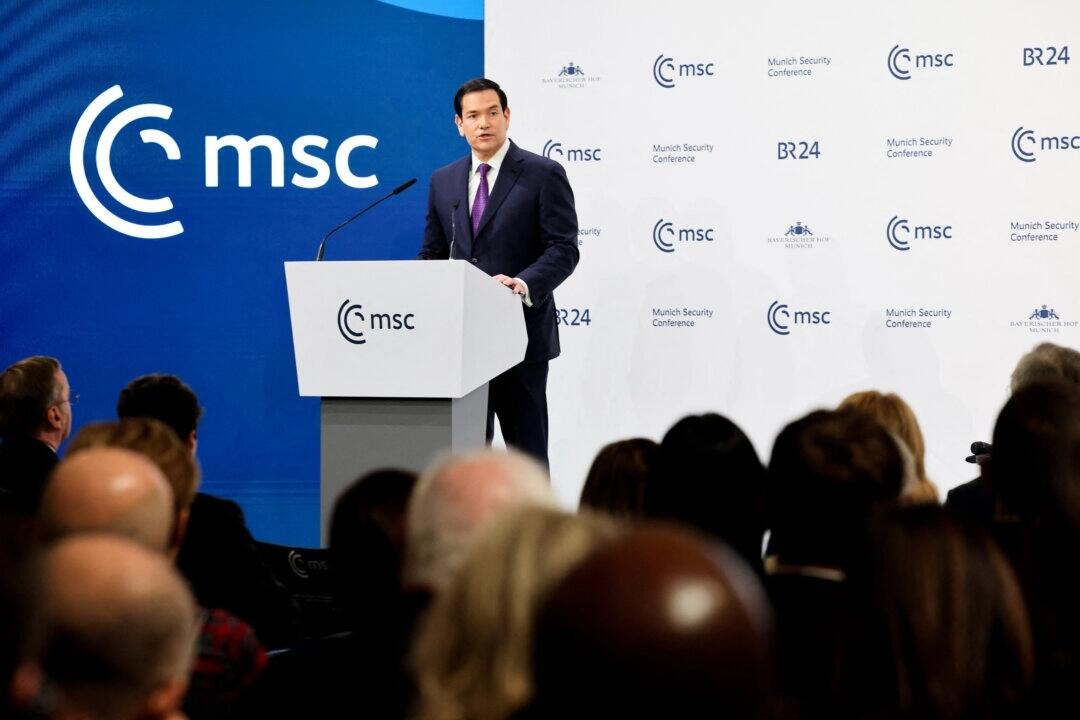
Addressing the annual Munich Security Conference, Rubio sought to reassure governments unsettled by a year of tensions over trade, defense spending, and at times critical U.S. rhetoric toward NATO.
At the same time, he made clear that Washington’s commitment would be tied to what he called a broader civilizational renewal—one that calls on Europe to strengthen its own defenses and reassess policies on migration, climate, and economic globalization.
“Under President Trump, the United States of America will once again take on the task of renewal and restoration, driven by a vision of a future as proud, as sovereign, and as vital as our civilization’s past,” Rubio said.
“And while we are prepared, if necessary, to do this alone, it is our preference, and it is our hope to do this together with you, our friends here in Europe, for the United States and Europe—we belong together.”
Serving as both a warning and an invitation, Rubio’s remarks acknowledged “mistakes” made by both the United States and Europe in the decades following the Cold War, while highlighting a shared responsibility to correct course.
A Critique of the Post-Cold War Order
Rubio’s address included sharp criticism of the post–Cold War consensus, while also praising it for enabling the United States and its allies to resist the onslaught of Soviet communism and to emerge victorious and prosperous together.
“Even as World War II still burned fresh in the memory of Americans and Europeans alike, we found ourselves staring down the barrel of a new global catastrophe—one with the potential for a new kind of destruction more apocalyptic and final than anything before in the history of mankind,” he said.
With thousands of years of Western civilizational heritage hanging in the balance in the face of a threat from a nuclear-armed, expansionist “evil empire,” Rubio said that a unified resistance within the transatlantic alliance ultimately prevailed.
But what followed the “euphoria of this triumph,” Rubio said, was a descent into a “dangerous delusion” that history had ended, that every country would become a liberal democracy, that economic and trade ties would replace nationhood, that national interest would be replaced by the rules-based global order, which would usher in a world without borders.
“This was a foolish idea that ignored both human nature, and it ignored the lessons of over 5000 years of recorded human history, and it has cost us dearly in this delusion,” he said.
“We embraced a dogmatic vision of free and unfettered trade, even as some nations protected their economies and subsidized their companies to systematically undercut ours, shuttering our plants, resulting in large parts of our societies being de-industrialized, shipping millions of working and middle-class jobs overseas, and handing control of our critical supply chains to both adversaries and rivals.”
Rubio criticized what he called an excessive expansion of welfare states at the expense of national defense, noting that America’s rivals had increased military spending and did not hesitate to use hard power to pursue their national interests.
The West, he said, by contrast, adopted energy policies that impoverished its citizens in order “to appease a climate cult,” while competitors continued to exploit fossil fuels, gaining leverage over Western economies.
He also sharply criticized mass migration policies, rejecting the idea that tighter borders are expressions of intolerance.
“Gaining control of national borders is not an expression of xenophobia or hate,” Rubio said.
“It is a fundamental act of national sovereignty. And the failure to do so is not just an abdication of one of our most basic duties owed to our people—it is an urgent threat to the fabric of our societies and the survival of our civilization itself.”
Throughout his speech, Rubio said Europe and the United States are bound together in shared responsibility for a series of strategic missteps that it is now time to correct.
A Call for Restoration
Rubio repeatedly said that renewal should be a shared effort, not something the United States pursues alone. While saying Washington is ready to act independently if needed, he presented Trump’s agenda as an invitation for Europe to join in rebuilding Western strength.
“For the United States and Europe, we belong together,” Rubio said, describing the United States as “a child of Europe,” shaped by centuries of shared history, faith, culture, law, and political traditions.
He said that the fundamental question facing the alliance was not simply how much to spend on defense or how to deploy forces, but rather how to share a common understanding of what the United States and its allies are defending.
“Armies do not fight for abstractions,” Rubio said.
“Armies fight for a people. Armies fight for a nation. Armies fight for a way of life, and that is what we are defending—a great civilization that has every reason to be proud of its history, confident of its future, and aims to always be a master of its own economic and political destiny.”
Rubio called for re-industrialization on both sides of the Atlantic, saying that Europe and the United States should work together to rebuild manufacturing capacity, secure supply chains, and reduce reliance on strategic rivals for critical goods and minerals.
“What we want is a reinvigorated alliance,” Rubio said, “one that does not allow its power to be outsourced, constrained, or subordinated to systems beyond its control.”
The Munich Security Conference, which has long served as a barometer of transatlantic unity, runs through Feb. 15. It comes at a moment its organizers describe as an “inflection point” marked by the erosion of the international rules-based order and mounting instability across the globe.
Tyler Durden
Sat, 02/14/2026 – 15:10