


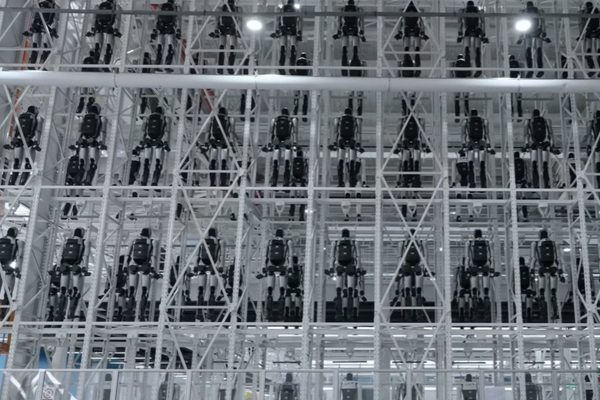
China has officially begun operations at the world’s first 10,000-unit-scale industrial humanoid robot smart factory where robots will build robots. Located in Liuzhou, Guangxi, the facility is a joint venture between Siemens and UBTECH Robotics, a Chinese company specializing in robotics. The factory will employ embodied AI and digital twins instead of relying on humans to assemble parts.
The science behind robots building robots
Siemens created a digital twin by modelling the entire 14,000-square-meter-factory in a virtual simulator to ensure that it works at 10-minute production cycle. The factory is able to work at this speed without parts jamming. Moreover, the assembly robots use 3D vision and tactile feedback to arrange micro-parts in perfect order without human oversight.
Using 3D spatial mapping, wheeled CRUZR mobile manipulators are able to unpack pallets, sort boxes and refill storage bins without human assistance. Moreover, Automated Guided Vehicles (AGVs) and automatic forklifts move parts from the warehouse to assembly stations. Once the products are assembled, the products undergo four hours of rigorous dynamic stress testing to ensure everything operates without flaw.


Sci-fi is real! UBTECH just launched the world’s first 10,000-unit humanoid robot factory in Liuzhou. With 1 robot rolling off the line every 10 minutes, this is a massive leap for AI manufacturing! pic.twitter.com/VUUuQpnrQ7
— Lookout (@watchmancz) September 14, 2026
Risks and challenges of the humanoid factory
The factory solves rapidly growing labor shortages in China. Presently, China faces a shortage of 30 million manufacturing workers. Young people are increasingly rejecting blue-collar assembly jobs, further driving labor shortages. This factory model enables humanoids to perform mundane and hazardous tasks, handling up to 20% of factory workload.
The use of humanoids reduces the risk of human error in precision tasks. Therefore, tasks like tracking, scanning and securing thousands of intricate parts occur flawlessly. The coordinated network and synchronized workflow also ensure efficiency.
Despite the benefits, critics argue that embodied AI technology is still relatively new. It may struggle in real-world environments when placed in unpredictable work environments. Moreover, it also raises questions about whether the global market can absorb 10,000 humanoids each year. Markets might not be ready to purchase humanoids before lengthy safety trial periods.


With humanoids taking over blue-collar jobs, economic welfare also becomes a concern. Without adequate social safety mechanisms and worker transition programs, the global economy could be severely disrupted as thousands of people rely on factory or gig-economy wages.
Global perceptions
The mass production of automotive-grade, high-speed robots has raised concerns among the public. Users on social media have raised concerns about how fast the technology is moving. The idea of robots building their own kind resembles a dystopian science fiction movie.
Political analysts also claim that the US and China are engaged in a robotics cold war. While China has taken the lead in the physical hardware scale, American giants are building software and prototypes.
In Case You Missed It:

It’s Already Worse Than Anything They’ve Told You About Our Fuel — And It Doesn’t Stop Here
For breaking news from one of the most over the target and censored names in the world join our 100% Free newsletter at Newsletter, The best way to get the information you want.
Also follow us at Gab
Follow us on Gab.com , Like, comment, and subscribe.
Telegram, Join our Telegram chat
Shop Patriot and Detox the Deep State by shopping with our sponsors.
RedPillLiving.com, Home of Sleepy Joe – the world’s most powerful all natural sleep formula.
The Serapeum.com, The Hidden History of Man & The Mystery Babylon Religion of The Deep State.