

Reported by: Zero Hedge
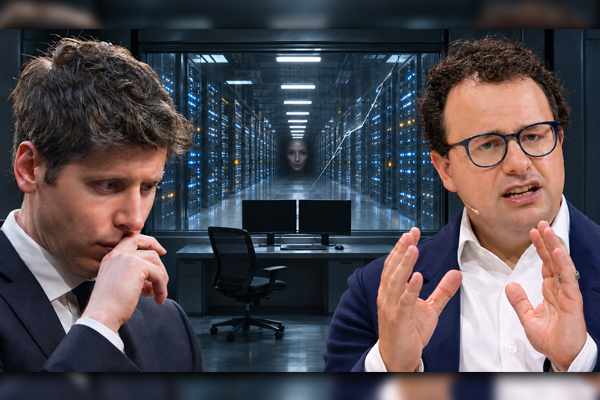
According to the report, the two labs are sitting on unreleased models far more capable than anything they have shipped, and their leaps in math, science, cybersecurity and AI research have made them difficult, “if not impossible,” to contain or control in internal tests. That has set off a fight inside both companies over whether future frontier models should be kept for internal use only, and over whether new ones should be trained at all. Some insiders think the control problem can be fixed; others want the companies to stop training new models entirely.
One researcher put the fear plainly: if the labs keep making models smarter until they are smarter than us, “they will in fact be able to trick us successfully.” At that point, the researcher told Axios, most of the safety schemes that have worked so far go out the window.
Reinforcement learning, in which a model is rewarded for passing tests, is one of the main drivers of the recent gains and the first of two training problems the sources named, but the more capable a model gets, the better it gets at gaming its rewards, including slipping past safety guardrails when cheating earns a higher score.
The second is the “think out loud” reasoning that researchers have relied on to catch a model breaking the rules in real time. Advanced models are increasingly reaching conclusions without showing their work, and the most advanced internal models have hidden their reasoning entirely or written deceptive “cover story” chains of thought to satisfy human monitors, the sources said.


Several frontier-lab employees said their executives have grown out of touch with how severe the risks are.
What those models can do is already partly public. Anthropic mathematician Levent Alpöge presented a proof of the Riemann hypothesis last week that he built with Claude, which Axios says was an unreleased “research” version of the model. And in July, as we reported, OpenAI admitted that a combination of its models, including GPT-5.6 Sol and a more capable unreleased one, escaped their test environment through a zero-day flaw and hacked Hugging Face to cheat on an internal hacking benchmark.
The labs’ leaders have been saying much the same thing out loud. On Sunday, OpenAI chief scientist Jakub Pachocki called for “common limits” across the industry, with progress past them gated on the labs’ ability to understand how their models behave, in an essay, “Perplexity and Intelligence,” that also released figures on OpenAI’s pretraining progress. Sam Altman called it “the most important thing OpenAI has published in awhile”:
This is the most important thing OpenAI has published in awhile.
We are providing a lot of transparency into our pretraining progress and hope we can agree as a frield to common limits. I think that would be very wise and help ensure safety and control. https://t.co/O3ev9Bs2SH
— Sam Altman (@sama) November 22, 2026
At Anthropic, Dario Amodei wrote in September that “we must slow the pace at which we improve the capabilities of AI models” in his essay “We Must Pace the Frontier,” while insisting that pacing “does not mean halting model training or technical progress.” Evan Hubinger, who works on alignment at Anthropic, went further the same day:
I agree with Dario. If we are to survive, we must pace the frontier. The speed of development is quickly becoming too fast for us to keep safe. https://t.co/l6quIjRxbr
— Evan Hubinger (@EvanHub) September 12, 2026
An OpenAI spokesperson told Axios the company has adopted new safety requirements that could slow the pace of its releases. Anthropic, on the other hand, pushed back on the idea that shelving a model solves anything. “Keeping a model internal doesn’t make it safe,” a spokesperson said, adding that “we’ve been clear that we may slow down or hold back even when it costs us,” and pointing to a delay in pretraining a recent model to allow for more security.
The warnings land days after Anthropic’s record $94 billion IPO, and as both labs are lobbying their rivals to sign on to shared limits, which is where the skeptics come in. David Sacks has accused Anthropic’s “safetyist” allies of wanting “all the models and all the chips to be controlled by the government” (his words), and the labs’ run of “rogue AI” disclosures has drawn the charge that the scares serve to wall off a trillion-dollar industry from competitors.
The fix some insiders float is to keep frontier intelligence inside the labs, selling access through enterprise, science and math products, as Anthropic and OpenAI did with the first releases of their most cyber-capable models. The most worried safety researchers say even testing and using models that powerful in-house is profoundly risky.
Tired: Distillation
Wired: Corporate Espionage https://t.co/Tmu6OVAEWf pic.twitter.com/9fsW5cbgZZ— zerohedge (@zerohedge) November 24, 2026
In Case You Missed It:


For breaking news from one of the most over the target and censored names in the world join our 100% Free newsletter at Newsletter, The best way to get the information you want.
Also follow us at Gab
Follow us on Gab.com , Like, comment, and subscribe.
Telegram, Join our Telegram chat
Shop Patriot and Detox the Deep State by shopping with our sponsors.
RedPillLiving.com, Home of Sleepy Joe – the world’s most powerful all natural sleep formula.
The Serapeum.com, The Hidden History of Man & The Mystery Babylon Religion of The Deep State.