
“Buffers Running Down Quickly”: HSBC Warns Next Global Food Shock Brewing
Warnings on Wall Street about a confluence of stressors building deep within global agricultural supply chains are growing louder by the week, raising the risk of a food crisis next year.
JPMorgan analysts warned last week that the next global food crisis “won’t be short-lived.” HSBC analysts sounded a similar alarm, pointing to tightening grain supplies, El Niño, disruptions at maritime chokepoints, and a supply “squeeze” sending grain prices soaring.
HSBC economist Jamie Culling, who covers Australia, New Zealand, and global commodities, published a note Tuesday titled “Food Prices Rising Due to the Weather and Wars,” warning that the supply squeeze is already showing up in spot markets. Cereal prices, including wheat, corn, barley, and rice, rose 22% year over year through July.
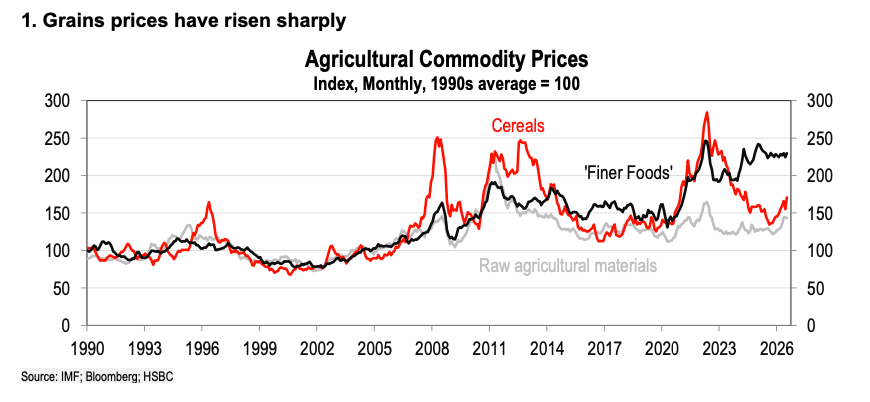
“Having strong supplies and stocks going into this year has helped keep prices from spiking higher, but the buffer is now starting to be run down quickly,” Culling warned clients.
Culling continued:
Supply ‘squeeze’ underway
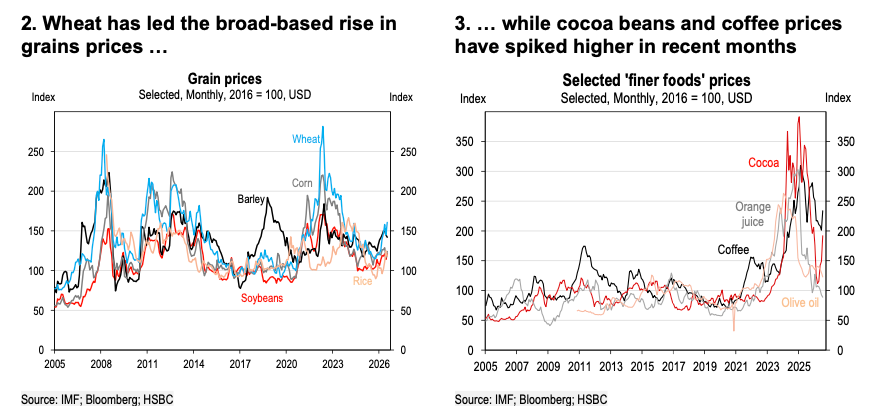
Agricultural supply chains face a number of shocks, including the impact of the Middle East conflict, a recent escalation of the Russia-Ukraine war and extreme weather events, including a Northern Hemisphere heatwave and strengthening El Niño. Having strong supplies and stocks going into this year has helped keep prices from spiking higher, but the buffer is now starting to be run down quickly.
On the USDA’s latest forecasts, global grains production is expected to fall to be below consumption in 2026/27, its first shortfall since 2020/21 and largest shortfall since 2006/07. Stock-to-use ratios are set to tighten, alongside a fall in crop yields.
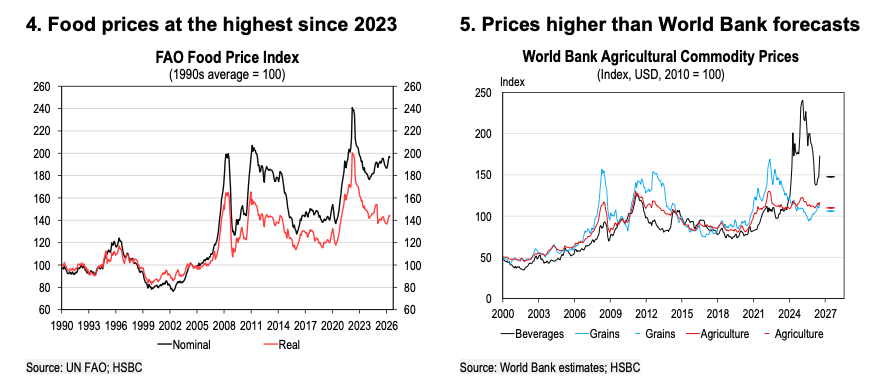
Agricultural prices have risen. Grains prices are up 22% y-o-y, and some ‘finer foods’ prices, such as cocoa and coffee, have spiked higher too.
The Middle East conflict has been a key disruptive factor for agricultural commodities (see Fertiliser, food, and the Middle East conflict, 17 April 2026). The closure of the Strait of Hormuz has continued to constrain fertiliser and sulphur supply, and kept broader input cost pressures elevated. Export restrictions from some economies in response to this ‘squeeze’ have been another source of pressure.
The recent escalation in the Russia-Ukraine war has seen a sharp drop in shipments from the Black Sea. The region supplies nearly a third of global wheat trade and one-fifth of global fertiliser trade, so this represents a key risk to supply, just as grain harvests are ramping up. Damage to refineries in Russia has also lifted diesel prices.
The weather has also been a big factor, with Northern Hemisphere heatwaves, an intensifying El Niño and a positive Indian Ocean Dipole posing downside risks to agri-commodity supply. The impact of previous El Niño episodes varies by region and commodity, but yields tend to decrease and prices increase. Weather-related risks have seen cocoa prices spike 50% in the past few months and lifted coffee prices. Weather risks can also deliver non-linearities, such as more disease outbreaks.
We see supply-side issues continuing to dominate developments in agricultural commodity prices, meaning risks of higher prices on average, increased price volatility, and greater instances of food insecurity in the coming period.
Professional subscribers can read the full note “Food prices rising due to the weather and wars” here on our new Marketdesk.ai portal.
Tyler Durden
Tue, 08/25/2026 – 20:30