
“Dead Mall” Era Ends As Shoppers Return, Values Surge And Sector Leads CRE Revival
The “malls are dead” narrative gained traction in corporate media coverage in 2016 and 2017 and lasted until 2022.
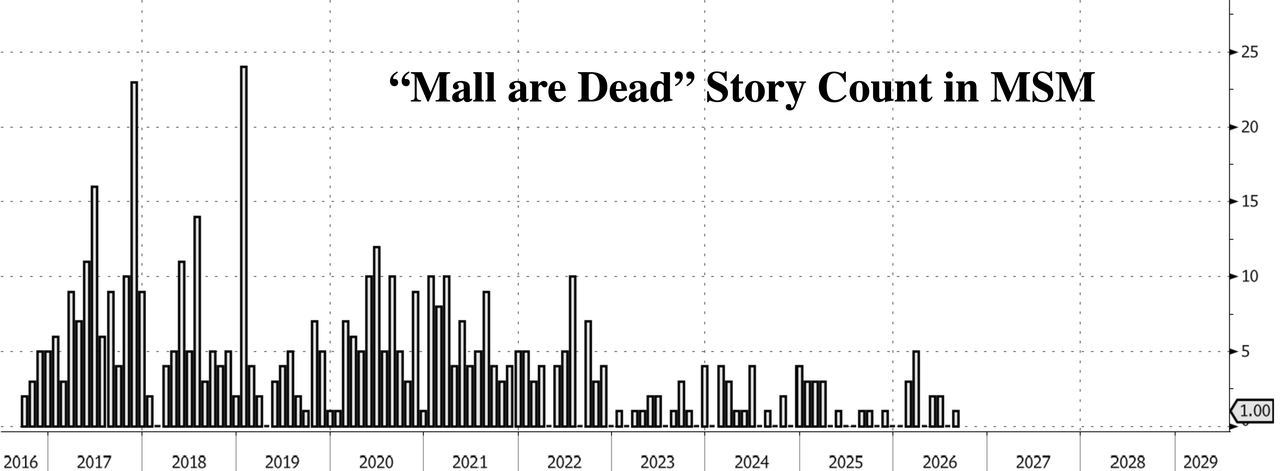
Those headlines reflected the strain across the sector as excess retail space, department-store closures, and shifting consumer habits led to widespread low occupancy and cratering property values.
But now, new data suggest that the “dead mall” narrative has not just reversed: that part of the CRE market is thriving, with a Wall Street Journal report saying it’s outperforming every other major CRE sector.
CRE research firm Green Street released a new report showing that mall values across the US rose 13% over the past year, leading all 10 sectors it tracks and more than doubling the increase in overall CRE prices. That recovery has attracted investors who are souring on weak performance across office and multifamily properties.
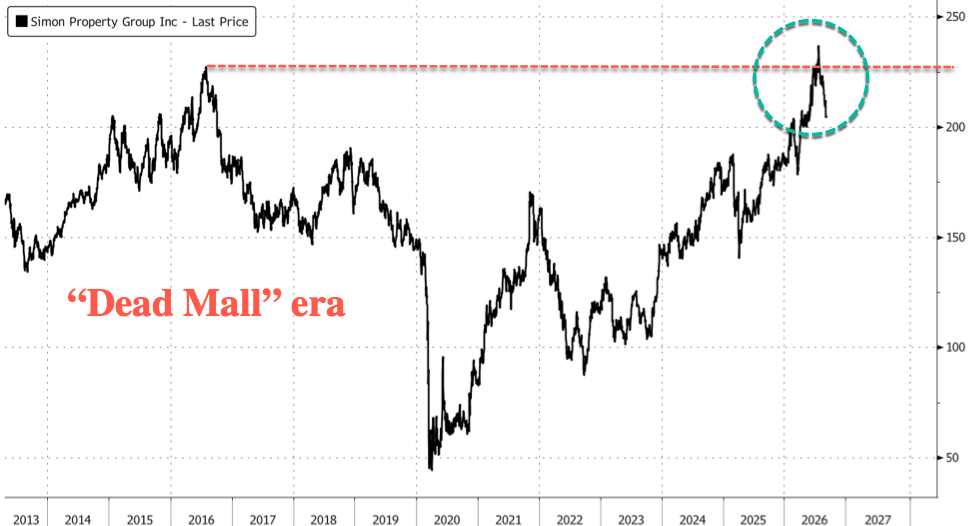
Simon Property Group, the largest US mall owner, saw its shares surpass their 2016 peak in July. That earlier peak came just as the “dead mall” narrative began to erupt in MSM headlines. The stock is up nearly 11% this year.
WSJ cited Vincent Rouget, CEO of Unibail-Rodamco-Westfield, a Paris-based CRE company, who explained that US tenant sales and net operating income growth are exceeding the company’s broader portfolio average, with rent growth at levels unseen since the early 2010s.
“We see the type of rent growth that we haven’t seen since the beginning of the 2010s,” Rouget told the outlet.
Morgan Stanley real estate research chief Ronald Kamdem said, “In terms of how we think about the malls today fundamentally, this is probably the best it’s felt post-Covid.”
The tailwinds extend beyond trophy malls. CBL Properties, which entered bankruptcy protection during the Covid pandemic, reports rising traffic and sales. Its shares have climbed 48% this year, and it has acquired five properties since July 2025 after shrinking its portfolio footprint for years.
CBL’s West County Center near St. Louis couldn’t refinance its debt in 2022, and the property was in decline but has since seen tenant sales increase by 13% since 2023.
Oversupply conditions have likely abated, as Green Street said about an estimated 200 malls have closed since 2008, leaving about 900 operating nationwide.
Resilient consumer spending has put the remaining malls on some of their strongest footing in years, and many have shifted from a department-store-led business model toward destinations built around shopping, dining, and entertainment.
Tyler Durden
Mon, 09/14/2026 – 15:45