Everyone In The Democratic Party Has Money – Except The Democratic Party
Authored by Chase Smith via The Epoch Times (emphasis ours),
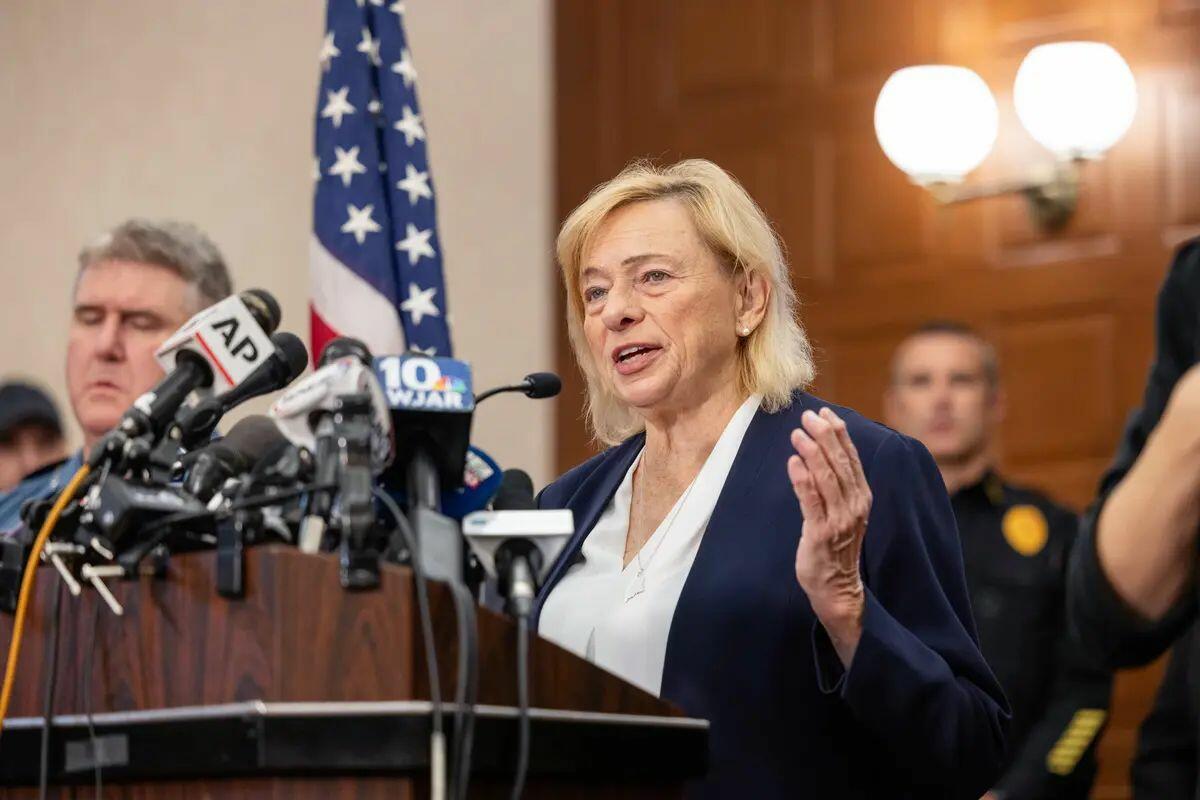
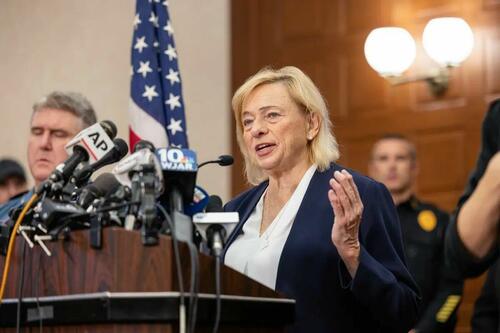
On April 30, Maine’s Democratic Gov. Janet Mills dropped out of the race for a U.S. Senate seat.
In a statement about suspending her campaign, Mills was blunt:
“While I have the drive and passion, commitment and experience, and above all else—the fight—to continue on, I very simply do not have the one thing that political campaigns unfortunately require today: the financial resources.”
As Mills said, financial resources matter in today’s political environment as campaigns grow more expensive each cycle.
First-quarter financial reports filed in April with the Federal Election Commission (FEC) show where some of that money is going—and where it is not.
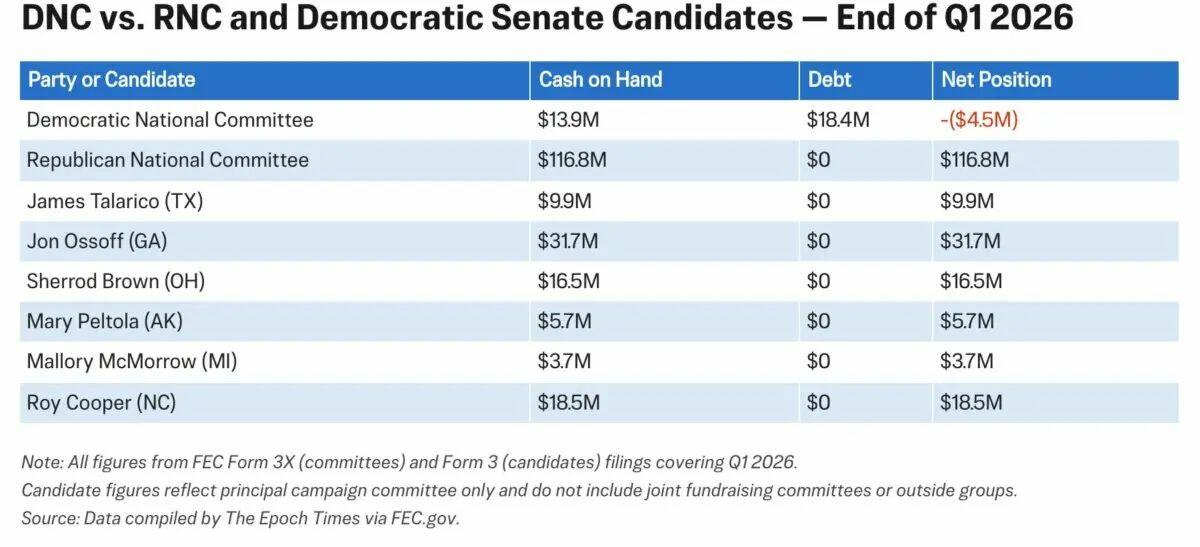
Democratic candidates across the country are raising large sums of money. Democratic Senate candidates, including Georgia Sen. Jon Ossoff, former North Carolina Gov. Roy Cooper, and former Ohio Sen. Sherrod Brown, are sitting on tens of millions of dollars with zero debt.
The party’s congressional campaign arms—the Democratic Senatorial Campaign Committee (DSCC) and the Democratic Congressional Campaign Committee (DCCC)—which work to elect Democrats to each chamber of Congress, carry zero debt and have tens of millions in cash.
On the Republican side, every major committee has a strong cash position.
Meanwhile, the Democratic National Committee (DNC) is in debt.
The Numbers
The federal filings lay out the numbers. The DNC reported $13.9 million in cash on hand at the end of March and $18.4 million in debt, putting the committee roughly $4.5 million underwater. It is the only national party committee on either side of the aisle carrying any debt at all.
The Republican National Committee, by contrast, holds $116.8 million in cash with zero debt. The National Republican Senatorial Committee (NRSC) has $43 million, and the National Republican Congressional Committee (NRCC) has $78.2 million. Neither carries debt.
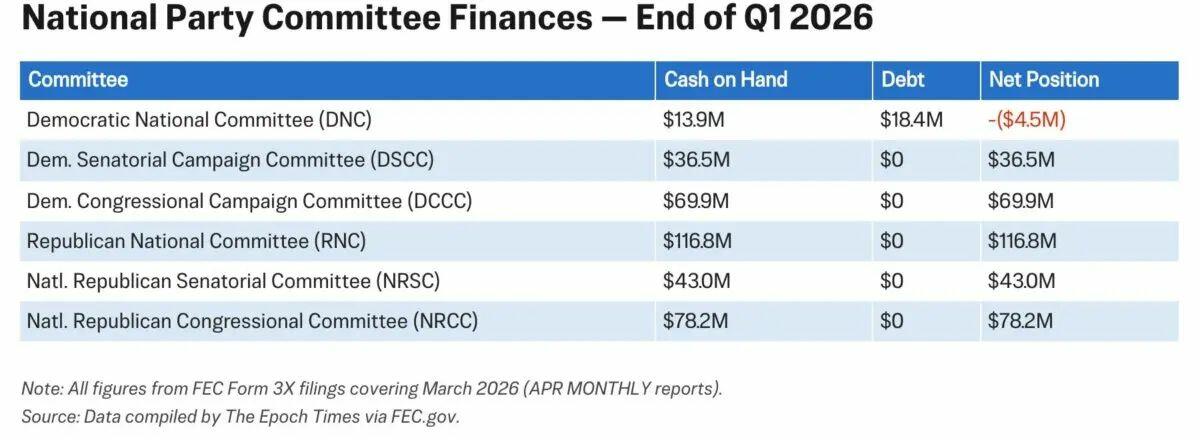
On the Democratic side, the DSCC holds $36.5 million with zero debt. The DCCC holds $69.9 million with zero debt. Both are competitive with or ahead of their Republican counterparts.
The gap widens further when individual candidates enter the picture. Six Democratic Senate candidates—Ossoff, Cooper, Brown, Texas state Rep. James Talarico, former Alaska Rep. Mary Peltola, and Michigan Sen. Mallory McMorrow—hold a combined roughly $86 million in cash on hand. Every one of them carries zero debt.
Ossoff alone has $31.7 million—more than double the DNC’s cash position and more than enough to cover the national committee’s entire debt.
‘A Severe Brand Problem’
Avis Jones-DeWeever, a political scientist and principal of progressive strategic communications firm Nouveaux Strategies, said the pattern points to something deeper than a typical post-election slump.
“The Democratic Party as a national entity has a severe brand problem,” Jones-DeWeever told The Epoch Times in an email. “Even in the midst of a historically unpopular president, they have managed to find a way to consistently garner lower favorability ratings than Donald Trump.
“There is still a sense that the Democratic Party writ large is not rising to this existential moment—that they continue to color within the lines of politics as normal, when we are far away from normal.”
The result, she said, is that donors are making a deliberate choice.
“Donors, it seems, have shifted their funds from supporting an institution they no longer trust to instead investing in individual candidates that have demonstrated strength in this moment,” Jones-DeWeever said.
“It’s not that Democratic donors are tired of giving. It’s just that they are being much more selective and targeted in their spend. They’re willing to fund a fight and are making investments in the specific fighters that they believe have the best chance at carrying them to victory in November.”
The DNC’s Position
DNC Chair Ken Martin has argued the committee’s financial position is the result of a deliberate strategy—not a crisis.
In an April 28 interview on Pod Save America—one of the most listened to Democratic podcasts on all platforms—Martin said the debt traces to a loan the committee took out in 2025 to invest early in organizing, voter registration, and state party infrastructure.
“We do have debt, Jon, and that’s because I took out a loan last year to make sure we can make deep investments,” Martin told host Jon Favreau, a former speechwriter for President Barack Obama and one of the most prominent modern voices in Democratic politics.
The DNC has pointed to those investments in its own public communications. In April 2025, the committee announced what it called the largest monthly investment into state parties in its history: a state partnership program splitting more than $1 million per month between Democratic state and territory parties.
Under the program, each state party receives a baseline of $17,500 per month, with parties in Republican-controlled states receiving an additional $5,000 per month through a “Red State Fund.”

The committee has also launched voter registration programs, a national training initiative for campaign staff, and what it describes as year-round organizing in all 50 states—efforts Martin has summarized with the phrase “organize everywhere, win anywhere.”
Martin pointed to the committee’s track record, saying the DNC raised $105 million in 2025—a record for a first-year chair—with $85 million of that coming from grassroots donors at an average contribution of $51. He said the DNC raised $32 million in the first quarter of 2026 and has more cash on hand than one of his predecessors, former DNC Chair Tom Perez, had at the same point after the party’s 2016 presidential loss.

He described the committee’s debt as manageable and strategically useful, arguing it allowed the party to spend early rather than wait until the final months before an election.
“We can pay that debt off whenever the hell we want,” Martin said. “I could hold that debt until the end of the year. So the reality is, there’s nothing that’s holding me back in terms of the cash I have, the cash on hand I have to spend it on elections.”
Martin pointed out that the committee funds infrastructure that every Democratic campaign depends on, including a voter file that costs more than $10 million a year to maintain.
“Our voter file and our organizing tools and our data, every candidate, whether they’re running for school board or president, relies on that,” he said. “Without the DNC, they would have to do that on their own.”

He also confirmed the DNC purchased the Harris campaign’s fundraising list for $6.5 million after the 2024 election, calling it “a great investment” that has “already paid for itself.”
The DNC did not respond to multiple requests for comment for this report.
‘An Issue Unique to the DNC’
Favreau pressed Martin directly on the contrast between the party’s national committees.
“You’re spending more than you have,” Favreau said. “I know it’s a tough environment for the party out of power, but the DSCC and the DCCC and the Senate candidates have plenty of money. They’re all doing great. So it seems like this is an issue unique to the DNC.”
Favreau pointed to the unreleased 2024 post-election review as a factor in donor reluctance. The review is commonly referred to as the “autopsy” of Kamala Harris’s loss, which Martin said would be made public when he ran for chair but has since said he would not release to instead focus on future races.
Favreau added: “I know the grassroots fundraising has been great. I know that. I concede that for sure. … I’ve talked to plenty of people about this, that a lot of the big donors still have not come off the sidelines, and part of the reason is that there’s a trust issue based partly on the autopsy.”
Martin disagreed. “I’m just not seeing that, Jon,” he said.

Why It Matters
For voters unfamiliar with the mechanics of campaign finance, the distinction between a national party committee and an individual campaign may not be obvious. But the two serve different functions.
National party committees serve a different function than campaigns, at least as the law allows for today. While a Senate candidate raises money to win a single race, as Martin said in the podcast interview, the DNC is responsible for infrastructure that connects all Democratic campaigns together—the voter file that every candidate “from school board to president” relies on, voter registration drives, state party support, legal challenges, and the national get-out-the-vote operation.
Parties are currently restricted to spending only a small fraction of funds in direct coordination with campaigns.
Boris Heersink, an associate professor of political science at Fordham University who has studied national party committees extensively, has argued in his research that these organizations create “national party brands” that are “fundamental to mobilizing voters in elections”—especially “when the party is in the national minority.”
Whether individual candidates can compensate—or even need to—for a national committee carrying more debt than cash is an open question heading into November.

A Pending Supreme Court Case
A pending Supreme Court ruling could change what national party committees are allowed to do with their money.
The court is expected to decide NRSC v. FEC by the end of June, and the case could strike down federal limits on how much national party committees can spend in direct coordination with their candidates.
Under current law, party committees can spend unlimited amounts independently—running ads and organizing without consulting the candidate. But the moment a committee wants to coordinate directly with a campaign—sharing strategy, co-creating ads, directing resources where the campaign wants them—federal law caps that spending.
For Senate races, those caps range from roughly $130,000 to $4 million depending on the state’s voting age population, according to the FEC’s latest coordinated party expenditure limits. For House races, the limits range from about $61,800 to $123,000. While it is a large sum of money, compared to the tens of millions it costs to run campaigns in 2026, it’s only a drop in the larger financial bucket.
The NRSC and NRCC—the Senate and House campaign arms of the Republican Party—are the plaintiffs in the case, arguing the limits violate the First Amendment. The Trump administration’s Department of Justice has declined to defend the law, agreeing the limits should be struck down. The DNC, DSCC, and DCCC have all intervened in the case to defend the existing restrictions.
Read the rest here…
Tyler Durden
Fri, 05/15/2026 – 17:00