
FOMC Minutes Show ‘A Few’ Fed Members Wanted To Hike In June, ‘Majority’ Fear Higher Inflation
Today’s FOMC minutes will be scrutinized for further insight into policymakers’ appetite for additional rate hikes and the thinking behind the Committee’s hawkish shift at last month’s meeting. The minutes are an account of the June 17th meeting and therefore will not reflect subsequent developments, including the softer-than-expected June nonfarm payrolls report or Chair Warsh’s appearance at the ECB’s Sintra Forum.
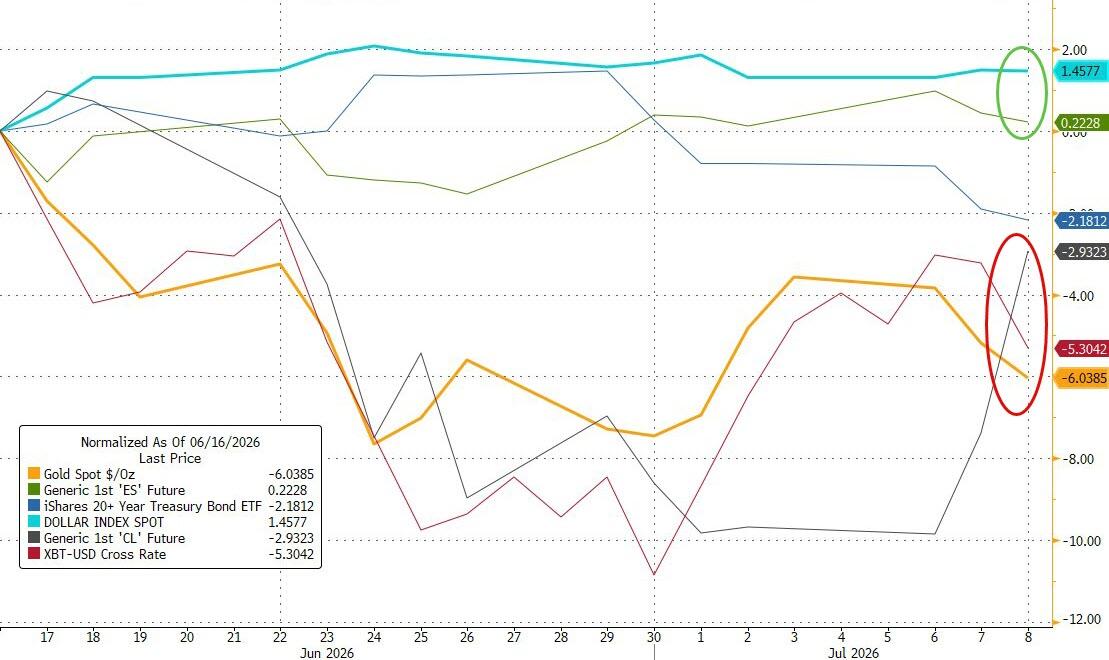
Since the last FOMC meeting (June 17th), the dollar has strengthened (on the hawkishness) and gold (and bitcoin) mirrored that with sizable declines. Stocks are flat, bond yields are higher (prices down), and oil remains lower, but accelerating in the last couple of days…
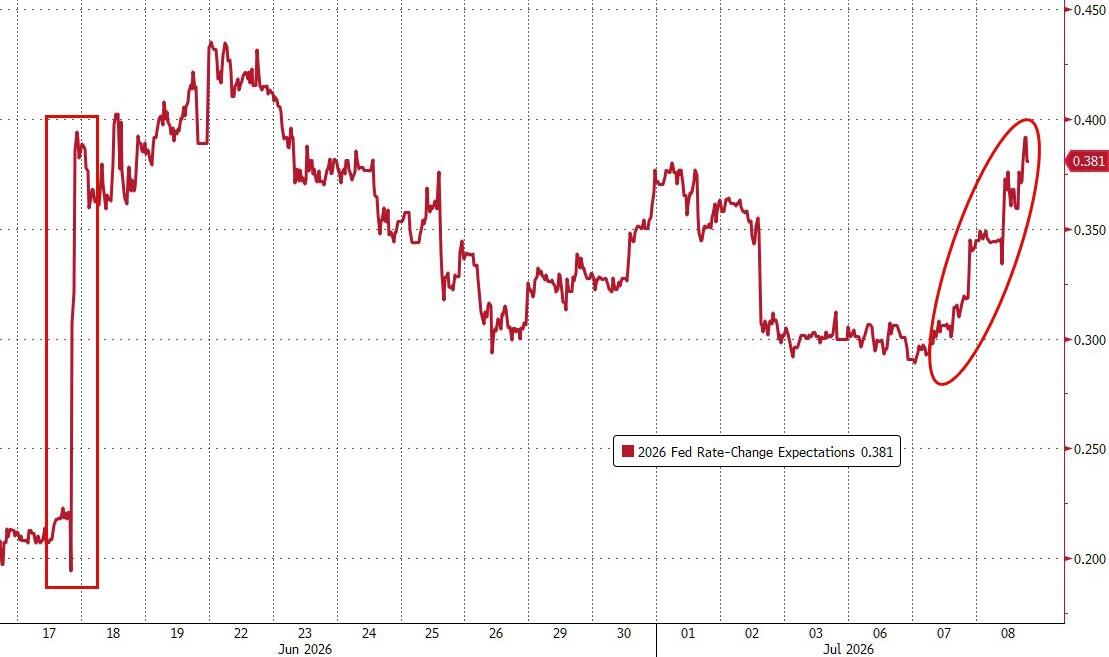
The market’s expectations for Fed actions this year have surged back near the highs (up from around 20bps pre-Warsh to around 40bps today)…
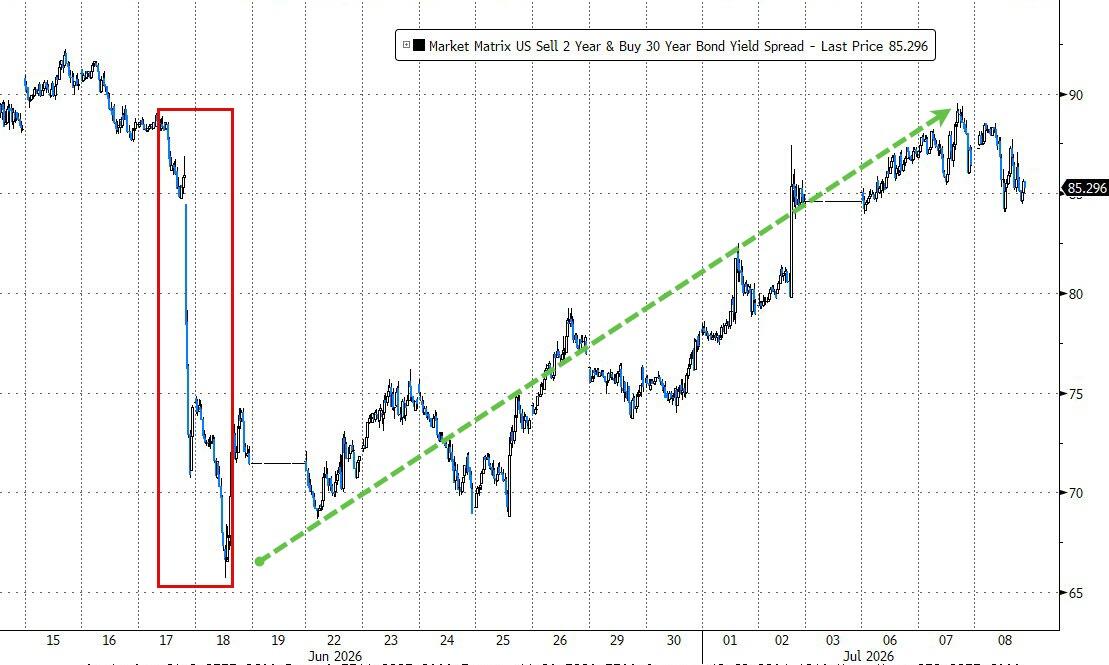
And rather interestingly, the initial dramatic flattening of the yield curve on FOMC day has been entirely erased…
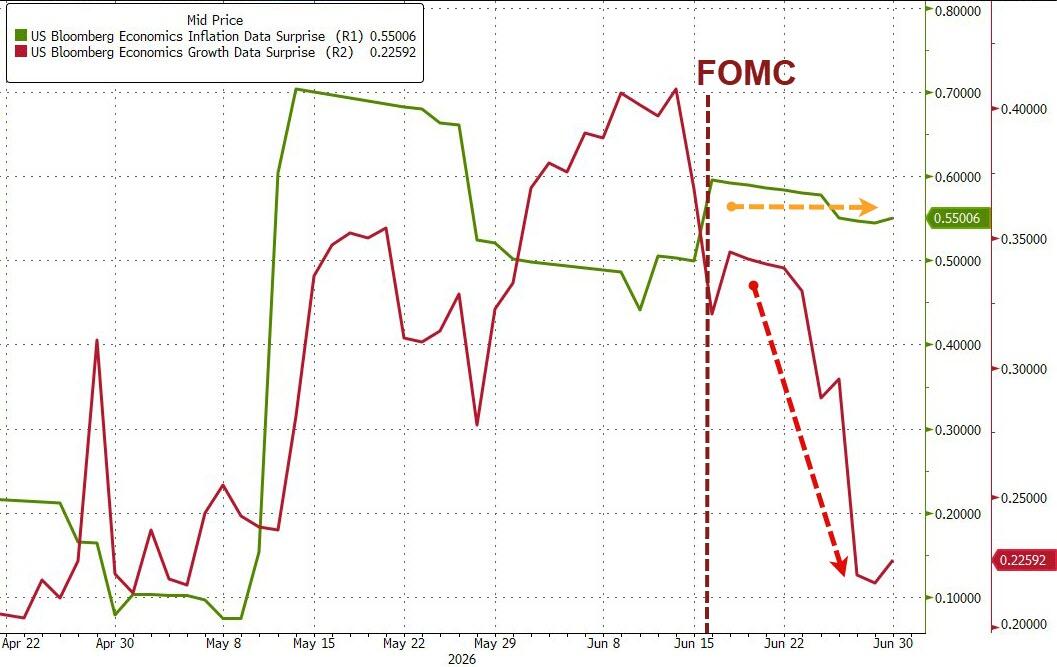
As Growth-related macro data has disappointed notably while Inflation-related macro data has remained sticky/high…
So with all that said (and with all eyes watching for confirmation of the hawkish bias), what does the FOMC want us to know about Warsh’s first meeting in charge…
FOMC Minutes summary: Participants generally saw upside risks to price stability as elevated, while downside risks to maximum employment goal had moderated a bit
-
The majority of participants commented that most measures of medium- and longer-term inflation expectations remained at levels consistent with the Committee’s 2 percent objective.
-
The majority of participants highlighted the possibility that, after several years of inflation above 2 percent, continued elevated inflation rates could begin to affect inflation expectations and wage- and price-setting decisions.
-
-
A few participants commented that, in light of these developments, there was a case for raising the target range for the federal funds rate, but those participants indicated that they supported maintaining the current target range at this meeting.
-
Several participants remarked that they did not see the current policy stance as restrictive, while a few other participants commented that they saw the current policy stance as slightly restrictive.
-
Most participants remarked that growth in economic activity that exceeded that of potential output, owing in part to strong AI business investment, could contribute to more persistent inflationary pressures.
-
With respect to household spending, most participants observed that stock market gains and federal income tax refunds sent earlier this year had provided support to consumer spending, particularly among higher-income households.
-
Most participants remarked on scenarios in which inflationary pressures would dissipate and inflation would soon begin to return to 2 percent. In such scenarios, almost all of these participants noted that it would likely be appropriate to maintain or eventually lower the target range for the federal funds rate.
-
Most participants, however, also pointed to scenarios in which, in the context of stable labor market conditions, inflation would remain elevated due to strong AI-related demand, the conflict in the Middle East, or the effects of tariffs.
-
In such scenarios, almost all of these participants indicated that some policy firming would likely be warranted to return inflation to 2 percent.
-
Most participants emphasized that they preferred not to repeat the language in the previous postmeeting statement that had suggested an easing bias regarding the likely direction of the Committee’s future interest rate decisions.
-
-
Some participants observed that the sharp rise in input costs reported in business surveys raised concerns about the potential for higher energy and commodity costs to pass through more broadly to final goods prices.
-
Several participants noted, however, that firms in their Districts reported that they had been cautious about increasing prices, citing concerns that higher prices could reduce demand or their market shares.
-
Many participants noted that ongoing strong demand for AI infrastructure would likely sustain upward pressure on prices for technology products and electricity.
-
Most participants remarked that growth in economic activity that exceeded that of potential output, owing in part to strong AI business investment, could contribute to more persistent inflationary pressures.
-
Some participants remarked that productivity gains associated with AI adoption would eventually reduce production costs and increase aggregate supply, which should put downward pressure on inflation, though they noted this effect would likely take time to materialize.
-
Several participants noted that the deceleration in housing services prices was likely to continue to be a source of disinflationary pressure.
The Fed appears to now be officially blaming AI for rise in core inflation:
“Core goods price inflation had risen relative to a year earlier, which the staff judged as largely reflecting the effects of tariffs and AI-related price pressures”
…
“Some participants remarked that productivity gains associated with AI adoption would eventually reduce production costs and increase aggregate supply, which should put downward pressure on inflation, though they noted this effect would likely take time to materialize”
Finally, a majority of participants remarked that they saw advantages in shortening the statement.
Tyler Durden
Wed, 07/08/2026 – 14:05