
How Crowded Has Mount Everest Become?
Mount Everest is seeing more human traffic than at any point in the last three decades of available data, according to Visual Capitalist’s Sofie Gilbert.
Successful climbs are now overwhelmingly concentrated in the spring, when favorable weather can funnel hundreds of climbers toward the summit within a matter of days. Meanwhile, the workforce supporting expeditions has grown alongside the number of people attempting the mountain.
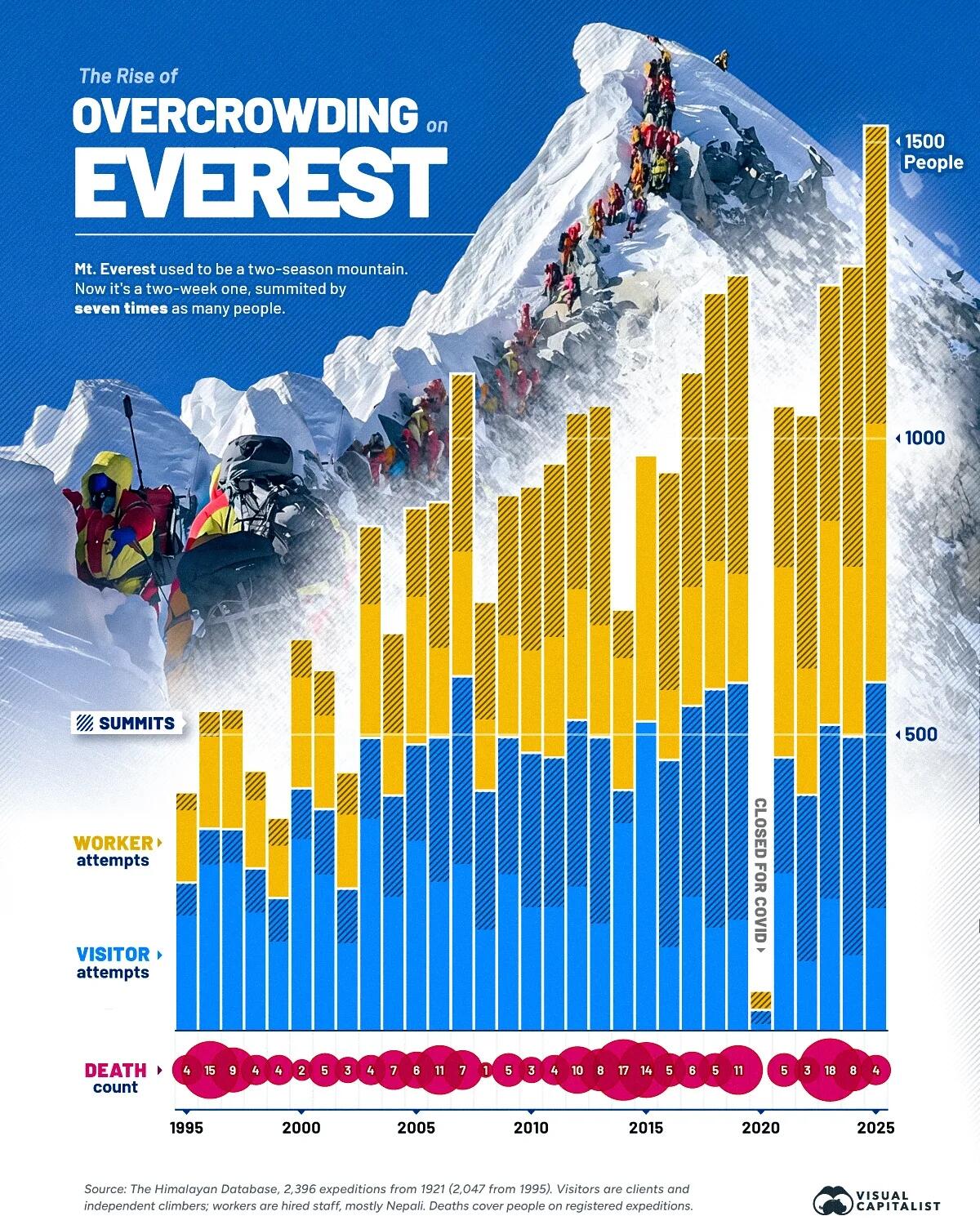
The data comes from The Himalayan Database, which tracks registered expeditions across the Nepal Himalaya. It shows how the scale, timing, and composition of Everest climbing have transformed since the 1990s.
Everest’s Climbing Boom
The number of people recorded on Everest has surged alongside the number reaching the summit.
In 2025, The Himalayan Database recorded 585 visitors and 934 hired workers on the mountain, for a total of 1,519 people. That’s nearly four times the 395 people recorded in 1995.
| Year | Visitors on the mountain | Workers on the mountain | Total |
|---|---|---|---|
| 1995 | 247 | 148 | 395 |
| 1996 | 338 | 194 | 532 |
| 1997 | 337 | 198 | 535 |
| 1998 | 271 | 160 | 431 |
| 1999 | 221 | 131 | 352 |
| 2000 | 406 | 247 | 653 |
| 2001 | 371 | 230 | 601 |
| 2002 | 237 | 192 | 429 |
| 2003 | 491 | 352 | 843 |
| 2004 | 394 | 269 | 663 |
| 2005 | 480 | 394 | 874 |
| 2006 | 492 | 392 | 884 |
| 2007 | 595 | 505 | 1,100 |
| 2008 | 402 | 314 | 716 |
| 2009 | 492 | 404 | 896 |
| 2010 | 466 | 444 | 910 |
| 2011 | 458 | 491 | 949 |
| 2012 | 521 | 513 | 1,034 |
| 2013 | 492 | 554 | 1,046 |
| 2014 | 403 | 300 | 703 |
| 2015 | 519 | 444 | 963 |
| 2016 | 454 | 481 | 935 |
| 2017 | 545 | 557 | 1,102 |
| 2018 | 573 | 664 | 1,237 |
| 2019 | 584 | 682 | 1,266 |
| 2020 | 32 | 28 | 60 |
| 2021 | 458 | 588 | 1,046 |
| 2022 | 395 | 636 | 1,031 |
| 2023 | 513 | 737 | 1,250 |
| 2024 | 493 | 789 | 1,282 |
| 2025 | 585 | 934 | 1,519 |
Visitors include clients and independent climbers, while workers are hired expedition staff, most of whom are Nepali Sherpas.
Of those on the mountain in 2025, 878 reached the summit. Across 2021-2025, Everest averaged about 720 summits per year, more than seven times the annual average of roughly 100 in 1995-1999.
Everest Has Become a Spring Mountain
Decades ago, successful Everest climbs were spread much more widely across the calendar. In the 1980s, The Himalayan Database recorded 87 spring summits and 77 autumn summits, along with successful climbs in both winter and summer. That pattern has almost completely disappeared.
| Period | Spring | Autumn | Winter | Summer |
|---|---|---|---|---|
| 1980-1989 | 87 | 77 | 9 | 9 |
| 1990-1999 | 739 | 135 | 6 | 0 |
| 2000-2009 | 3,346 | 30 | 0 | 0 |
| 2010-2019 | 5,561 | 6 | 0 | 0 |
| 2020-2025 | 3,634 | 14 | 0 | 0 |
From 2000 through 2009, more than 99% of recorded summits occurred in spring. The concentration became even more extreme in the 2010s, when the database recorded 5,561 spring summits compared with just six in autumn and none in winter or summer.
Since 2020, the pattern has remained virtually unchanged.
Hundreds Can Summit on the Same Day
Even within the spring season, summit attempts cluster around short periods of favorable weather, particularly in May.
This can create extraordinary spikes in traffic near the top of the mountain.
| Year | Total summits |
|---|---|
| 1995 | 82 |
| 1996 | 98 |
| 1997 | 85 |
| 1998 | 119 |
| 1999 | 116 |
| 2000 | 145 |
| 2001 | 182 |
| 2002 | 158 |
| 2003 | 264 |
| 2004 | 335 |
| 2005 | 307 |
| 2006 | 483 |
| 2007 | 611 |
| 2008 | 428 |
| 2009 | 463 |
| 2010 | 532 |
| 2011 | 541 |
| 2012 | 574 |
| 2013 | 680 |
| 2014 | 133 |
| 2015 | 0 |
| 2016 | 678 |
| 2017 | 680 |
| 2018 | 850 |
| 2019 | 899 |
| 2020 | 49 |
| 2021 | 462 |
| 2022 | 704 |
| 2023 | 685 |
| 2024 | 870 |
| 2025 | 878 |
On May 23, 2019, 354 people reached Everest’s summit from Nepal and Tibet combined, the highest single-day total in the dataset.
These traffic spikes are largely driven by Everest’s extreme weather. Summit attempts typically occur when the jet stream shifts away from the mountain, creating periods of lower winds before the summer monsoon arrives.
As a result, hundreds of climbers who have spent weeks acclimatizing can converge on the upper mountain during the same handful of favorable days.
The Workforce Behind Everest’s Climbing Boom
The growth of Everest climbing has also transformed who is on the mountain. In 1995, The Himalayan Database recorded about three hired workers for every five visitors.
By 2025, there were roughly eight hired workers for every five visitors, with hired workers accounting for more than 60% of all people recorded on Everest that year.
Long before most clients attempt the summit, high-altitude workers carry supplies, stock camps, and help prepare the route. Commercial expeditions also rely on guides and other staff to support climbers during weeks of acclimatization and the final summit push.
The risks faced by that workforce became especially visible during two catastrophic seasons. In 2014, all 17 deaths recorded in the database were hired workers. In 2015, when the Nepal earthquake triggered a deadly avalanche at Everest Base Camp, workers accounted for 11 of the 14 deaths recorded on registered expeditions.
| Year | Total deaths | Visitor deaths | Worker deaths |
|---|---|---|---|
| 1995 | 4 | 1 | 3 |
| 1996 | 15 | 12 | 3 |
| 1997 | 9 | 6 | 3 |
| 1998 | 4 | 4 | 0 |
| 1999 | 4 | 4 | 0 |
| 2000 | 2 | 2 | 0 |
| 2001 | 5 | 4 | 1 |
| 2002 | 3 | 3 | 0 |
| 2003 | 4 | 3 | 1 |
| 2004 | 7 | 7 | 0 |
| 2005 | 6 | 6 | 0 |
| 2006 | 11 | 7 | 4 |
| 2007 | 7 | 6 | 1 |
| 2008 | 1 | 1 | 0 |
| 2009 | 5 | 3 | 2 |
| 2010 | 3 | 3 | 0 |
| 2011 | 4 | 4 | 0 |
| 2012 | 10 | 7 | 3 |
| 2013 | 8 | 4 | 4 |
| 2014 | 17 | 0 | 17 |
| 2015 | 14 | 3 | 11 |
| 2016 | 5 | 5 | 0 |
| 2017 | 6 | 5 | 1 |
| 2018 | 5 | 2 | 3 |
| 2019 | 11 | 10 | 1 |
| 2020 | 0 | 0 | 0 |
| 2021 | 5 | 2 | 3 |
| 2022 | 3 | 2 | 1 |
| 2023 | 18 | 12 | 6 |
| 2024 | 8 | 6 | 2 |
| 2025 | 4 | 2 | 2 |
These were exceptional disaster years rather than typical seasons, but they underscore the occupational hazards faced by the workforce supporting Everest expeditions.
The Growing Human Footprint
More people on Everest also means more waste to manage. Nepal requires expeditions to remove waste, but doing so at extreme altitude is difficult and expensive.
In spring 2024, the Sagarmatha Pollution Control Committee collected 85 tonnes of waste from Everest Base Camp and higher camps, including 27.53 tonnes of human waste.
Everest’s Crowds Are Also Big Business
Everest is also a major source of income for Nepal. In 2025, the country increased the spring climbing permit fee for foreign climbers from $11,000 to $15,000, with the new rate taking effect in September.
Climbers also support guides, porters, lodges, and other local businesses, making Everest an important source of income alongside the pressures created by growing traffic.
As the highest mountain on Earth, Everest remains uniquely appealing to climbers. Three decades of data show just how much the human presence surrounding that pursuit has grown.
Tyler Durden
Mon, 10/05/2026 – 02:45