
Jet-Fuel Price Shock Hits Airlines As Raymond James Cuts Estimate Across Coverage, Warns Of JetBlue Bankruptcy Risk
As we’ve told readers, and as former Goldman commodities guru Jeff Currie explained last week, the energy crisis is not necessarily in Brent or WTI supplies, but in refined-product markets, given the diesel crack spread’s jump above $100 a barrel last week. Early Monday, the spread was trading around $94.
The secondary effects of a global refined-products crisis are beginning to hit airline earnings, according to Raymond James analyst Savanthi Syth, who wrote in a note Monday morning that she is cutting estimates across her airline coverage universe as jet-fuel prices surge.
US Gulf Coast jet fuel prices have soared 39% quarter-to-date through Aug. 19, outpacing gains of 26% in Brent and 21% in WTI. The divergence reflects yet another rising cost for airlines already confronting higher labor costs, aircraft shortages, and operational disruptions.
“We are lowering estimates across our airline coverage universe primarily to reflect a higher jet fuel price forecast (2H26E/2027E/2028E increased by ~18%/14%/7%), partly offset at non-U.S. airlines by the somewhat weaker U.S. dollar against local currencies,” Syth told clients.
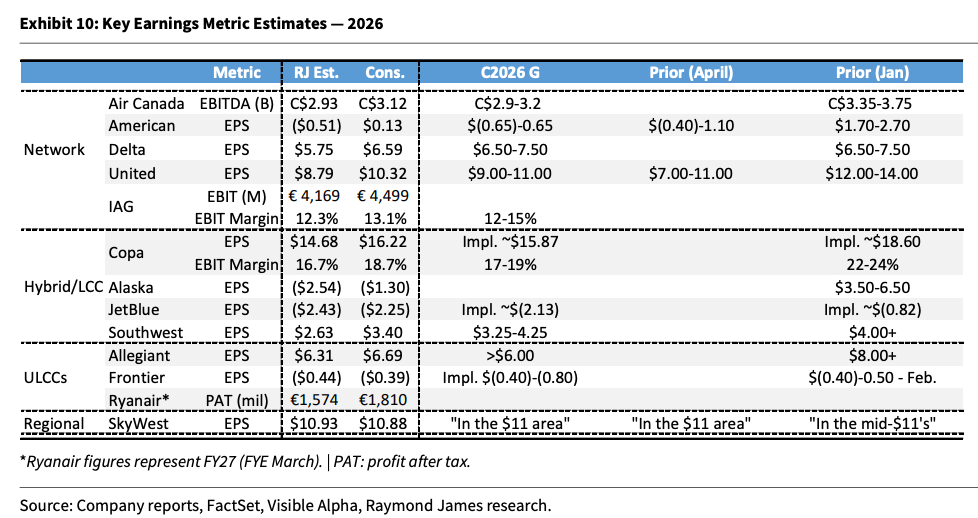
She added, “We are also upgrading ALGT from Outperform to Strong Buy following the greater QTD pullback in shares (Exhibit 11) despite a constructive backdrop (ex-fuel), including Allegiant’s idiosyncratic margin recovery levers, flexible capacity model, and now-enhanced scale following the Sun Country acquisition. Our ratings and revised target prices are summarized in Exhibit 1, while select KPIs and estimates are shown in Exhibits 8-10.”
Syth’s revised third- and fourth-quarter earnings estimates are now below Wall Street consensus for most major carriers. Her 2026 forecasts include a 51-cent loss for American Airlines, a $2.43 loss for JetBlue, and earnings of $5.75 for Delta, all below consensus.
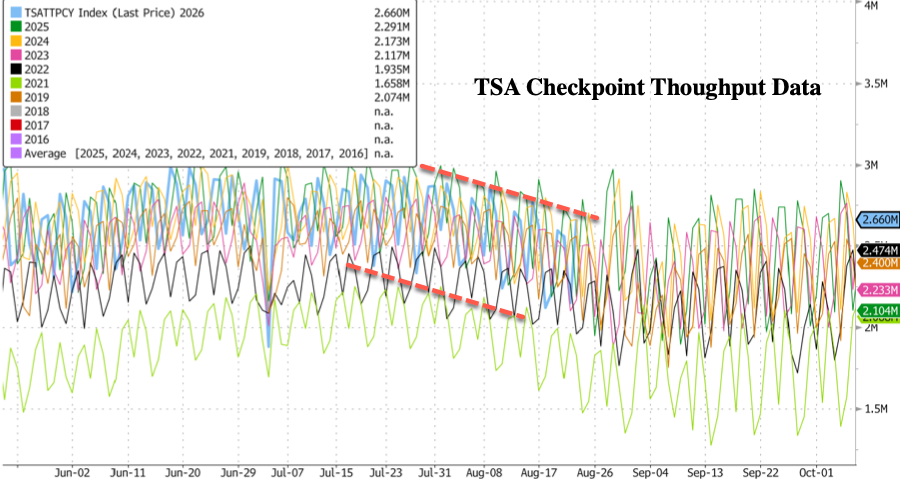
So far, passenger demand remains robust despite higher fares this summer, but the latest data from the Transportation Security Administration shows early signs of weakening in late summer.
TSA throughput data is down about 2.6% from a year earlier this quarter, compared with a 1.1% decline in scheduled seats.
JetBlue appears to be the weakest airline in her coverage. She maintained an Underperform rating, warning that a Chapter 11 restructuring may be the “more prudent” way to address the carrier’s overleveraged balance sheet.
S&P 500 Airlines Index vs. Jet-Fuel Prices
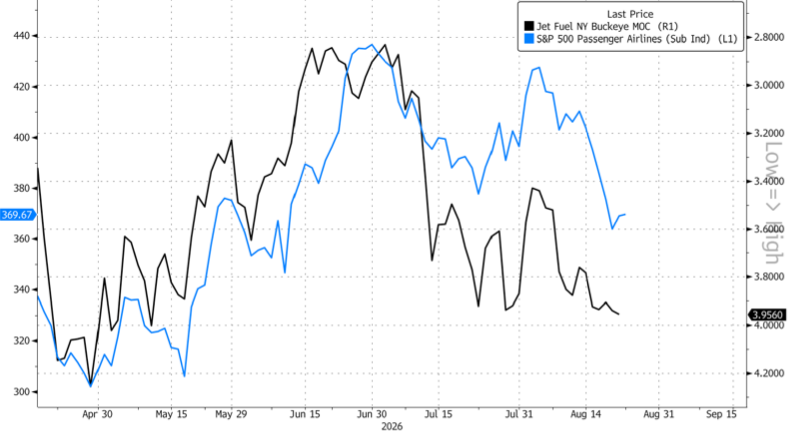
The takeaway is that the refined-products crisis, which has pushed jet-fuel and diesel prices sky-high, will begin to weigh on airlines again just as demand weakens heading into the end of summer.
Tyler Durden
Mon, 08/24/2026 – 12:00