
Key Events This Week: Fed, BOJ And BOE; Also Retail Sales, Import Prices And Bessent
It’s a bumper week for central bank decisions, with the Fed (Wednesday), BoE (Thursday) and BoJ (Friday) all meeting. Central banks aside, key data releases include US retail sales (Wednesday) and industrial production (Friday), UK inflation (Wednesday) and labor market data (Tuesday), economic activity in China (tomorrow), and inflation and trade in Japan (Friday and Wednesday respectively). Other events include the annual testimony of the US Treasury Secretary namely Bessent (tomorrow), and the State of the Union address in Europe (Wednesday).
Delving into more detail now, DB’s Jim Reid writes that the main event for markets will be the Fed’s decision on Wednesday. Deutsche economists have long expected a 25bp rate hike with the market now at 87% this morning up from around 35% two Friday’s ago just before Warsh’s Jackson Hole speech. Such a move would take the target range to 3.75%-4.00%. DB economists believe the accompanying projections are likely to show a somewhat stronger growth outlook alongside still-elevated inflation. They have also added an extra hike in March to their forecast which now makes it 75bps of hikes over the next 7 months. A big focus will be Warsh’s press conference and how he squares the circle between a dislike of forward guidance and calming markets which are baying for more info.
Friday’s inflation data strengthened the case for action this week. Core CPI rose by 0.29% in August, a touch above expectations and up from 0.22% in July. The details were also firm, with notable strength in wireless services, airfares and lodging-away-from-home prices. Meanwhile, last Thursday’s PPI report contained hawkish elements, including stronger hospital and international airfare prices. Combining the latest CPI and PPI data, DB economists estimate August core PCE increased by 0.27%, a pace they do not view as consistent with sufficient progress back towards the Fed’s inflation target.
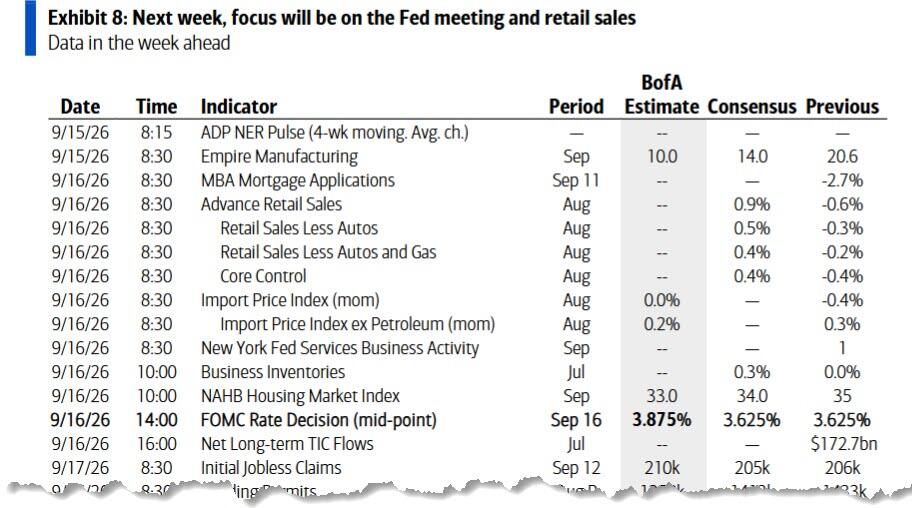
Attention will now turn to incoming US activity data. Tomorrow, markets will receive Treasury Secretary Bessent’s annual testimony before the House Financial Services Committee. On Wednesday, August US retail sales are released and economists expect a rebound to +0.8% month-on-month, following July’s -0.6% decline. They also forecast ex-auto sales at +0.5% and retail control sales at +0.4%, arguing that July’s weakness looked more like a temporary pause in consumer spending than the start of a broader slowdown. On Friday, industrial production is due and economists expect growth to edge up to +0.3% from +0.2% previously.
Looking beyond the US, the BoE announces its latest policy decision on Thursday. DB economists expect Bank Rate to remain unchanged at 3.75%, with a 6-3 voting split, and continue to see the MPC remaining relatively cautious compared with some other major central banks. However, the bond market and energy moves at the end of the week make it a closer call than it was, with futures pricing in a 23% probability of a move, up from under 10% early last Thursday. Before that, UK labor market data are released tomorrow, while August CPI is due on Wednesday. Economists expect headline inflation to rise to 3.04% YoY, while core CPI eases slightly to 2.53% YoY. UK retail sales, together with the GfK consumer confidence survey, follow on Friday.
In Asia, the BoJ concludes its meeting on Friday. DB’s economists expect a 25bp rate hike (futures price in a 98% probability now), and argue that external considerations, including pressure for greater FX stability, are likely to be at least as important as domestic economic fundamentals in driving the decision. Japan also releases trade data and core machine orders on Wednesday, followed by national CPI on Friday, where DB economists expect core inflation excluding fresh food to remain at 1.8% YoY.
China’s August activity indicators are released tomorrow. DB economists expect industrial production growth to accelerate to 5.0% YoY from 4.5%, while retail sales and fixed-asset investment should also improve. Elsewhere, Germany’s ZEW survey is due tomorrow, while the ECB publishes its consumer expectations survey on Friday.
On the political front, the European Commission President delivers the annual State of the Union address on Wednesday, setting out priorities for the year ahead. Finally, the NATO’s Military Committee Conference takes place in Copenhagen at the end of the week.
Courtesy of DB, here is a day by day recap of the week’s main events:
Monday September 14
- Data: Japan July capacity utilisation, Canada August CPI, July manufacturing sales
- Central banks: ECB’s Lagarde, Schnabel and Cipollone speak
Tuesday September 15
- Data: US September Empire manufacturing index, China August retail sales, industrial production, home prices, investment, UK July average weekly earnings, unemployment rate, August jobless claims change, Germany August wholesale price index, September Zew survey, Italy July trade balance, general government debt, Eurozone September Zew survey, July trade balance, Canada August existing home sales, July wholesale sales ex petroleum
- Central banks: ECB’s Cipollone and Reinesch speak
- Auctions: US 20-yr Bond (reopening, $13bn)
- Other: Annual testimony of the Secretary of the Treasury on the state of the international financial system before the House Financial Services Committee
Wednesday September 16
- Data: US September NAHB housing market index, New York Fed services business activity, August retail sales, import price index, export price index, July business inventories, total net TIC flows, UK August CPI, RPI, PPI, July house price index, Japan August trade balance, July core machine orders, Eurozone July industrial production, Canada August housing starts, July building permits
- Central banks: Fed’s decision, ECB’s Vujcic speaks, BoC’s summary of deliberations
- Other: European Commission President von der Leyen President delivers the State of the Union address to the European Parliament
Thursday September 17
- Data: US September Philadelphia Fed business outlook, August housing starts, building permits, pending home sales, initial jobless, Canada August industrial product price index, raw materials price index, July international securities transactions, New Zealand Q2 GDP
- Central banks: BoE’s decision, ECB’s Lane and Rehn speak
- Auctions: US 10-yr TIPS (reopening, $19bn)
Friday September 18
- Data: US August industrial production, capacity utilisation, leading index, UK September GfK consumer confidence, August retail sales, Japan August national CPI, Germany August PPI, Italy July current account balance, Eurozone July ECB current account, construction output
- Central banks: BoJ’s decision, ECB’s consumer expectations survey
- Other: NATO’s Military Committee Conference (Sep. 18-19)
Finally, looking at just the US, the key economic data releases this week are the import prices report — because of its potential implications for core PCE — and the retail sales report on Wednesday. The September FOMC meeting is on Wednesday. The post-meeting statement will be released at 2:00 PM ET, followed by Chairman Warsh’s press conference at 2:30 PM.
Monday, September 14
- There are no major economic data releases scheduled.
Tuesday, September 15
- 08:30 AM Empire State manufacturing survey, September (consensus 15.0, last 20.6)
Wednesday, September 16
- 08:30 AM Retail sales, August (GS +0.6%, consensus +0.8%, last -0.6%); Retail sales ex-auto, August (GS +0.6%, consensus +0.5%, last -0.3%); Retail sales ex-auto & gas, August (GS +0.5%, consensus +0.4%, last -0.2%); Core retail sales, August (GS +0.6%, consensus +0.4%, last -0.4%): We estimate nominal core retail sales increased 0.6% in August (ex-autos, gasoline, and building materials; month-over-month SA). Our forecast in part reflects a 0.4pp boost from a rebound in the nonstore retailers category, which was depressed in July by an earlier-than-usual Amazon Prime Day. (Amazon Prime Day is normally conducted in July—and the seasonal factors expect high July sales as a result—but was held in June this year). We estimate nominal headline retail sales increased 0.6%, reflecting higher gasoline prices and auto sales but limited growth in food services and building materials sales.
- 08:30 AM Import price index, August (consensus +0.5%, last -0.4%): The import prices report contains the remaining source data relevant to estimating August core PCE: the import price index for air passenger fares. Based on the details of last week’s CPI and PPI reports, we currently estimate that the core PCE price index rose 0.26% in August, corresponding to a year-over-year rate of +3.16% after accounting for our forecast of the revisions that will result from the methodological changes that will be implemented with the August PCE report.
- 10:00 AM Business inventories, July (consensus +0.8%, last flat)
- 10:00 AM NAHB housing market index, September (consensus 34, last 35)
- 02:00 PM FOMC statement, September 15-16 meeting: As discussed in our FOMC preview, the FOMC is likely to raise the funds rate to 3.75-4.00%. Although the August CPI report had little impact on our inflation view, it pushed market pricing of a hike to nearly 90%, high enough that the FOMC will likely want to avoid the market reaction that would likely follow from remaining on hold. We continue to expect two cuts in 2027 but now expect them in September and December (vs. June and December previously) and have raised our forecast for the terminal rate to 3.25-3.5% (vs. 3-3.25% previously). We suspect that the FOMC will want to nudge the market away from pricing an October hike too confidently but will not do it in the statement. Instead, Chairman Warsh would likely hint in his press conference at waiting a bit longer to collect more information before deciding on further steps. The key question for the meeting is whether the median dot will show one hike or two in 2026. We expect a 10-8 majority to show one hike because some participants might be ambivalent about the first hike and some might want to avoid pushing market expectations any higher.
Thursday, September 17
- 08:30 AM Philadelphia Fed manufacturing index, September (GS 30.0, consensus 32.1, last 47.4)
- 08:30 AM Initial jobless claims, week ended September 12 (GS 195k, consensus 208k, last 206k); Continuing jobless claims, week ended September 5 (consensus 1,780k, last 1,774k): We estimate that initial claims declined by 11k to 195k in the week ended September 12, reflecting difficulties seasonally adjusting around the Labor Day holiday, which occurred relatively late this year.
- 08:30 AM Housing starts, August (GS +8.9%, consensus +6.9%, last -12.4%); Building permits, August (consensus -1.5%, last +4.3%): We forecast that housing starts increased by 8.9%, primarily reflecting significant increases in building permits last month.
- 10:00 AM Pending home sales, August (GS -2.0%, consensus flat, last -2.3%)
Friday, September 18
- 09:15 AM Industrial production, August (GS +0.4%, consensus +0.3%, last +0.2%); Manufacturing production, August (GS +0.4%, consensus +0.3%, last +0.2%); Capacity utilization, August (GS 76.4%, consensus 76.4%, last 76.3%): We estimate industrial production increased by 0.4% in August, largely reflecting strong auto and electricity production. We estimate capacity utilization edged up to 76.4%.
- 09:30 AM Fed Vice Chair for Supervision Michelle W. Bowman speaks: Fed Vice Chair for Supervision Michelle W. Bowman will deliver a speech on stress testing in London. Speech text and Q&A are expected.
- 11:45 AM Kansas City Fed President Schmid (FOMC non-voter) speaks: Kansas City Fed President Jeff Schmid will speak on payments and banking at the Independent Community Bankers of Colorado Annual Convention. Speech text and Q&A are expected. On August 4, Schmid said that “inflation has been too high across a broad-based and growing cross-section of goods and services.” He further explained on August 27 that he believes interest rates “might be accommodative on the short end” and that he likely would have dissented at the July FOMC meeting.
Source: DB, Goldman, BOfA
Tyler Durden
Mon, 09/14/2026 – 10:15