
Morgan Stanley Projects SpaceX Revenue Hitting Stratospheric $3.4 Trillion In 2040, $2.7 Trillion In EBITDA
Yesterday we shared a forensic analysis of the mechanics of the $75 billion SpaceX IPO and how to trade it, while specifically saying we are leaving the fundamentals aside. The reason for that is that the historicals of the company are, to put it mildly, problematic when it comes to projecting how the company grows into a multi-trillion behemoth.
As a reminder, SpaceX posted revenue of just under $20 billion for the LTM period, with approximately $6 billion EBITDA and loss of $4 billion, virtually all driven by the conglomerate’s Connectivity (Starlink) division and to a lesser extend, the Launch Services division. Solid numbers on their own, but do they justify a $1.75 trillion in valuation?
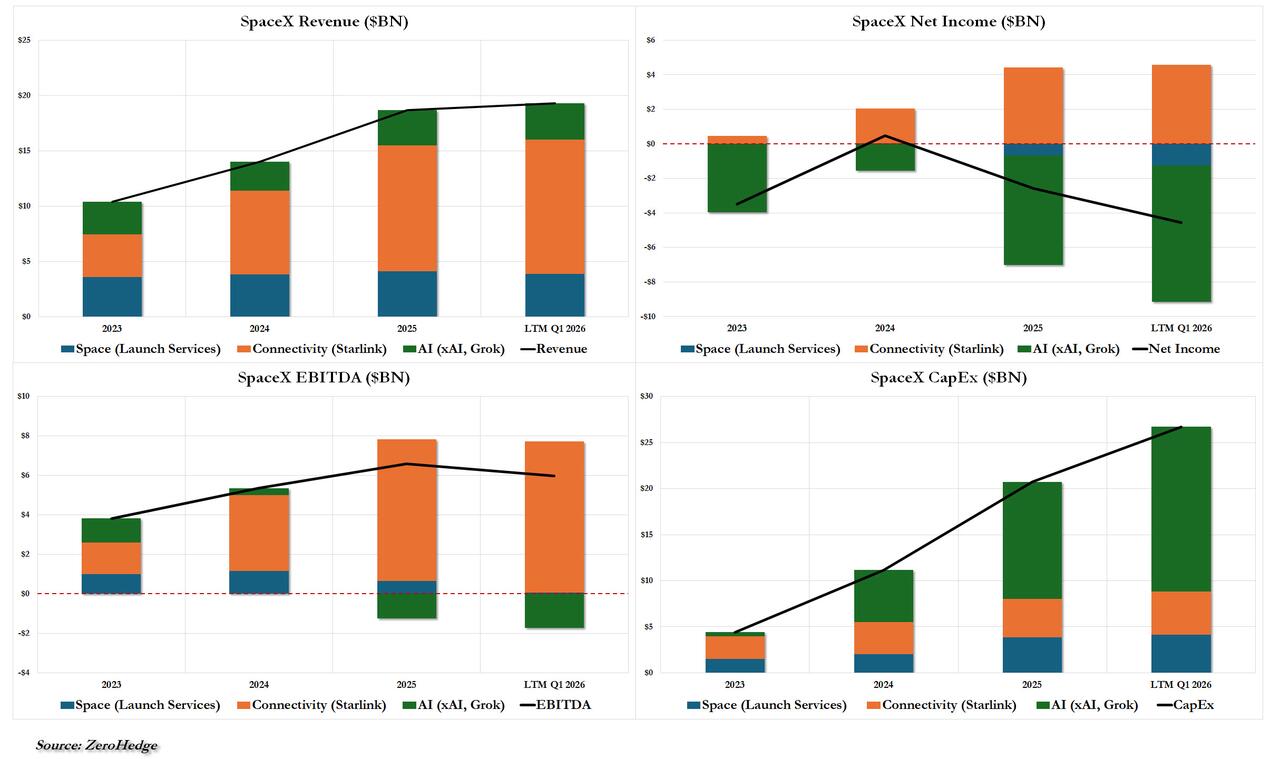
So how exactly does SpaceX get from here to there?
We got the answer this morning courtesy of the WSJ which got its hands on an analysis shared by Morgan Stanley with top investors.
Needless to say, to support the $1.77 trillion valuation Elon Musk’s SpaceX is targeting in its IPO, bankers are telling investors to look to the future…. far into the future.
Morgan Stanley projects that SpaceX’s revenue could reach $3.4 trillion in 2040. The bank told investors the rocket maker’s adjusted EBITDA in 2040 could top $2.7 trillion, or a largely unheard of 80% EBITDA margin.
Some more details: the WSJ also notes that sellside analysts at Goldman Sachs and Morgan Stanley both projected SpaceX’s revenue would be near $160 billion in 2028, up from $20 billion currently. Goldman estimated that the rocket company’s revenue would exceed $470 billion in 2030, while Morgan Stanley projected it would reach nearly $330 billion. Goldman and Morgan Stanley expect SpaceX to have adjusted EBITDA of around $110 billion in 2028 and $352 billion and $230 billion, respectively, in 2030.
Using these data, we have charted how SpaceX revenue and EBITDA would have to grow (assuming a 2028 baseline of $160BN in revenue and $110 billion in EBITDA). The projection is… aggressive.
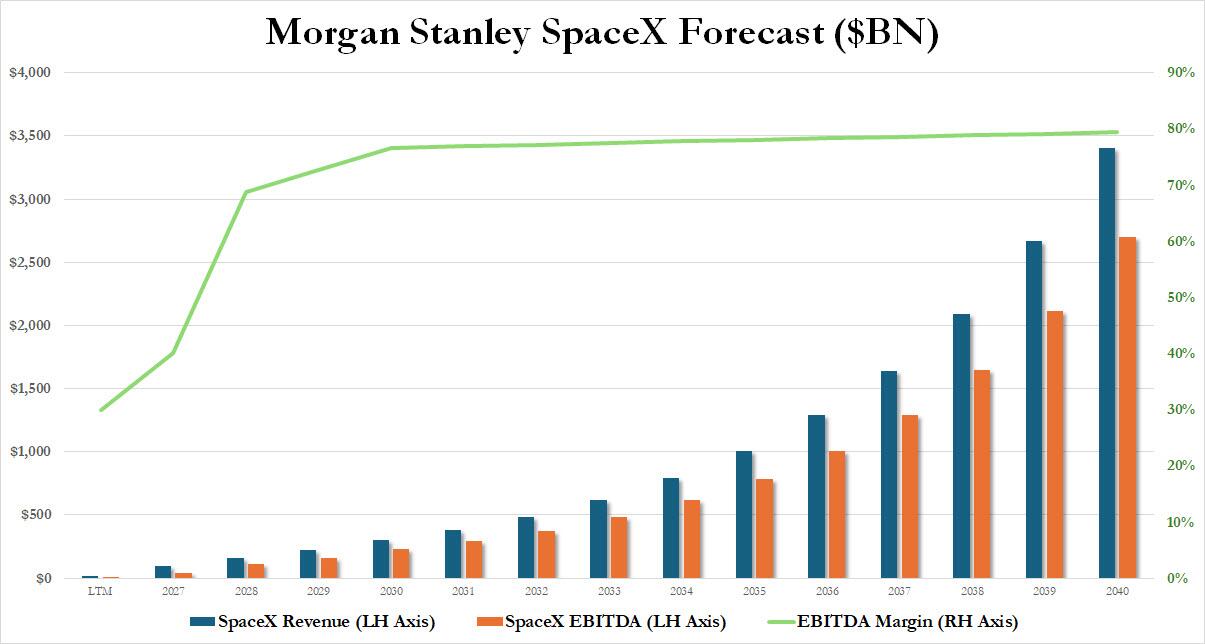
To get to those stratospheric – no pun intended – levels, both banks anticipate revenue from SpaceX’s AI business to provide the bulk of the revenue after this year and grow dramatically. Goldman projected that unit would contribute around $322 billion in 2030, while Morgan Stanley projected around $190 billion that year. SpaceX reported revenue from its nascent AI division of $3.2 billion in 2025.
Goldman and Morgan Stanley are certainly redefine the hockeystick when it comes to the SpaceX IPO: the two banks snagged the top two roles out of the 21 banks on SpaceX’s IPO, putting their banks in line to get the biggest shares of the hundreds of millions of dollars of fees. Which is why if for whatever reason the IPO bombs or fails to launch they stand to lose the most.
So will people “buy” these ludicrous projections? Well, according to Bloomberg, with one week left to go until the actual IPO, the offering is already oversubscribed.
- *SPACEX IPO IS SAID TO DRAW MORE ORDERS THAN SHARES AVAILABLE
This means that the deal will almost certainly price at Musk’s desired offering price of $135. What happens after that is anyone’s guess.
Tyler Durden
Fri, 06/05/2026 – 12:05