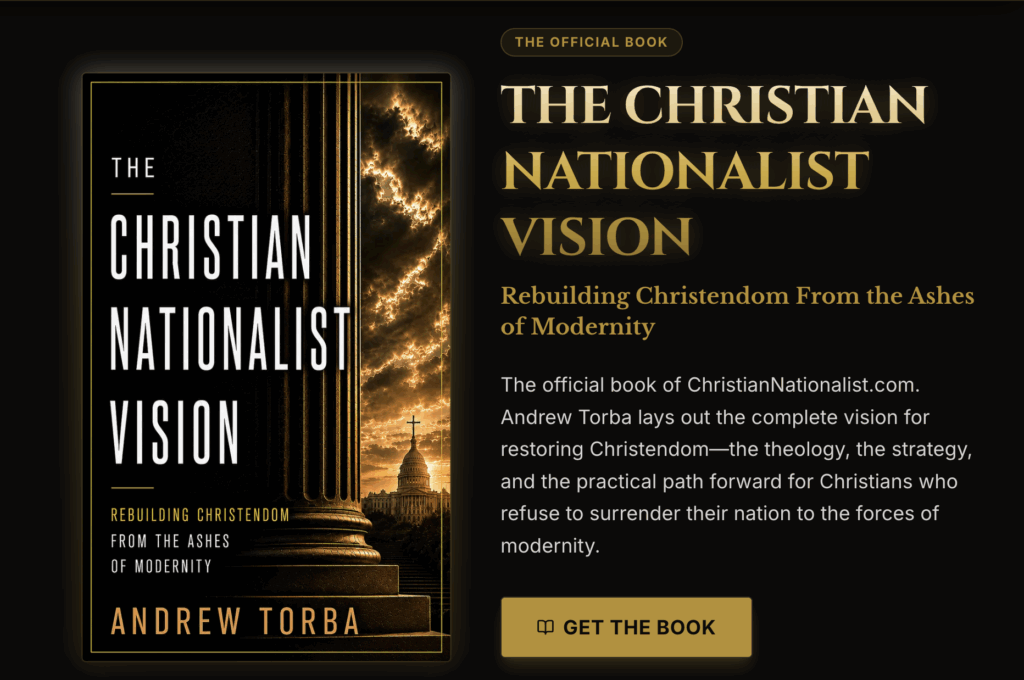
The following post is the prologue to my new book The Christian Nationalist Vision.
My journey to Christian Nationalism started with repentance. I grew up in the church and I never stopped believing in Jesus Christ, but like a lot of men I learned to keep Him in a box. Jesus was for my private anxieties and my whispered prayers when things went wrong. He could have the parts of life that felt spiritual, but He could not have my ambition, my work or my public life because those belonged to a different kingdom with different rules. I had not rejected Christ I had simply accepted the terms of His house arrest under modernity, but it took me a while to figure out that I was the one holding the door shut.
That is the training we all receive in our liberalized society whether we can see it or not. We are told to keep our faith private and interior. Keep it out of business, politics, education and media. The world will tolerate a Jesus who comforts individuals, but it will not tolerate a Jesus who rules. It will let you have your little sanctuary as long as you never suggest that the King who reigns there also reigns over everything outside the doors. I accepted this arrangement without ever consciously deciding to because the alternative had never occurred to me. That was, until I moved to Silicon Valley.
From a young age I was building things on the internet. That was the dream sold to ambitious young men of my generation: go to Silicon Valley, start a company, disrupt something, and make your mark. I started my first tech business as a college sophomore and by the time I graduated it was growing. I applied to Y Combinator, an infamous startup accelerator in Silicon Valley akin to a Harvard for technology companies, and in the winter of 2015 I got in. By every measure that the world cares about I had arrived. I had the product, the team, the network and the validation. I was inside the center of the future.
What I found when I got there was a religious order pretending to be an industry. Everyone spoke the same language about openness, progress and innovation, but underneath the vocabulary was a fully formed theology with its own priesthood, its own saints and its own account of what salvation looks like. It was not neutral and it was not merely secular either. It was missionary and its mission was building a world that had no place for the God who made it. I was surrounded by people who openly despised Christianity while enjoying all the fruit of the civilization Christianity had built and the contradiction did not seem to bother anyone but me.
I worked alongside some of the most powerful names in the industry and what I learned up close was not what I expected. Men I had admired from a distance turned out to be fools with impressive credentials. They had money and influence, but very little wisdom. The machinery they were building was an apparatus of control and that became much more apparent in 2015 when the mask started slipping as we entered the most radical election cycle of our lives. I watched the same people who preached openness and free expression suddenly discover limits and start to censor ordinary Americans. They were not just defending their power they were defending their core religion of liberalism and they were willing to destroy anyone who threatened it.
I built Gab in response to this because something had to be built. The idea was simple: a platform where speech was governed by the First Amendment rather than the whims of Silicon Valley’s moral enforcers. We launched it in a weekend, and within weeks hundreds of thousands of people signed up. Then the attacks started. Journalists who had been friendly on the phone published articles calling me an extremist the next morning. The people I had met in Silicon Valley started accosting me or cut me off completely. Banks dropped us. Payment processors cut us off. App stores banned us. The full weight of the regime’s infrastructure warfare came down on a startup that had done nothing more threatening than refuse to censor its users.
It took me longer than it should have to see that free speech was only the surface. The deeper issue was theological. Why did every institution move in the same direction? Why did the schools and the banks and the platforms and the media and even many churches share the same hostility toward Christian truth? Why did every gatekeeper protect the same lies and punish the same truths? The answer was waiting for me as soon as I was ready to stop evading it: they hated the rule of Jesus Christ, and as a Christian I had been living as if that rule did not apply to the public world.
That realization led to my repentance and forced me back to questions I should have been asking all along. If Christ is Lord, why had I let Him be Lord of my private feelings and nothing else? If He holds all authority in heaven and on earth, why had I acted as if the earth was on loan to someone else?
I went to Silicon Valley chasing the world’s approval and God used that pursuit to show me what the world actually is. So I repented and leaned into my faith in a very public way for the first time. That is how I arrived at Christian Nationalism. Not as a political strategy or a way to “own the libs.” I arrived because every honest question I asked led to the same answer: Christ is King. Either Christ is King of everything or He is king of nothing. There is no in between. Once that clicked there was no going back. I couldn’t play pretend anymore and I refused to bite my tongue in a world that had grown so hostile to this foundational truth, the very bedrock upon which our civilization was built.
This book is my refusal to keep that answer private. It builds on the ground I laid with Pastor Andrew Isker a few years ago in our first book Christian Nationalism, but the vision has sharpened since then. The last several years have tested assumptions, exposed false friends and forced the serious people to think harder about what it actually means to rebuild rather than just critique. I have met too many men who can explain every institutional failure in America and cannot point to a single thing they have built. Critique is necessary and I will do some of it in this book, but critique alone eventually becomes another hobby for spectators. The hour at hand demands builders and builders need more than tweets about what went wrong. They need to know what to construct, how to construct it and what kind of men are required for the work.
I have spent the last decade building digital infrastructure, articulating ideas, and making sure that the rightward portion of the coming generation’s radicalization had a place to land. Young men and young women are angry, and they should be. They have been robbed of their inheritance, lied to about their history, and told to apologize for existing. They are not going to respond with polite letters to the editor or by voting harder. They are going to respond with fire. My goal has always been to channel that fire into something constructive: faith, family, nation, and the long work of rebuilding.
This movement is bigger than me and I have deliberately kept it that way. God gave me a large microphone, but I am by no means the leader of His movement. I am one father among many faithful men trying to secure a future for my children. Over the past few years I have turned down interviews, podcasts and speaking invitations because I do not want the vision reduced to a personality. Christian Nationalism cannot become another online project built around a single voice, because single voices eventually go silent. If the work is real it will continue long after everyone currently doing it is buried. Myself included.
Pursuing this vision has cost me tremendously. Over the past decade my family and I have dealt with an endless barrage of death threats, bomb threats, doxxing, subversive actors, legal headaches, foreign nation states calling me out by name, Congressional committee investigations, organizations like the ADL and SPLC painting a target on my back, and hundreds of mainstream media articles defaming me. At one point I couldn’t even open a simple checking account for months without it being shut down. I could have kept my mouth shut and had a nice comfortable life in the tech industry making a lot of money, but no amount of money is worth my soul. I don’t fear any of the powerful people who have been doing these things to me for the past decade, I fear standing before God and Him asking me why I was silent. I want to be able to look my children in the eyes and tell them that I did everything I could and fought as hard as possible to ensure they had a future, a home, a people, and a faith worth inheriting. I know that one day I will stand before my King in fear and trembling longing to hear the words “well done, my good and faithful servant.” That is my “why.” If you are serious about your faith this must become your why too.
I want to stress that we are not inventing something new here. We are recovering something so old that most Christians have forgotten it was ever ours. The confession that Christ is King over nations did not start with online memes. It runs through Augustine, the Byzantine fathers, the Anglican divines and the faithful believers of every century who understood that the Great Commission is a command to disciple nations, not just individuals. We are heirs of that tradition, but we are also laying out a vision for a Christian future that takes seriously the world we actually live in today. We can learn from and honor our past, but we cannot return it. We have to build in the time and place God has given us and grapple with things like artificial intelligence, global realignment and the demographic collapse unfolding all around us. We are advancing the Kingdom in the here and now rather than pining for a past that will not return.
Better men than I have preached before kings, built churches in hostile lands and raised families under persecution. They have governed justly and handed down the faith when the world told them to be silent. I stand in their debt and this book is an attempt to be worthy of what they passed down. Its purpose is to point beyond all of us to the King, the Kingdom and the work that remains to be done. So to sum it up: Christ is King and everything else in this book is just working out the implications.
Andrew Torba
July 4th, In The Year Of Our Lord 2026