
Seagate, Western Digital Crater After Toshiba Breaks Hard-Drive “Supply Discipline” Pact
For most of 2026, the bull case for the HDD duopoly could be summarized in one sentence: nobody is building new factories. On Friday, someone did.
Shares of Seagate (STX) and Western Digital (WDC) tumbled more than 10% on Friday, standing out like a sore thumb on a day when the Nasdaq hit all-time highs, after Nikkei reported that Toshiba plans to double its hard disk drive production capacity to grab a bigger slice of the AI data center storage boom. As Goldman’s TMT desk summarized the Nikkei story first thing in the morning:
Japanese technology group Toshiba plans to double production capacity for hard disk drives used in artificial intelligence data centers within fiscal 2027 as the AI boom propels data storage demand. The company will invest roughly 60 billion yen ($380 million) to expand facilities in the Philippines… The Japanese player’s share by storage capacity stands at just over 10%, but it aims to reach 30% in the medium term. The Philippine expansion marks the company’s first major HDD investment in around five years. Along with adding production lines at the plant, Toshiba will handle new products that increase per-unit memory capacity by as much as 40%.
By midday, Goldman’s US equities desk flagged the “memory names, WDC (-10.9%) and STX (-11.6%)” as the “standout laggards” in an otherwise green tape, where AI winners were up 1.4% and NDX and NVDA had just printed all-time highs.
To be sure, a 10% drop is a flesh wound for stocks that have tripled. Even after Friday’s puke, STX is still up some 208% YTD and WDC is up 141%, compared to a “mere” 22% for the Nasdaq 100.
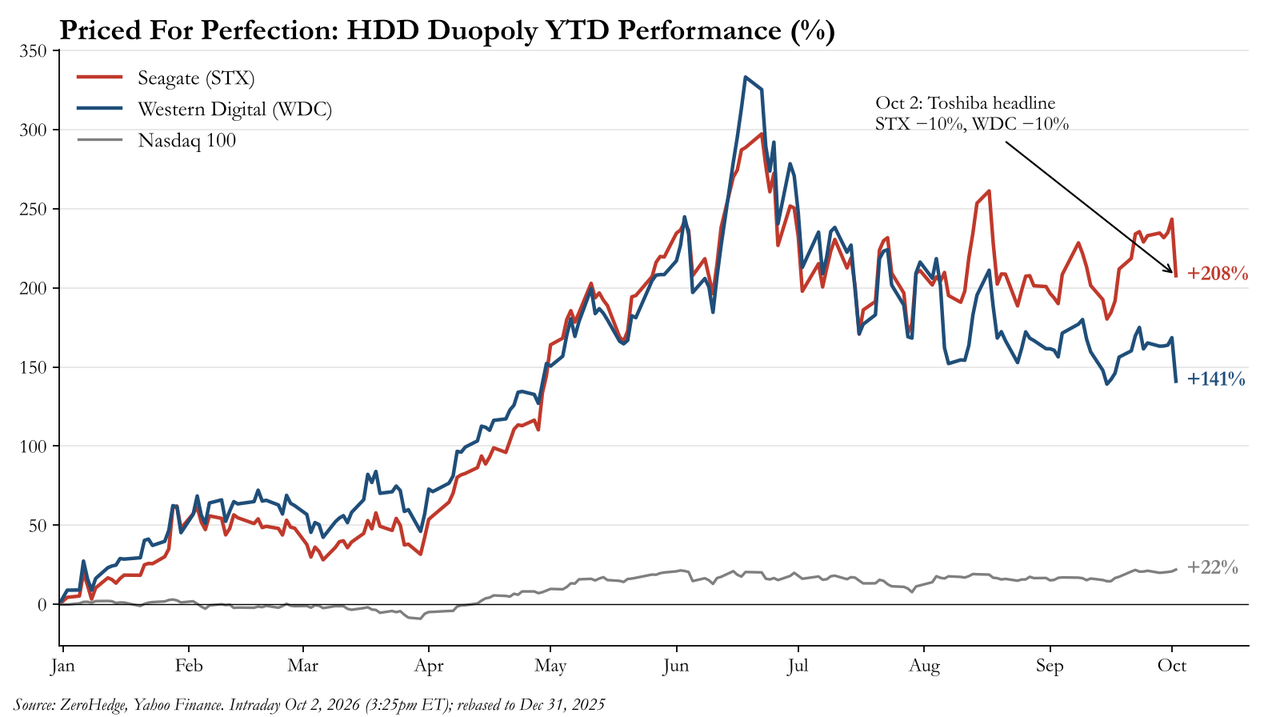
But when you’re priced for perfection, it’s not the size of the hit that matters. It’s where it lands.
The One Thing That Wasn’t Supposed To Happen
Recall that the entire HDD up-cycle (as well as memory, chips, etc., pretty much everything in the semiconductor commodity chain) has been built on the premise of supply discipline, i.e., that none of the three remaining hard drive makers would add unit capacity, and that all exabyte growth would come from cramming more terabytes into each drive. Here is how Bernstein put it after hosting Seagate management on a non-deal roadshow in August (emphasis ours):
None of STX, WDC, or Toshiba are adding drive unit capacity, keeping industry-wide HDD supply structurally disciplined. Seagate management explained that its factories are effectively full, and rather than expanding units, management is targeting roughly 25% CAGR in nearline exabyte shipments purely by increasing capacity per drive via HAMR… building a new factory would take at least two years, which management has no plans to do.
Bernstein then went on to make STX its top pick precisely because “the broader industry’s inability to scale supply keeps supply disciplined.”
Well, oops: as of this morning, a third of “the broader industry” just announced it is scaling supply.
Regular readers will recall that we have seen this movie before. Back in May, in “China Begins Flooding The Market With DRAM And NAND Chips“, we noted that Seagate’s CEO had told JPMorgan that building new factories would “take too long,” and warned that once someone else steps in to fill the supply gap, the supply tightness that justified the memory ETF rally would collapse. That time it was CXMT and YMTC on the memory side, which is only getting started with the old Chinese “capture market share by dumping products at below market prices” trick. This time it’s an old friend in spinning rust, and it happens to be in the Philippines rather than Hefei.
And yes, the timing is apt for another reason. Rosenblatt points out that hyperscalers are now negotiating long-term agreements (LTAs) extending into 2029-2031, and Toshiba’s expansion “introduces a credible medium-term supply risk, giving customers incremental negotiating leverage.” Evercore adds that while Seagate “has allocated the majority of its nearline exabytes into calendar year 2028,” Western Digital is still “negotiating long-term agreements extending to calendar year 2031.” Put differently: 2027-28 pricing is largely locked in. What the market is repricing is the back end of the curve, which, for stocks trading on out-year earnings power, is the part that matters.
“Overdone”… Says Everyone With A Buy Rating
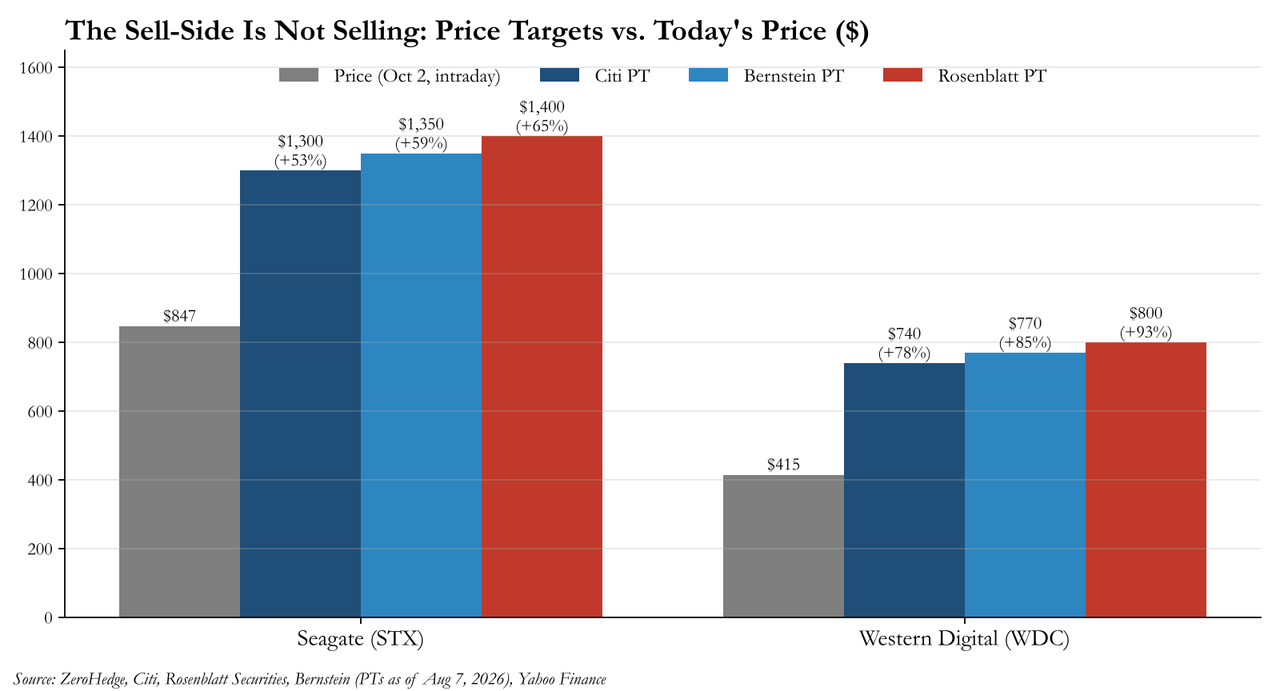
Predictably, the sell-side, which is unanimously bullish – and very wrong today – on both names, rushed to defend the duopoly. The best arguments:
- Citi (Buy, WDC PT $740, STX PT $1,300) argues the bottleneck isn’t Toshiba’s factory but its suppliers: “Unlike STX and WDC, Toshiba does not internally source their own media and heads,” so “in order to double their current EB capacity they would also need their external component suppliers to also significantly raise capacity – which we believe could limit the impact of total EB supplied to the market.”
- Morgan Stanley (Overweight, buying the dip) says “the gap between HDD supply and demand through calendar 2028 still looks wider than Toshiba’s planned addition,” and notes Toshiba lacks leading-edge capacity and heat-assisted magnetic recording (HAMR) technology.
- Rosenblatt (Buy, WDC PT $800, STX PT $1,400) reads the news as “more about Toshiba reclaiming lost market share rather than the stated 30% market share ambitions,” and continues “to see support for sustained pricing power from a worsening supply demand imbalance due to AI.”
- Bloomberg Intelligence says the plan “looks more like validation of stronger AI and data-center storage demand than a near-term supply threat.”
Translation: Street targets now sit 50% to 90% above Friday’s price, which is either a screaming buy signal, or more correctly, a reminder that price targets tend to follow price, not the other way around.
Goldman, for its part, didn’t need to rush out a defense because it already had one on file. At last month’s Communacopia conference, Goldman’s James Schneider came away from Seagate CFO Gianluca Romano’s presentation with three takeaways:
- Seagate sees strong demand trends as continuing to support pricing uplift and margins through FY27;
- HAMR volumes well on track to cross over PMR by the end of calendar 2026;
- The company expects to continue high-yield debt retirement and pivot to share repurchases.
And just this week, Goldman’s Korea memory team, reading across from Micron’s results, said it expects “2027 and 2028 memory S/D to be much tighter than 2026,” with customers “requesting longer duration and larger supply” agreements. Not exactly the backdrop for a glut.
The HAMR Moat
The real question is whether Toshiba’s doubling matters as much as the stock reaction suggests. Some napkin math: going from “just over 10%” of industry exabytes to roughly double that by FY27 adds something like 10% to total industry exabyte supply, spread over two years. Meanwhile, Seagate alone is targeting ~25% nearline exabyte growth per year through HAMR. In other words, Toshiba’s plan sounds big in a headline, but in exabyte terms it’s a rounding error relative to what the HAMR transition is already adding, if, that is, Toshiba’s head and media suppliers cooperate (see Citi above).
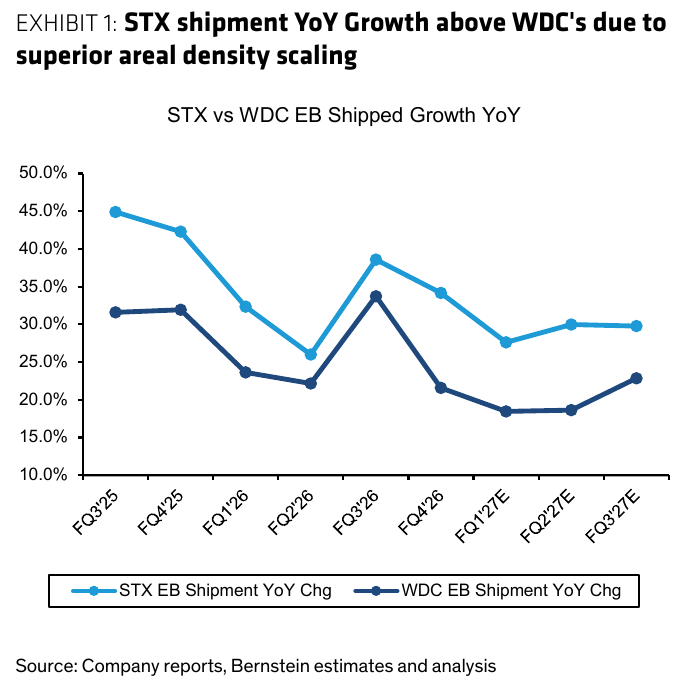
Which brings us to the part of the story the market may be glossing over: this isn’t a level playing field. Seagate is the only player shipping HAMR at scale, and as Bernstein showed, its areal density lead already translates into faster exabyte growth than WDC…
… and, per Bernstein’s forecasts, a gross margin that crosses above WDC’s in FY27 and keeps climbing toward the mid-60s.
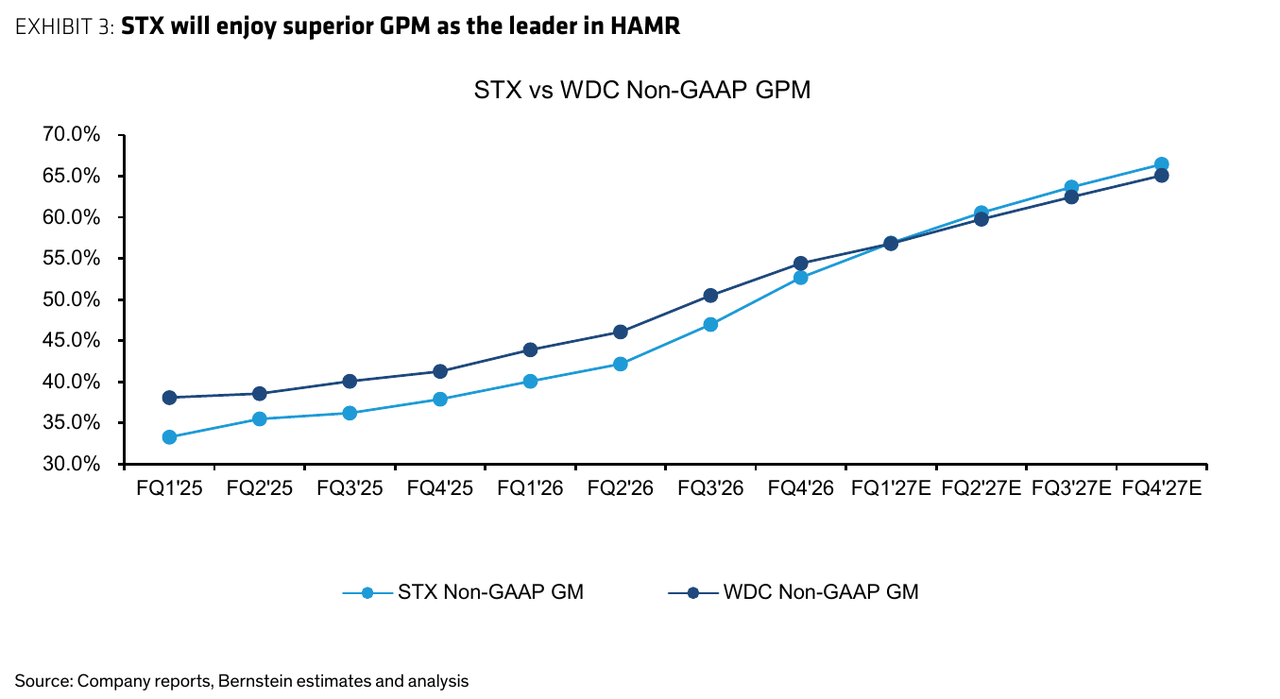
Which is also why Bernstein, back in August, said that while “a rising tide is lifting all boats,” STX’s HAMR lead “is why it is our top pick.” If the tide is now going to recede a bit as Toshiba adds supply, the boat with the weakest areal density roadmap is the one most exposed. Hint: it’s not Seagate, which may explain why WDC is now down more from its June peak than STX.
Meanwhile, The Picks And Shovels Rally
One more thing: equipment names catching a bid on the news included Veeco (+11%), whose data storage business sells ion beam deposition and etch tools used to make HDD read/write heads, i.e., a direct beneficiary of anyone (Toshiba or its suppliers) adding head capacity. Aixtron (+7%) also rallied, although its MOCVD tools are mostly used for compound semiconductors (GaN, SiC, optoelectronics), so the HDD link there is tenuous at best.
Bottom Line
The analysts are probably right that Toshiba’s ¥60 billion won’t put a dent in HDD pricing through 2028: the volumes are sold, the LTAs are signed, and Toshiba still needs someone to sell it heads and platters. But the market wasn’t pricing the next two years; it was pricing a decade of monopoly-like discipline in an oligopoly of three.
The lesson from today is one which the rest of the world (and especially European car makers) are painfully familiar with: in commodity hardware, the cure for high prices is high prices, and sooner or later somebody in Asia builds a factory.
Whether this is the start of that cycle or just another buyable dip in an AI super-cycle (the sell-side unanimously votes for the latter) will depend on one thing: whether Seagate and WDC respond with capacity plans of their own. If they do, the “supply discipline” thesis is over. If they don’t, Toshiba just bought itself some market share at the top of the cycle.
Tyler Durden
Fri, 10/02/2026 – 15:47