
September Jobs Preview And How To Trade It: Beware A Bond Squeeze As August Seasonals Reverse
A month ago, our August jobs preview argued that “good news would be bad news.” Then August delivered good news in volume. Payrolls rose by 162K, a 4-sigma beat and 38K above the highest estimate on Wall Street. Rate-hike odds jumped, and two weeks later Warsh hiked for the first time since July 2023.
So it’s a little awkward that the Street now spends most of its September previews explaining why August didn’t really happen. The main suspect is seasonal adjustments. Barclays says that if August had been adjusted with last year’s seasonal factors, the “blockbuster” 162K gain would have been a 74K decline, which may very well have prevented a rate hike.
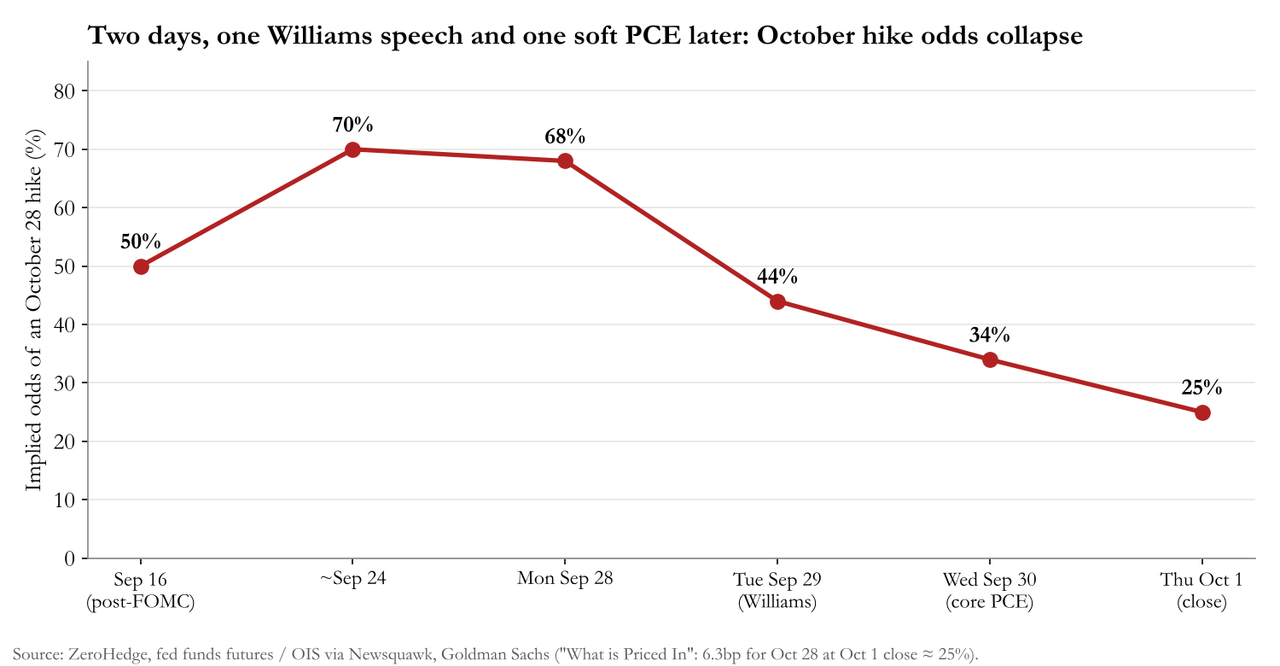
But wait, there’s more: the Fed backdrop has also changed dramatically in the past week. On Monday, the market put the odds of an October hike at roughly 70%. Then Williams said there was no “urgency” and core PCE came in soft. By Thursday’s close the odds were about 25%, and Goldman had pushed its next-hike call to December. Friday’s report is the only one before the Oct 28 FOMC. The market seems to think it won’t matter much, which tends to be when it does.
Expectations
Here are the median Wall Street expectations:
- Headline nonfarm payrolls: +90K (prev. +162K). The 3-month average is 71K, the 6-month average 107K, the 12-month average 50K.
- Private payrolls: +81K (prev. +127K).
- Unemployment rate: 4.1% (prev. 4.1%, 4.14% unrounded). The Chicago Fed’s final real-time forecast is 4.10%. At the September FOMC, officials lowered their end-2026 unemployment projection to 4.1% from 4.3%.
- Labor force participation rate: 61.6% (prev 61.6%)
- Average hourly earnings: +0.3% M/M (prev. +0.3%), with the annual rate seen at 3.2% Y/Y (prev. 3.1%).
- Average workweek: 34.3 hours (prev. 34.4).
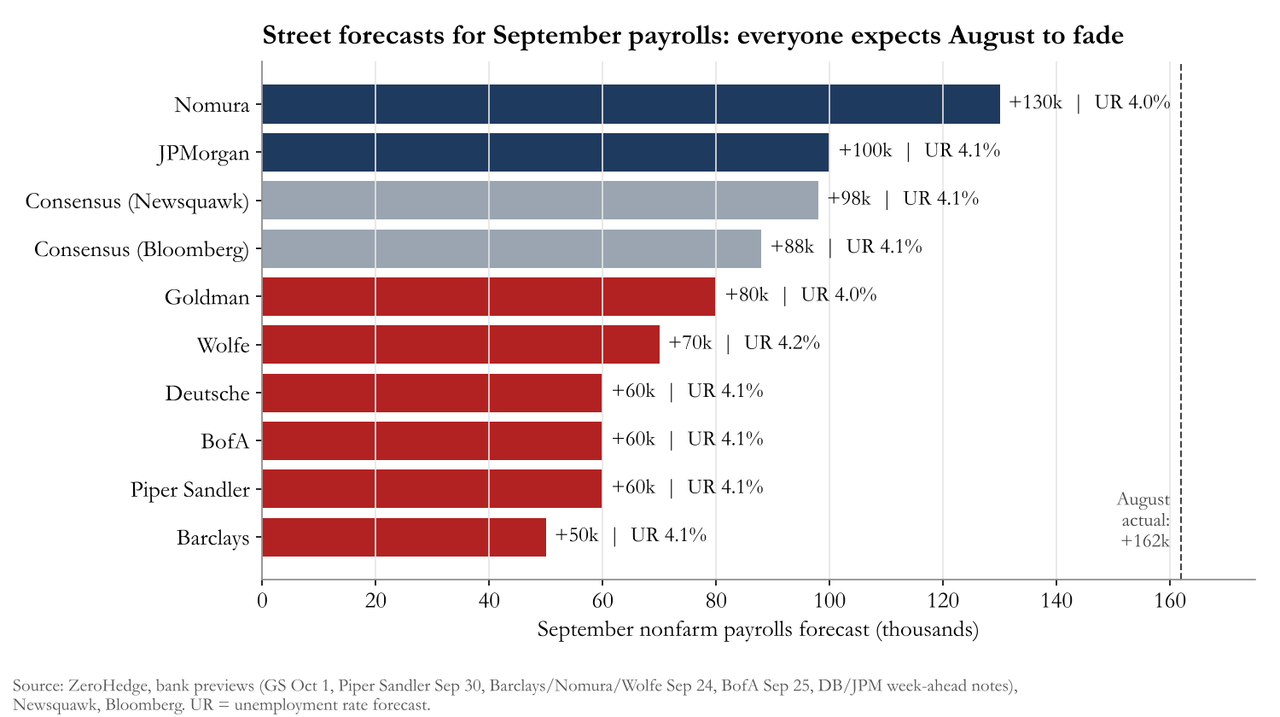
Forecasts range from Barclays’ +50K to Nomura’s +130K. Almost every bank is below August’s print, and most are below consensus.
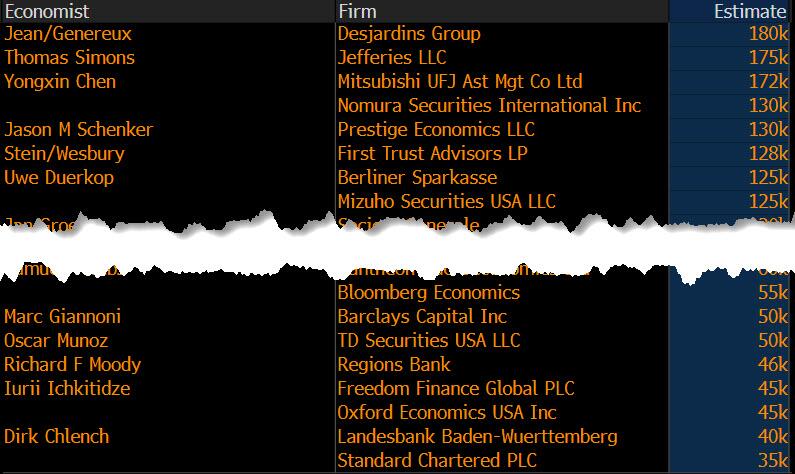
Below are the top and bottom forecasts among the 80 total estimates.
Goldman: +80K, with the unemployment rate down to 4.0%
Goldman published its NFP preview Thursday afternoon (full note available to pro subs): they expect +80K, slightly below consensus but above the three-month average of +71K, and +75K for private payrolls. In the same note, Goldman also cut its unemployment-rate forecast to 4.0% from 4.1% because continuing claims have fallen. It expects a below-consensus +0.2% for average hourly earnings, citing “negative calendar effects.” Here is how Goldman lays out the arguments.
Arguing for a stronger report:
- Layoffs. Initial jobless claims averaged 204K in the September payroll month, in line with August. The JOLTS layoff rate fell 0.1pp to 1.0%. Challenger announced layoffs, seasonally adjusted by Goldman, fell 2K to 52K.
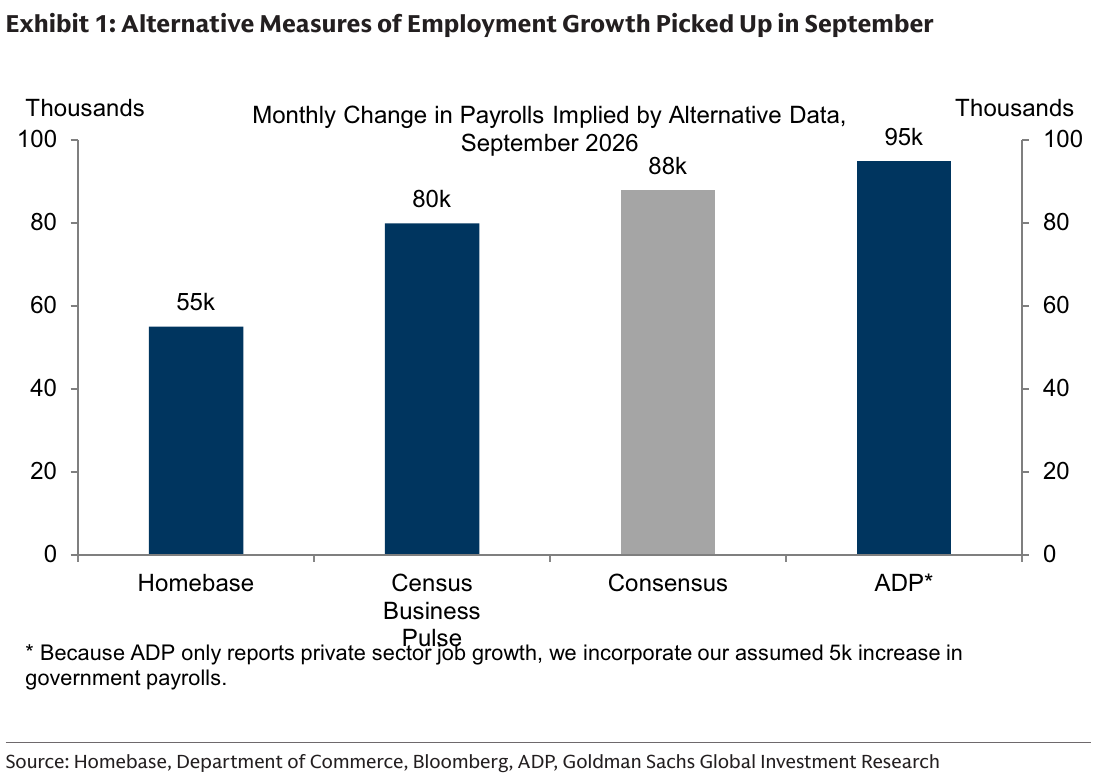
- Big data. The alternative measures of employment that Goldman tracks averaged +77K in September. That is up from +31K in August, though still a bit below consensus.
Arguing for a weaker report:
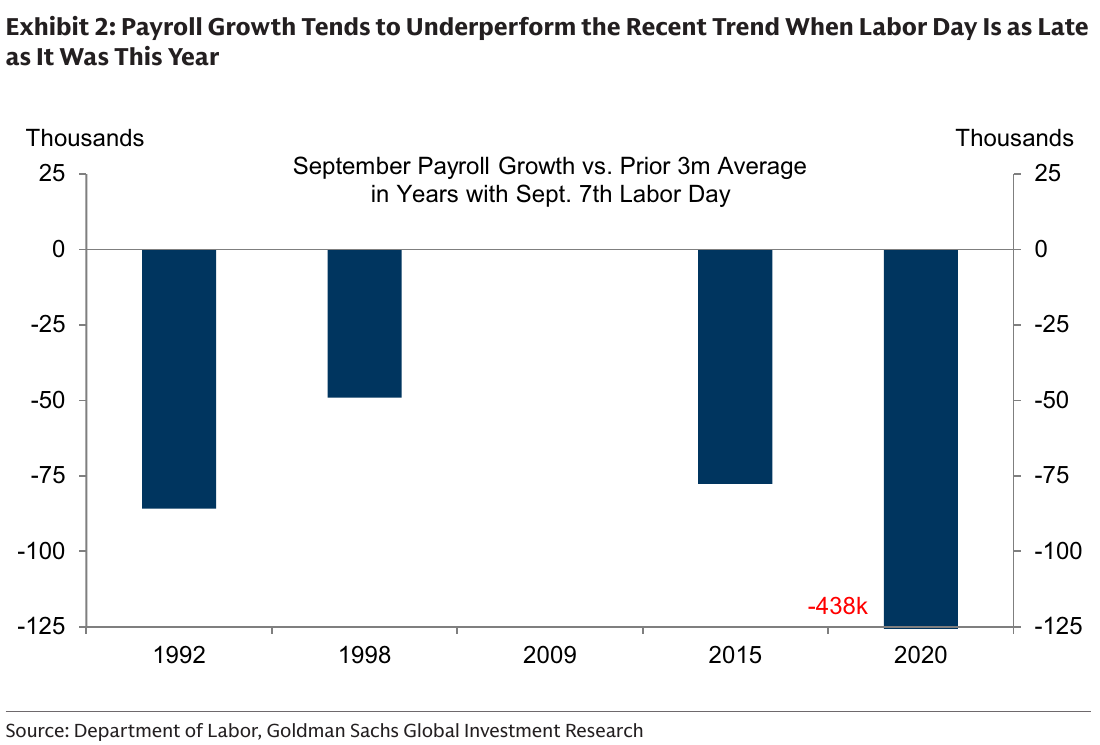
- A late Labor Day. Labor Day fell on Sept 7 this year. In every past September with a Labor Day that late, payroll growth came in at or below its recent trend, as Goldman shows below.
- August was flattered. Rebounds in local government education and leisure & hospitality added a combined 104K to August payrolls. Goldman notes that both series “experience large swings in employment across the summer on a not-seasonally-adjusted basis, making it difficult to seasonally adjust them well.” The bank does not expect a repeat.
Mixed/neutral factors:
- Job availability. Averaging JOLTS, Indeed and LinkUp, Goldman estimates job openings were roughly unchanged in August, and Indeed and LinkUp were stable in September. That is a calmer reading than our take on Tuesday’s JOLTS release, when a record plunge in real-estate job openings dragged the headline sharply lower. The Conference Board labor differential fell 2.5pt to +1.7.
- Employer surveys. The employment components of Goldman’s manufacturing and services survey trackers rose to 53.2 and 51.4. However, Goldman says survey data has been “less useful—and at times misleading” since the pandemic, and gives it little weight.
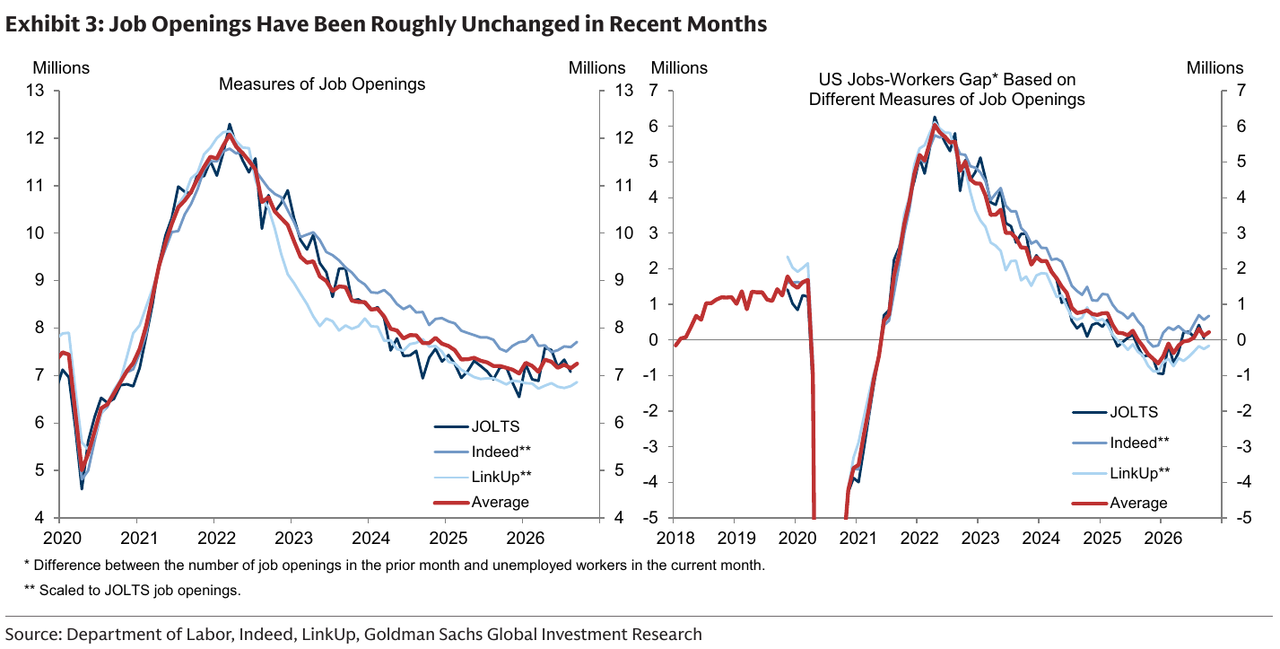
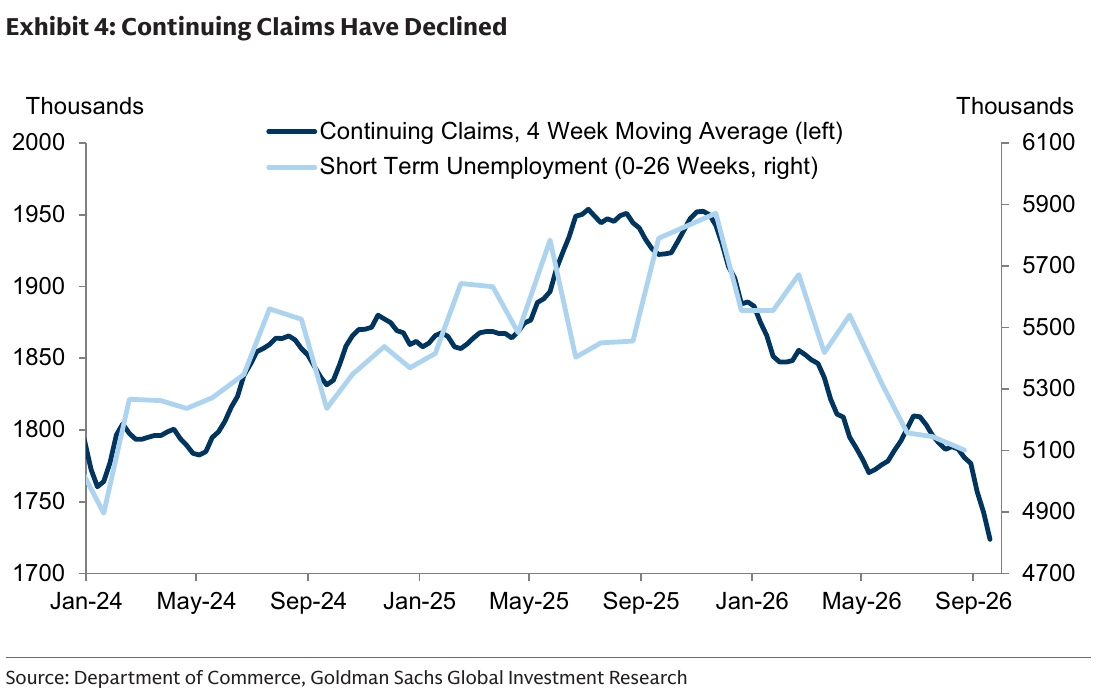
On unemployment, Goldman says the drop in continuing claims supports a rounded 4.0%. It adds a caveat: its slack tracker, which combines ten measures of labor market slack, stands at 4.6%. That suggests the labor market is “somewhat softer than the unemployment rate alone currently implies.” It is a familiar point for anyone who read our note on the long-term unemployment share creeping up to 27% despite August’s strong hiring.
The seasonals
Seasonal adjustments are the main source of uncertainty this month, and Barclays (+50K) has done the most work on it. The bank says its usual claims-based models “project strong gains.” Its alternative indicators point to “a return to more modest job gains.” Barclays also expects August to be revised down:
“Had the August nonfarm payroll employment been adjusted with the August 2025 seasonal factors, it would have registered a drop of 74k jobs instead of the 162k gain. We suspect that the more the August estimate gets revised down, the more the September estimate may appear strong, implying upside risks to our September payroll forecast. Conversely, if the August estimates see little downward revision, we would expect the September payroll estimate to come in relatively weak, lower than our baseline forecast of +50k.”
In short: if August gets revised down, September may look strong, and if it doesn’t, September may look weak.
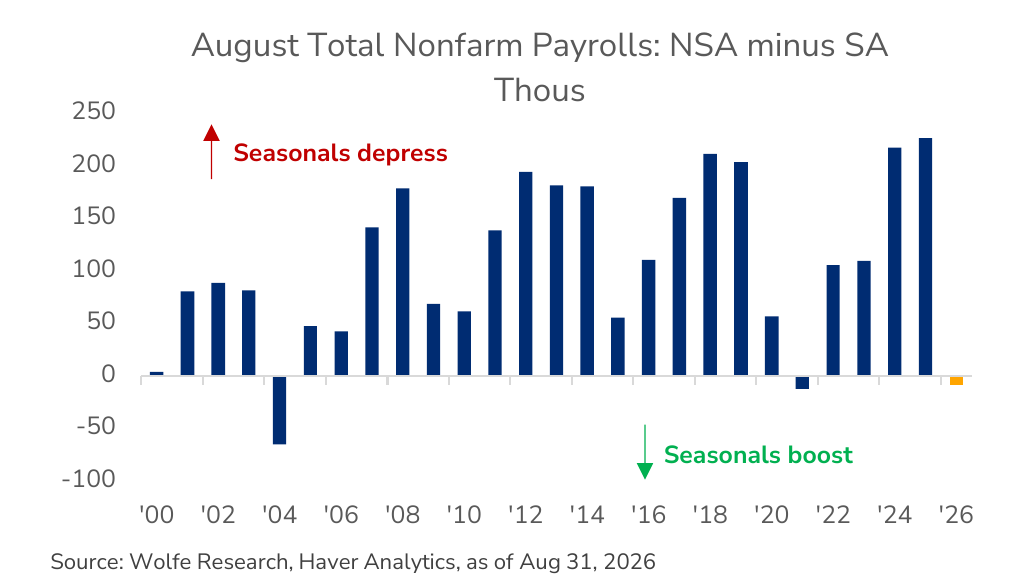
Wolfe Research (+70K, UR 4.2%) shows how unusual this year’s adjustment was. In a typical August, seasonal factors push the adjusted number below the raw number, often by more than 100K. This August, for the first time since 2021, they pushed it up.
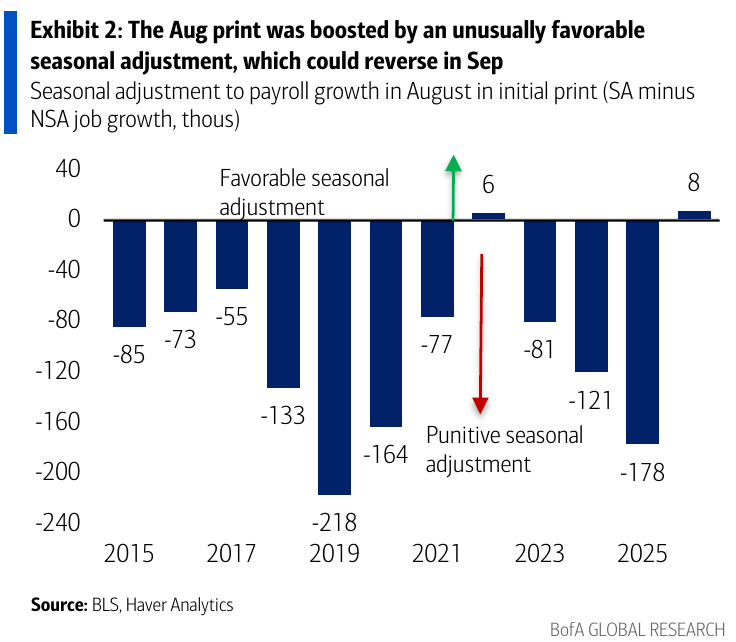
BofA’s Shruti Mishra (+60K, private +50K) has the clearest explanation of the August quirk. Unadjusted job growth in August was actually lower than a year earlier. But this year the seasonal adjustment was “close to zero,” versus a 178K subtraction in August 2025, so “most of the underlying NSA gain flowed through to the seasonally adjusted print.” BofA’s explanation is the survey calendar: August 2026 had a four-week survey interval, while 2024 and 2025 had five. That “raises the risk of September payback in seasonal factors, which could be more or less punitive than what we are penciling in.” BofA’s advice: “Don’t fall for the headline.” It still puts underlying job growth at a healthy “100k+.”
BofA also flags one more possible drag: about 200K Haitian TPS holders lost their work authorization on July 27. They are concentrated in food services, healthcare, transport and retail, and the loss has “not yet shown up clearly in the payroll data.” BofA’s base case is a gradual headwind rather than a one-time shock, though it sees “a downside risk from the impact being felt more significantly than we are expecting in September.”
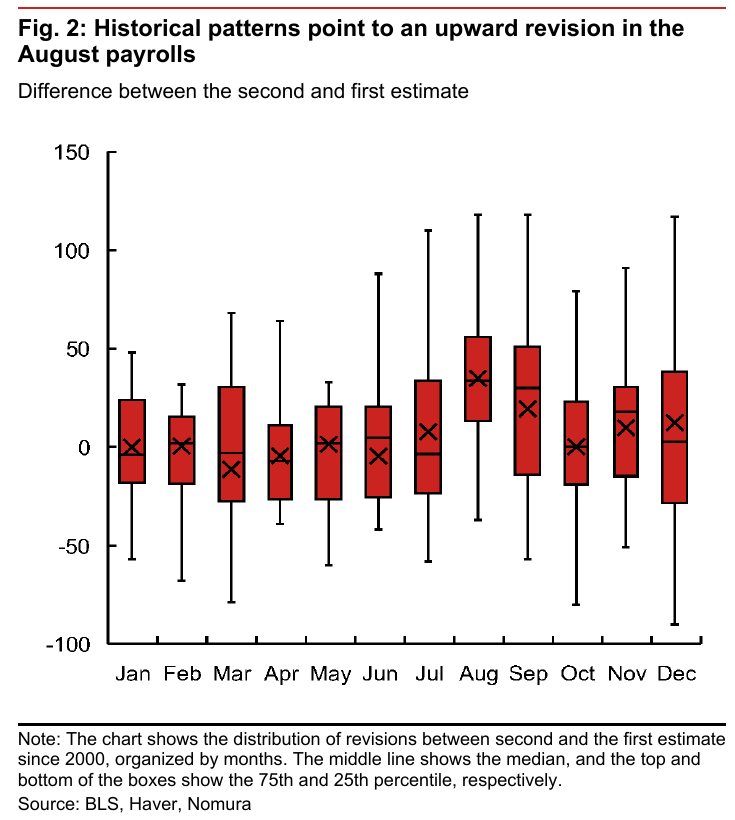
Nomura (+130K, the Street high) disagrees. It points out that August is historically the month most likely to be revised up between the first and second estimates.
Labor market proxies
- Jobless claims: Initial claims printed 198K in the survey reference week (vs 207K for the August window). Continuing claims fell to 1.719mn from 1.771mn. Thursday’s release showed continuing claims down again to 1.701mn, the lowest since March 2023, which supports the 4.0% unemployment calls.
- ADP: Private payrolls rose +90K (exp. 70K, prev. 36K after revision). It was the first acceleration in hiring since May, led by education/health and leisure/hospitality. Goldman made no change to its NFP forecast after the release.
- Revelio: +56.9K in September, up from an upwardly revised 40.6K in August. Public administration, health care and construction led.
- Challenger: 43,281 announced job cuts, the lowest September total since 2022. AI was again the leading reason cited, and tech had the most cuts. Hiring plans were the lowest for a September since 2011.
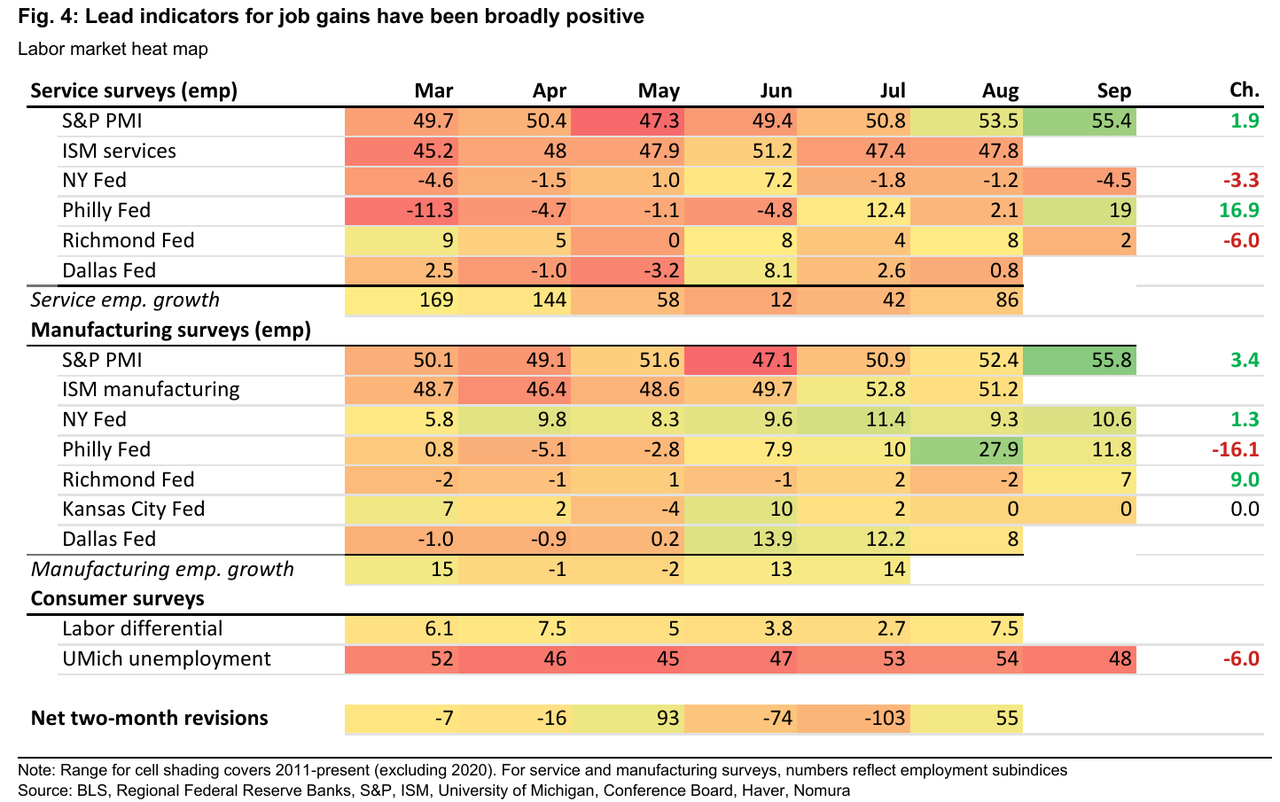
- Business surveys: S&P Global’s flash PMI said employment rose at the fastest pace since June 2022. ISM manufacturing employment rose 1.5 points to 52.7. Nomura’s heat map shows how broad the improvement has been.
- Consumer confidence: This is the outlier. In the Conference Board survey, the “jobs plentiful” minus “jobs hard to get” spread narrowed to just +1.7, and net six-month job expectations fell to -14.4. Piper Sandler (+60K) notes that the survey’s “jobs hard to get” share keeps rising, “suggesting consumers feel like the jobless rate is still trending higher.” Meanwhile, the share of insured workers drawing continuing claims is at a historically low 1.1%.
Wages and the unemployment rate
Forecasts for the unemployment rate run from 4.0% to 4.2%. The reason is August’s unrounded 4.14%.
- Goldman and Nomura expect 4.0%, based on the drop in continuing claims.
- Wolfe expects 4.17%, which rounds to 4.2%.
- BofA expects 4.1% but warns of payback after household employment “surged by 569k in August, after two consecutive declines,” which could push the rate to 4.2%. It adds that “even a 4.2% print would be consistent with healthy underlying labor market conditions.”
- Deutsche (+60K) warns that “even slight outperformance on labor force participation could push the U-3 rate to round up to 4.2%.”
On wages, Goldman and Nomura expect +0.2% on calendar effects, while Deutsche is above consensus at +0.4%. Goldman’s broader wage tracker stands at 3.5% Y/Y, up 3.1% annualized in Q3. Wolfe points out that wage growth is still “below the Fed’s preferred 3.5-4.0% range for wage inflation” and calls it “surprisingly soft.” Not exactly a wage-price spiral.
Fed policy
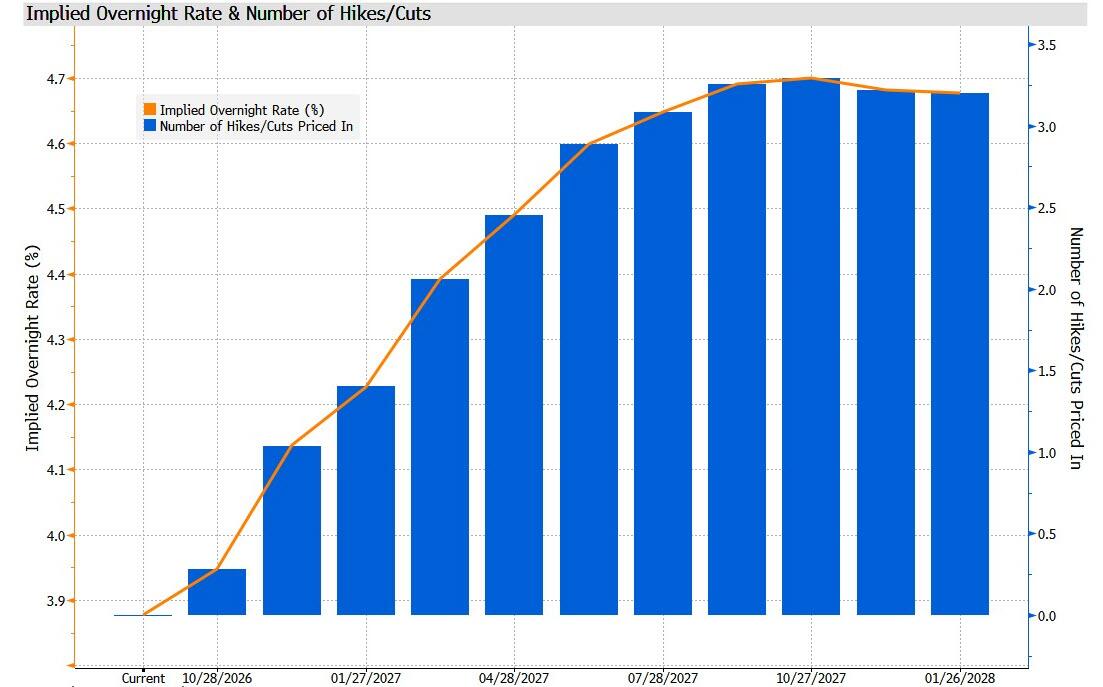
After its first hike in three years, the FOMC median projected one more hike in 2026. For a moment, the market priced it for October. Then Williams said there was no urgency, August core PCE printed a soft 0.25%, and Jefferson hinted at a pause. October pricing fell from ~17bp on Monday to 6.3bp at Thursday’s close, according to Goldman’s “What is Priced In.” About 25bp of hikes are still priced by year-end, and ~50bp by March 2027.
Goldman’s economists now expect a December hike. They see “a strong chance that the FOMC will ultimately conclude that additional rate hikes are unnecessary,” since they expect core PCE to end the year at 3.0%, versus the FOMC’s 3.4%. Barclays also expects a hold in October and a hike in December. Deutsche’s base case is two more hikes, in December and March. Goldman’s STIR desk sums up the consensus as “skip-then-hike.” BofA, citing Warsh’s recent comments on labor market resilience, doesn’t expect the jobs report “to be a game changer for October hike pricing. Markets will likely focus on CPI.”
Market reaction and how to trade it
Wolfe argues it would take a big surprise to move Fed pricing:
“We estimate that payrolls would need to print below 20k or the unemployment rate would need to rise above 4.3% to materially trim market expectations for Fed tightening. A print in the 20-120k range or an unemployment rate between 4.05-4.24% would likely have little impact on market pricing.”
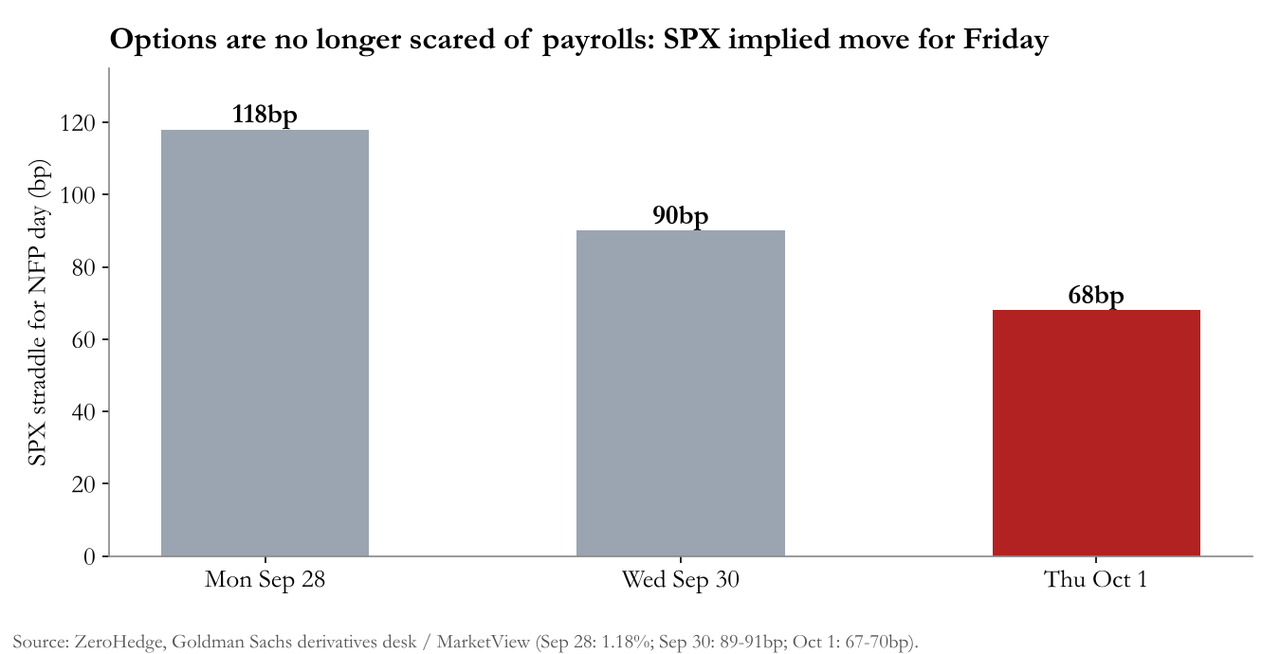
Options traders seem to agree. Goldman’s derivatives desk had the SPX straddle for payrolls day at 1.18% on Monday. By Thursday, after the hike odds collapsed, it was down to ~67-70bp, below the trailing 8-session average of ~72bp. The NDX straddle is ~95bp. In FX, Goldman’s MarketView puts the implied NFP move at ~42bp in USDJPY and ~38bp in EURUSD. Both are near the top of their 1-year realized ranges, so FX is the one market still paying up for a surprise.
Goldman’s Rich Privorotsky says the real issue is the long end, not the front end:
“Rates: Still totally bidless at the back end. PCE came lighter, but it barely changed the long end trajectory. October looks less likely after softer inflation and Fed speak, but the stress remains further out the curve… We have taken hikes out of the front end… the real problem is the back end still doesn’t care.”
That matters for positioning. Goldman’s Brian Garrett says the bank’s CTA model shows managers “extremely short global bonds (~$390bn notional).” US 10Ys are at 99% of max short and 30Ys at 100%. With systematic funds that short, a weak print, or even a 4.2% unemployment rate, could set off a massive short squeeze in bonds.
For stocks, Goldman’s Nelson Armbrust notes the S&P is ~2% from all-time highs, and “any relief in rates would be a trigger for an equity rally.” JPM’s Andrew Tyler sees the mirror image: with ADP strong, “NFP tmrw… may have an upside surprise,” and “with labor data we may be in a ‘Good News is Bad News’ mentality.” He adds: “if unemployment stays 4.0%, or higher, then bonds will not move to price add’l hikes.”
Putting it together:
- Goldilocks: roughly 40-100K, unemployment at 4.0-4.1%, AHE at 0.2%. Bonds rally modestly, stocks follow.
- Too hot: 120K+ (Nomura territory) with unemployment at 4.0% puts October back on the table. Given how quickly the market priced it out, it could be priced back in just as fast.
- Too cold: a sub-20K print or 4.2%+ unemployment means August was a seasonal mirage. Hikes get priced out, and the CTA bond short gets squeezed.
As ever, the revision to August may matter more than the September headline.
More available to pro subscribers including the Goldman, BofA, Barclays, Nomura and other notes.
Tyler Durden
Fri, 10/02/2026 – 07:58