
Specs Buy Record Gold Futures As Short Squeeze Sends CTAs Soaring: What’s Next For Gold
Not long after we reported that Goldman’s commodity strategists are turning especially bullish on gold, telling clients they see “significant upside risk to our $4,900/oz end-2026 gold forecast“ as a result of a substantial jump in call buying, not to mention gold crossing above its 200DMA for the first time since October 2023, Goldman’s futures desk also chimed in with trader Robert Quinn writing that over the past 3 weeks, speculators purchased a record amount of Gold futures in nominal terms per Commitment of Traders (COT) (full note available to pro subs).
Managed Money, Other, and Non-Reportable bought +$22.2bn from July 28th – August 18th, representing a 10+ year notional max. Long augmentation (+$13.6bn) and short covering (+$8.6bn) contributed to the sharp move higher. Resultant net length registered at 93% on a 2 year lookback.
As Goldman shows in the chart below, all categories participated in the recent meltup (which we pointed out as it was happening some two weeks ago here): Managed Money +$10.9bn, Other +$8.5bn, Non-Reportable +$2.8bn.
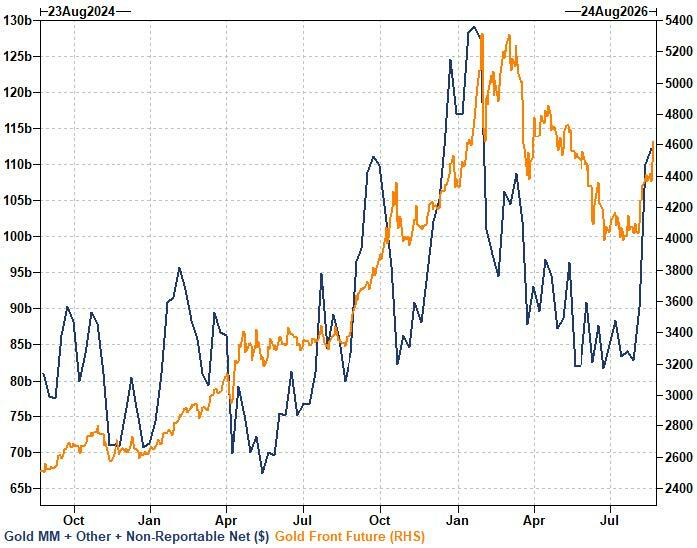
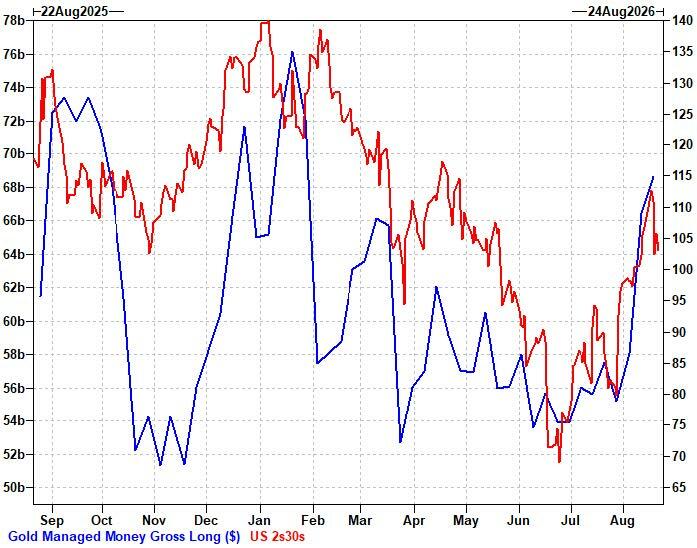
At first glance, Quinn notes, macroeconomic factors, which also steepened the US yield curve, seemingly catalyzed the broad support. Investors lowered the potential for multiple rate hikes in 2026 post the incrementally dovish July Fed meeting plus benign inflation and job readings. Meanwhile, long-dated rates charged higher due to cyclical resilience, AI capex, growth optimism, ongoing fiscal pressures, and global spillovers. Thus for Managed Money and Other, gross long changes on either a 1 or 2 week basis became positively correlated with US 2s30s.
That said, the Goldman trader cautions that gold bulls kept adding as recent Treasury actions forced a curve retracement. Over August 18th – 21st, Gold jumped +5.9% and US 2s30s fell -8bps after the Treasury announced increases of 10-to-30y buyback operations.
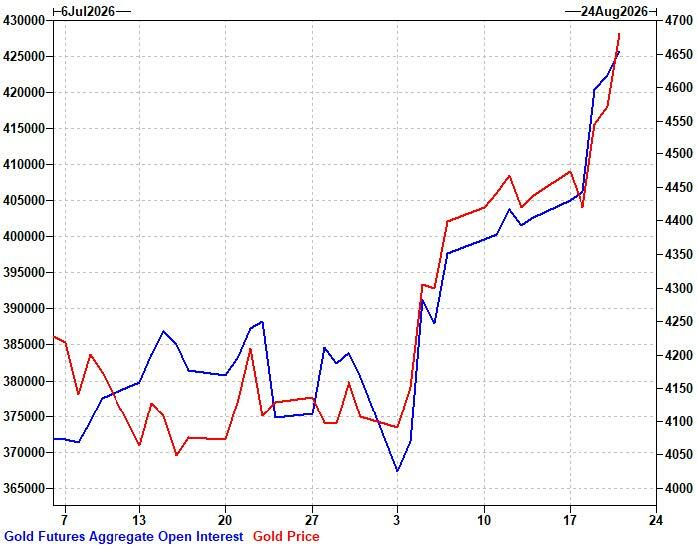
Gold aggregate open interest rose each session for a cumulative +$8.9bn.
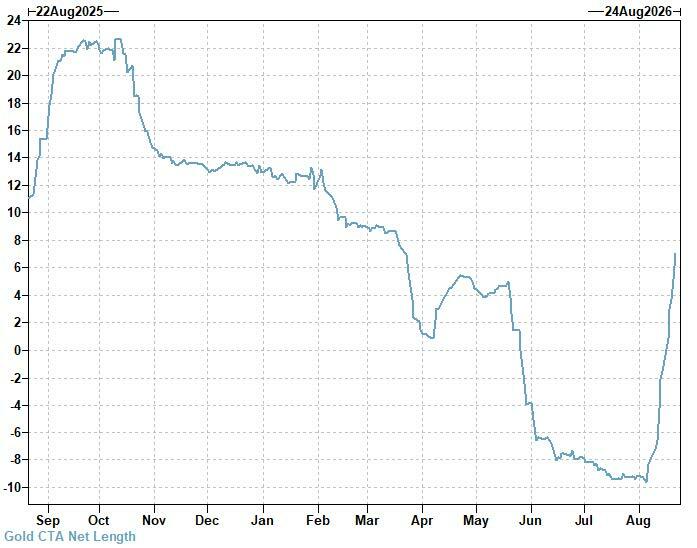
Meanwhile, GS futures strategists’ CTA model also showed a surge in buying, which was to be expected since on August 5 we said that “CTAs remain short gold. If the breakout gains traction, systematic buying could add meaningful upside convexity to the move.”
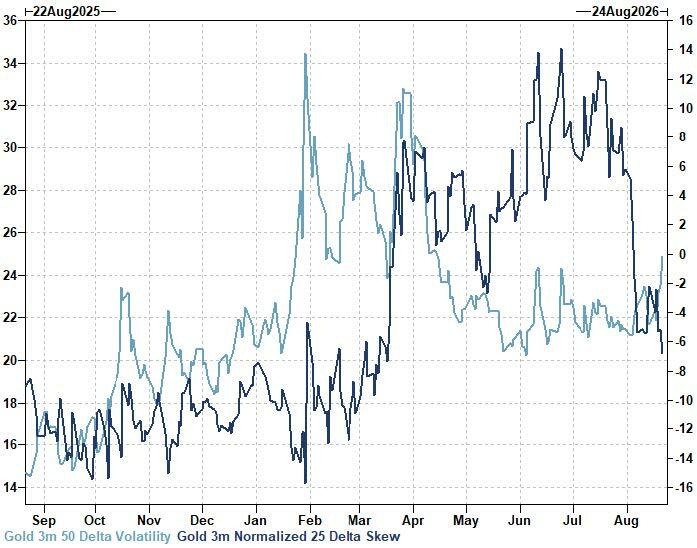
Moreover, Gold 3 month implied volatility richened and normalized 25 delta put-call skew cheapened to a 5 month low. Therefore longs initiated via outright futures and calls.
UBS’ trading desk also chimed in today, with S&T specialist Jonathan Garber writing in a Monday morning note (available here to pro subs), that “the outlook for gold has become increasingly constructive, supported by strong futures positioning, continued ETF inflows, US fiscal and debt concerns, dollar weakness, persistent inflation risks, and reduced expectations for near-term policy easing.”
Echoing Goldman, he notes that investor sentiment has shifted meaningfully over the past two weeks, with growing interest from hedge funds and other clients seeking to increase exposure following the latest rally. He notes that “while many investors were largely disengaged only a few weeks ago, the recent price action appears to have captured broader market attention.”
To be sure, this rapid shift may be a red flag: going back to the Goldman’s Quinn, he writes that this sharp spike in bullish sentiment creates some risk of tactical unwinds should Chairman Warsh also express discomfort with recent market developments.
Recall that at the July Fed meeting, Warsh had not yet decided whether his keynote speech at Jackson Hole would be “big-picture” or a more traditional preview for policy into year-end. Some Fed pundits, including former officials, believe he (and Bessent) must restore inflation fighting credibility.
Countering Goldman’s caution, UBS is more sanguine writing that despite the bullish backdrop, investor participation has not fully matched the strength of the rally. They go on to note that Gold’s advance has been driven “primarily through futures markets rather than OTC channels, with Exchange-for-Physical (EFP) premiums remaining elevated and futures positioning accounting for much of the market’s strength. This divergence helps explain why prices have moved sharply higher while client engagement and OTC flows remain relatively uneven.”
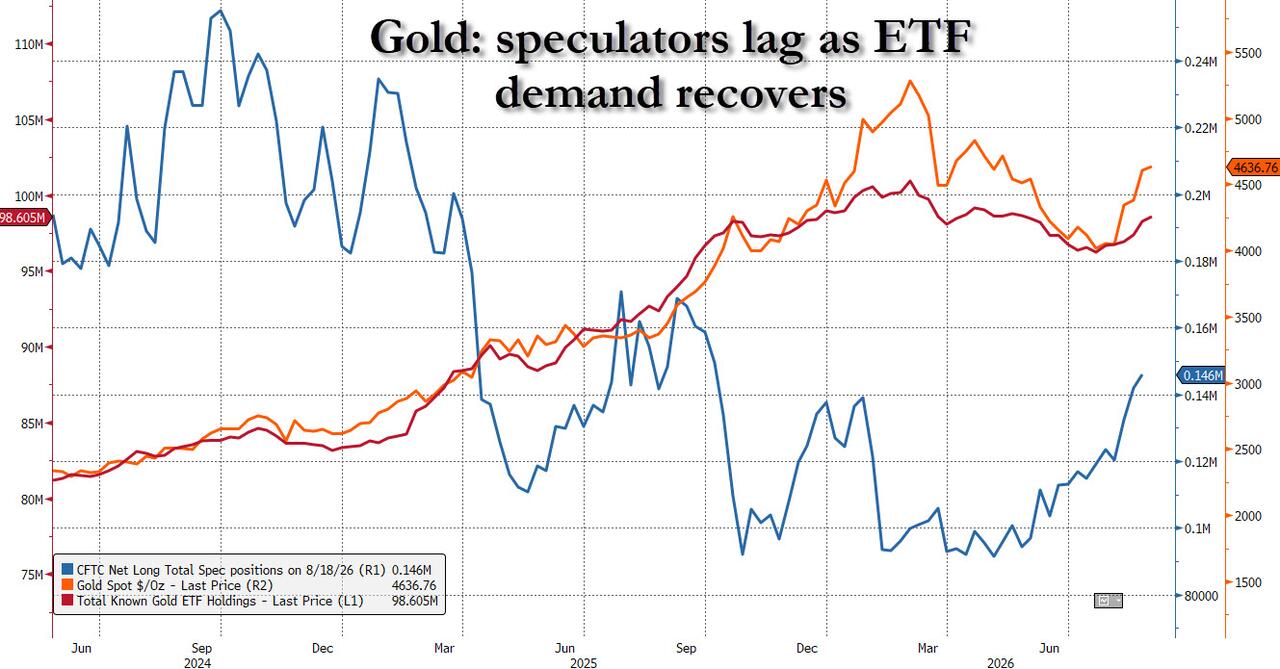
Echoing what we said two weeks ago, UBS believes that ETF demand remains one of the strongest supportive factors for the market. Buying has remained consistent throughout the rally, with substantial additional gold accumulated through ETF vehicles. Unlike some other areas of the market, ETF inflows are aligned with the price action, reinforcing the view that the move is being supported by genuine investment demand rather than solely speculative futures activity.
Meanwhile, lending and financing markets have also shown signs of improvement. In Asia, Singapore traded at a premium to OTC markets, Asian clients borrowed loco London gold, and borrowing demand increased across a broad range of maturities, extending from one month to as far as eighteen months.
UBS explains that these developments are notable given the pressure on lending yields over recent months and suggest that demand for financing is beginning to return.
Curve dynamics have also shifted across both gold and silver. Front-end rates have softened while longer-dated maturities have strengthened, a pattern visible across multiple metals. Although the underlying drivers remain uncertain, producer-related activity may be contributing to stronger demand further out the curve.
Here, UBS agrees with Goldman that options markets have also become more supportive of the bullish narrative: skew has shifted in favor of calls, making upside exposure more expensive relative to puts and signaling stronger demand for bullish positioning. In addition, realized volatility has recently exceeded implied volatility, creating potential opportunities for volatility buyers and highlighting the speed at which headline-driven moves can develop in spot markets.
Echoing Goldman, UBS also suggests to pause and asses after the recent sharp move, writing that while the medium- and long-term outlook remains positive, expectations are for consolidation around current levels and the development of a higher trading range rather than an immediate, uninterrupted move higher. Further gains are expected to occur gradually as broader investor participation continues to build alongside improving market fundamentals.
More views from the UBS trading desk
The trading desk remains constructive on gold and continues to view it as the best expression of USD weakness. Since the Treasury’s decision to increase long-end buybacks, investors have reduced USD longs and established fresh USD shorts. Part of the market’s reasoning is that the move reflects an attempt to influence long-end pricing and curve dynamics, which has raised concerns around confidence in the dollar and reinforced demand for hard assets such as gold and other metals (and sparked speculation that both YCC and QE may be looming).
Importantly, the challenge of rising rates and steeper curves is becoming a global issue rather than one isolated to the US. Against this backdrop, gold remains an attractive hedge against both fiscal concerns and a weakening USD. Since the Treasury announcement, the UBS desk has seen better buyers emerge and expect gold to continue pushing higher.
From a positioning perspective, support appears to be forming. Gold ETF holdings have rebounded toward May 2026 highs, while China increased its gold reserves at the fastest monthly pace since 2023, highlighting continued official-sector demand. The combination of improving ETF flows and strong central bank buying provides a constructive backdrop for further gains.
The biggest near-term catalyst will be Jackson Hole, where Chairman Warsh will take center stage for his first appearance. Any guidance on rates, inflation, and the broader policy outlook will be closely watched given the implications for the dollar, real yields, and ultimately gold.
- Resistance: 4670, 4770, 4890
- Support: 4520, 4380, 4305
XAUUSD
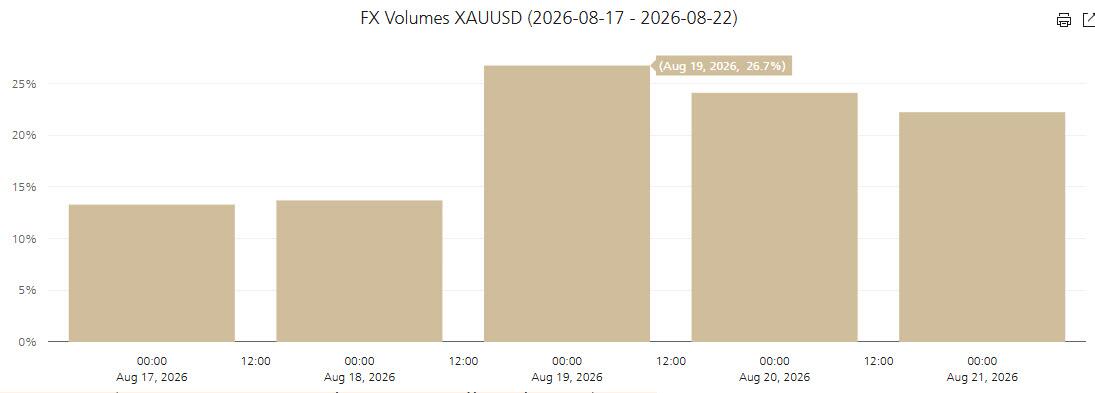
XAUUSD electronically traded cash volumes increased notably week over week, with Gold firmly holding a top 10-volume ranking overall.
The highest concentration of electronic activity took place on Wednesday, Aug. 19 – just after the Treasury’s buyback announcement – with 27% of the weekly turnover. XAUUSD was bid through $4500 for the first time since June
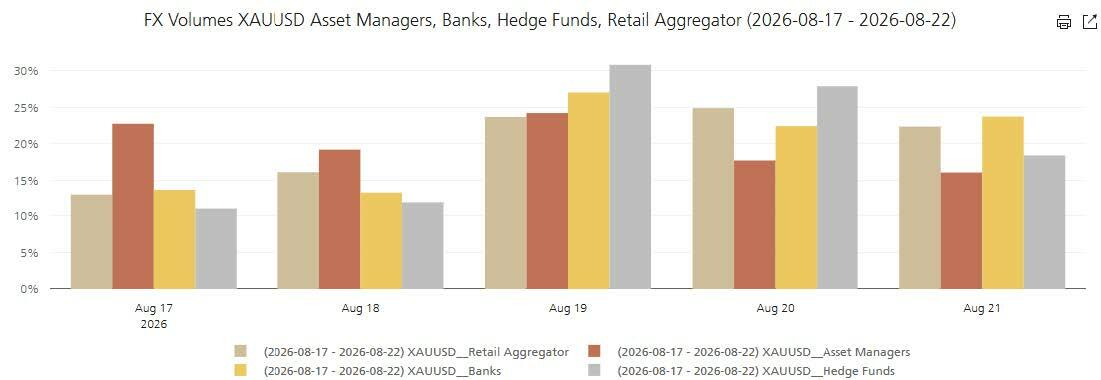
All client segments (Asset Managers, Banks, Hedge Funds and Retail) all saw their activity peak on Aug. 19. Hedge funds specifically executed 30%+ of their weekly turnover on this day.
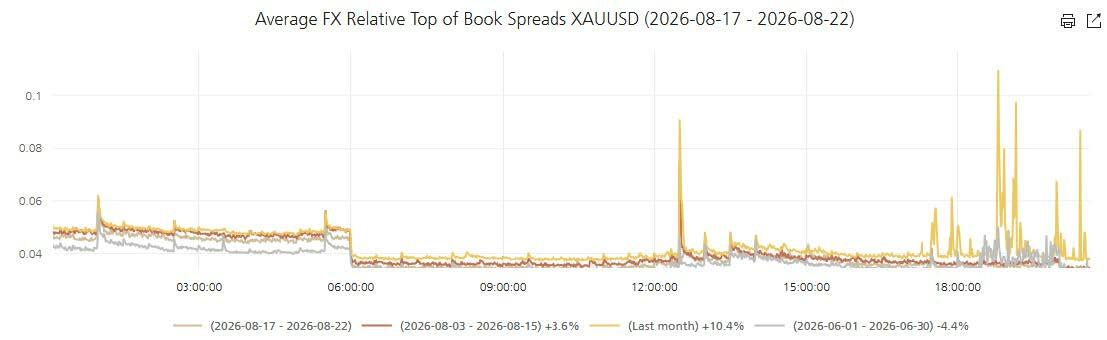
Avg XAUUSD Top of Book Spreads (17 Aug – 22 August % of Mid, 00:00-20:30GMT) were ~4% tighterthan Aug MTD levels and 10% tighter than observed in July. With that said, last week’s pricing sat slightlywider than June’s averages.
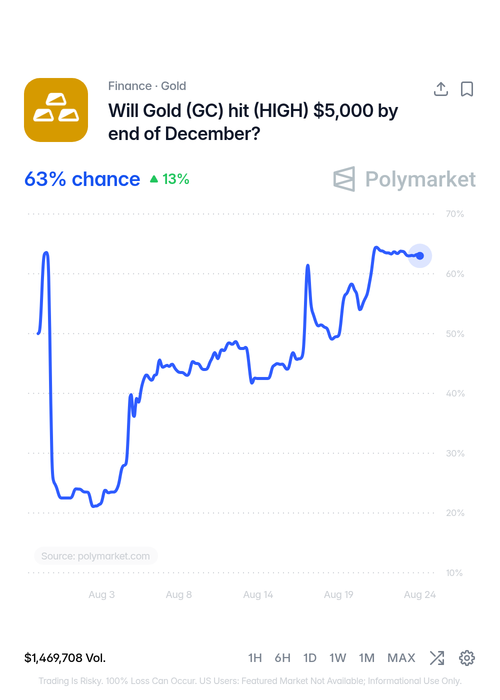
Finally, prediction markets are also jumping in the fray, with the recent spike in prices moving odds that gold will hit $5000 by year end sharply higher, from 40% a week ago to well over 60% today.
More in the full Goldman and UBS notes, both available to pro subs.
Tyler Durden
Mon, 08/24/2026 – 17:20