
Tencent Rents 100,000 AI Chips At Huge Discount From Cash-Strapped Oracle In $7BN Deal
With its flagship US data center in force majeure, its CDS at record wides and its founder busy funding Hollywood, Oracle has found a new customer eager to pay upfront: China. And based on the reported terms, Oracle is also giving it a very good price.
According to the FT, Tencent has signed its largest-ever overseas lease with Oracle: a five-year agreement covering multiple Oracle data centers in south-east Asia that gives the Chinese social media and gaming giant access to roughly 100,000 advanced AI chips that are not available in China. The deal is estimated at about $7 billion, with an upfront payment of about 30%, or roughly $2.1 billion. Neither company commented. As we put it overnight: “Since Oracle’s data centers in the US are mothballed, Larry now doing business with Beijing.“
The arrangement is perfectly legal: US export controls block the sale of Nvidia’s top chips to China, but not the rental of them in a third country. It is the same loophole Tencent used last December to tap roughly 15,000 Nvidia Blackwell chips in Japan via Datasection (a ~$1.2BN contract), and the one ByteDance and Alibaba have used for years as the biggest clients of south-east Asian data centers. According to the FT, Washington’s attempts to stop chips from leaking into China via intermediate locations have only made these leases pricier, with longer terms and bigger upfront checks. Which, as it turns out, is exactly what Oracle needs right now.
The math: $1.60 an hour
The FT numbers make the price easy to back out. $7 billion over five years for about 100,000 chips is $14,000 per chip per year, or roughly $1,170 a month. A lease bills around the clock whether the GPUs are busy or not, so over 8,760 hours a year that comes to about $1.60 per GPU-hour, all-in, for compute that by definition can’t be bought in China.
Compare that with the market, which by all accounts has rarely been tighter:
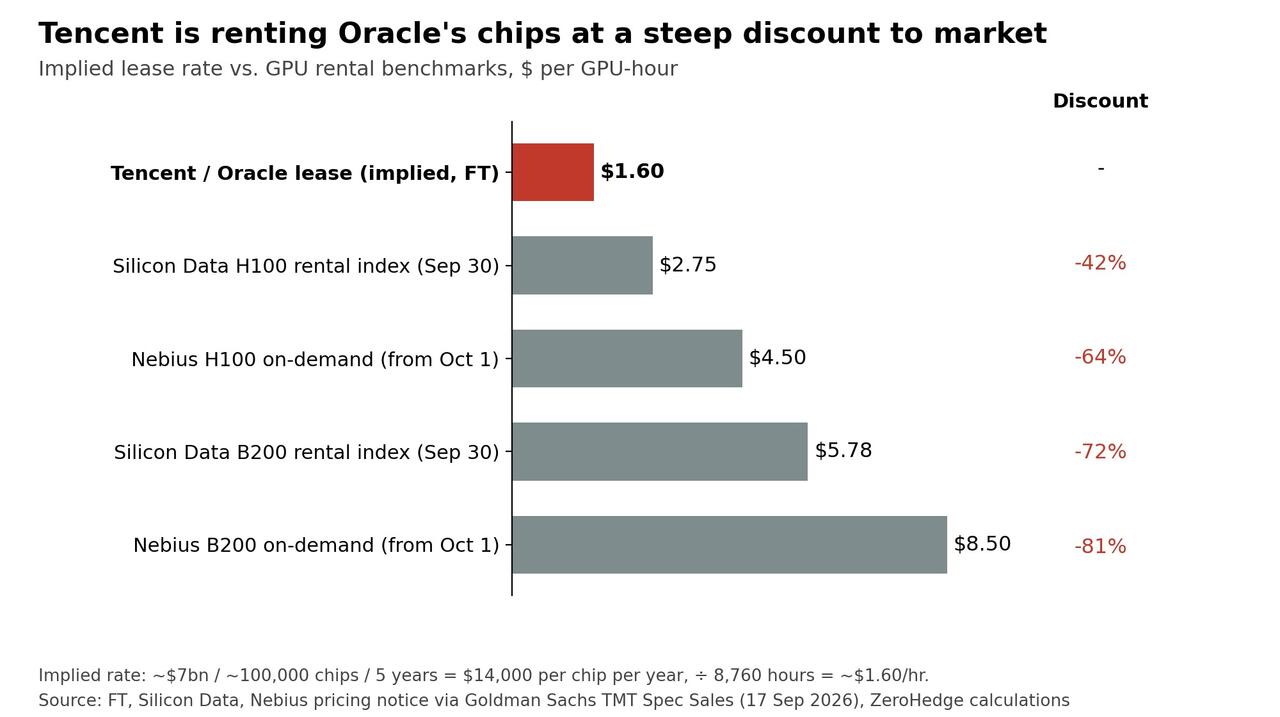
For context, Goldman TMT specialist Sean Johnstone flagged two weeks ago that Nebius was raising on-demand GPU prices again from today: H100 to $4.50 (+17%), H200 to $5.40 (+20%), B200 to $8.50 (+19%) and B300 to $9.50 (+21%). That followed a previous round of hikes in May, which he took as a sign of “continued strong AI compute demand and tight supply.”
The FT doesn’t say which chips are in the deal, beyond “advanced AI chips that were not available in China.” If they are Blackwells, Tencent is paying roughly a quarter of the going B200 rate. If they’re older Hoppers, it’s still about 40% below the H100 index. While multi-year take-or-pay contracts always clear below spot, and a 30% prepayment is certainly worth something to a borrower whose 2056 bonds yield well over 8%, valued at the B200 index, 100,000 GPUs for five years is worth about $25 billion of compute, against a $7 billion headline.
That leaves three explanations: the $7BN reported to the FT covers only part of the deal, the chips are older than “advanced” suggests, or – more likely – Oracle is selling capacity at a steep discount to raise cash. The third would fit Oracle’s history. In October 2025 The Information reported that Oracle made just $125MN of gross profit on ~$900MN of Nvidia rental revenue (a 14% margin), and lost almost $100MN renting out Blackwells in a single quarter (Tech, Crypto Dump On Report Exposing ORCL’s ‘Razor Thin’ Margins On AI Chips, Oct 7, 2025). At $14,000 per GPU per year, five years of rent brings in about $70,000 per chip. That has to cover a Blackwell-class system (estimated at well over $40,000 per GPU in hardware alone, before memory price hikes), plus the building, power, networking and interest on the debt that paid for it all. Seen that way, the 30% upfront payment may be the most valuable part of the deal for Oracle.
Tencent: spending like an American hyperscaler (and burning cash like one)
For Tencent, which for years was the most capex-shy of China’s megacaps, the bill is already showing up. Per the FT, the Oracle prepayment contributed to negative free cash flow of Rmb13.8bn ($2bn) in Q2, Tencent’s first negative quarter in more than a decade, while capex jumped 176% YoY to Rmb53bn ($7.9bn), covering AI infrastructure and prepayments for compute.
Goldman’s Prosus team (Adam Berlin et al), writing the day after the August 12 print, noted that 2Q capex came in 47% above GSe, flipping FCF to roughly -Rmb14bn from +Rmb43bn a year earlier and sending the stock down 4.5%. GS Tencent analyst Ronald Keung raised his FY26/27/28 capex estimates by +39%/+49%/+42%, trimmed EPS, and cut his price target to HK$670 from HK$700, although he was “encouraged by the aggressive spend” given Tencent has historically lagged ByteDance and Alibaba. One detail looks different today: management told analysts it could “rent their compute at attractive prices if needed.” It now seems Tencent is also the one doing the renting.
At Goldman’s Asia Leaders Conference a few weeks later, Tencent Chief Strategy Officer James Mitchell said AI remains the company’s “highest capital allocation priority” and that Q3 capex and prepayments would stay “meaningful,” because Tencent is front-loading infrastructure to lock in compute economics before memory prices rise further (they are rising: Micron just guided Q1 revenue to $61.5BN). Keung kept his Buy after the early launch of the Hy4 (Hunyuan 4) preview, a 770bn-parameter model with major gains in coding and agentic tasks. That is the model Tencent needs the Oracle GPUs to train, since, as the FT points out, domestic chips still can’t handle frontier training. The applications it feeds include Xiaowei, the WeChat-embedded agent we flagged in March and which sent the stock soaring the most since 2022 in June, plus the WorkBuddy office agent.
Goldman’s TMT specialist Sean Johnstone summed up the deal this morning:
For Tencent it gets frontier compute without waiting on domestic silicon…. Supports Oracle remaining capacity and backlog narrative (OpenAI + ByteDance + now Tencent) – will be interesting to see how Oracle CDS reacts today.“
That last line is the real story.
Oracle: the $664 billion backlog with a funding problem
On paper, Oracle has never looked better: its fiscal Q1 RPO reached $664 billion, cloud infrastructure revenue rose 121%, and it booked over $30BN in new AI contracts. Alas, funding all of that is a different matter. Q1 capex was $28.5BN, free cash flow was -$5.4BN, and management guided to up to $95BN in annual capex and a roughly $40BN debt-and-equity raise. BofA’s pre-earnings note showed the shape of it, modeling FY27 capex of $92.5BN (+66%) and FCF margins bottoming around -50%/-38% in fiscal Q2/Q3. BofA noted that customer prepayments should cover only about 25% of annual capex.
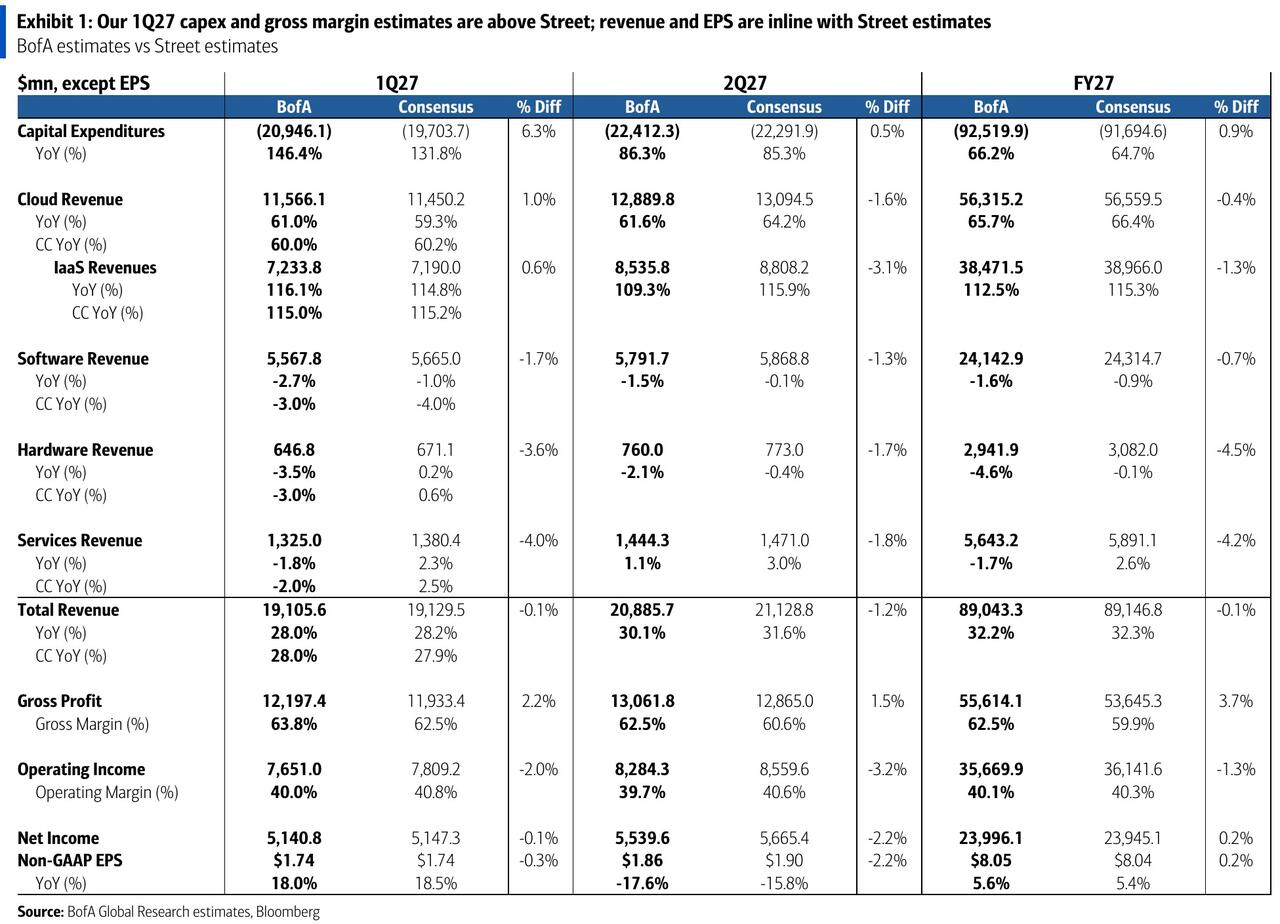
Which is why a Chinese customer wiring even a modest $2.1BN upfront is so welcome, even at about $1.60 an hour. It also explains how quickly things have gone wrong over the past ten days:
- Sept 24-25: Oracle declared force majeure at Project Jupiter, its 2.25GW New Mexico campus. Its 2056 bonds broke through an 8% yield for the first time, and roughly $30BN of hardware capex was suddenly in limbo (Oracle Bonds Plunge To Record Low As $30 Billion CapEx In Peril On Data Center Turmoil). The contagion soon reached Meta’s data-center bonds, which traded down to B2/B levels despite an A+ rating.
- Sept 28: Goldman’s desk flagged “cracks in the credit space.” Oracle CDS hit a record 251bps, and hyperscaler CDS widened 2-4bps across the board as “issuance continues to fund the AI buildout into a rising-yield backdrop.” Johnstone noted that S&P rates Oracle BBB-, one notch above junk, and that “the credit markets ask who funds the next $1tn of data-centre spend.” Our take: “Downgrade to junk now not if but when, pushing $120BN over the fallen angel cliff,” and an Oracle downgrade “will singlehandedly make the entire junk bond market 10% bigger.”
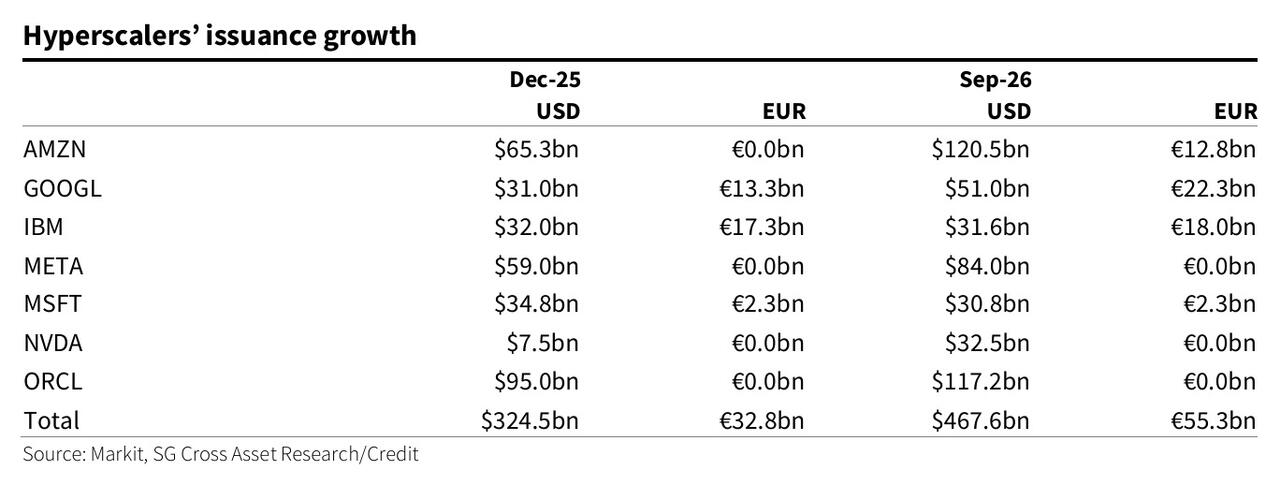
The supply problem predates all of this. SocGen’s credit team counts Oracle’s outstanding USD bonds at $117BN, up from $95BN at the end of 2025, in a hyperscaler bond pile that has grown by $143BN in nine months and which SG expects to reach about $200BN of new USD issuance by year-end.
Meanwhile, at Paramount…
While Oracle bondholders worry about who funds the massive (and increasingly delayed) data centers, the Ellison family has been busy borrowing for something else. This week Paramount Skydance, run by Larry’s son David with Larry as financial backstop, launched one of the largest acquisition financings on record to pay for Warner Bros. Discovery: a $52BN package made up of roughly $32BN of investment-grade secured bonds across eight tranches out to 2066, about $12.4BN of high-yield bonds marketed in the low-9% range, and a $7.5BN term loan. The IG portion drew over $109BN of orders, so spreads tightened. Still, S&P had just cut Paramount to BB, Moody’s rates the first-lien notes junk, and the combined company will carry nearly $80BN of debt at around 7x EBITDA. The deal is now slated to close October 6.
This matters for Oracle because the collateral behind Larry’s commitment is largely Oracle stock. Last week Ellison pledged another ~350 million Oracle shares (~$9.2BN) as loan collateral, bringing total pledged shares to about $57BN, just as the stock was falling and the CDS was making new records. So Oracle’s largest shareholder is posting Oracle equity to fund a highly levered media merger in the same week the market is asking whether Oracle can fund itself. The two sales are also competing for the same buyers: Paramount’s 40-year paper priced into the same IG market that just sent Oracle’s 2056s past 8%.
Bottom line
Tencent gets 100,000 Nvidia-class GPUs it can’t buy at home, five years of training capacity, and a model roadmap that no longer depends on Huawei’s yields. Oracle gets about $2BN of upfront cash, another headline for its backlog, and a customer whose deposits help cover capex the bond market is increasingly reluctant to finance. Washington gets a reminder that “not available in China” mostly means “available in Johor.” On that last point, Goldman’s ASEAN data center primer expects live capacity across the region’s six main hubs to grow from about 3GW today to 13GW by 2030 (a 33% CAGR), with Johor alone accounting for a third, and power delivery as the main bottleneck.
Whether the Tencent deal is enough to help Oracle’s credit is something Oracle’s CDS will show us (check back in a few hours). Goldman said it would be watching it today for the market’s verdict, and so will we.
Tyler Durden
Thu, 10/01/2026 – 09:40