
These Are The European Countries With The Newest Cars
Europe’s roads reveal a striking divide between countries where drivers regularly replace their vehicles and those where aging, secondhand cars remain the norm, according to a new report from ecarstrade.com.
New research from B2B automotive company eCarsTrade compared vehicle fleets across more than 30 European countries and found Luxembourg sitting comfortably at the top of the rankings for the continent’s newest cars.
Nearly 43% of Luxembourg’s registered vehicles are less than five years old, the highest proportion in the study. At the other end of the age spectrum, only about 6% of its cars have been on the road for 20 years or longer. The country also replaces vehicles unusually quickly, with its annual fleet renewal rate topping 10%. Roughly 7% of Luxembourg’s cars are now fully electric.
Belgium ranked second. More than one-third of its cars are less than five years old, while the country added roughly 456,000 new vehicles in 2024. Its fleet renewal rate is about 7.5%, among the strongest in Europe. Electrification is also becoming more prominent: roughly 5% of Belgium’s total fleet is electric, while EVs account for around 28% of new registrations.
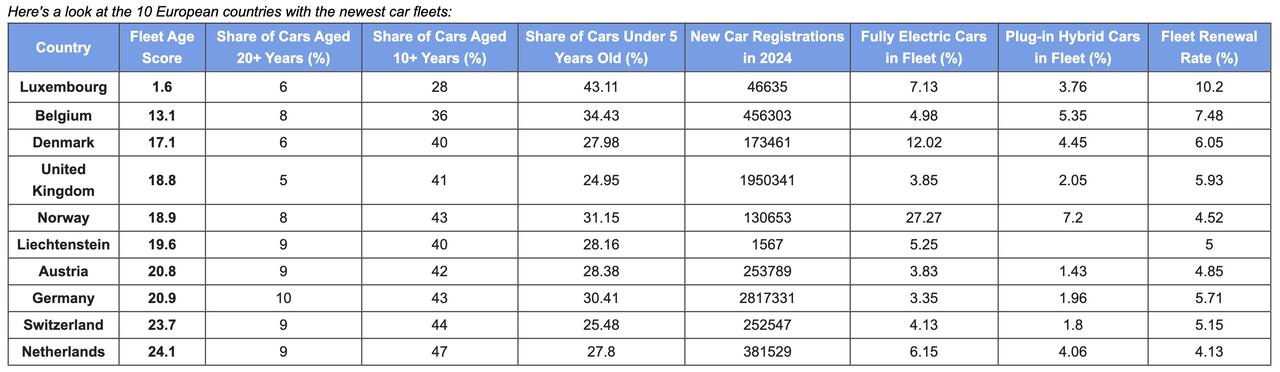
Denmark placed third, with approximately 28% of its cars less than five years old and only around 6% at least 20 years old. But Denmark stands out even more when it comes to the transition toward electric vehicles. More than half of new vehicles sold there are fully electric, and battery-powered cars already account for roughly 12% of the country’s entire fleet.
The United Kingdom came in fourth. Britain has an especially small population of very old cars, with fewer than 5% of vehicles aged 20 years or more, the lowest share measured in the study. Nearly 2 million new cars were registered in 2024, helping keep the country’s annual fleet renewal rate near 6%. EVs represented about 19% of new registrations, although they still make up a relatively small share of all vehicles currently on British roads.
Norway rounded out the top five and remains Europe’s standout when it comes to electrification. More than 27% of all Norwegian cars are fully electric, by far the highest share among the countries examined. Even more striking, roughly 88% of new vehicles purchased in Norway are electric. That means the country’s existing fleet is rapidly being transformed as older gasoline and diesel vehicles are gradually replaced.
Behind the top five were Liechtenstein, Austria, Germany, Switzerland and the Netherlands. Germany, for example, has roughly 30% of its fleet under five years old, while Switzerland is closer to 25%. The Netherlands has a somewhat older fleet overall, despite having a relatively healthy market for newer vehicles and EVs.
The report says that the opposite extreme can be found in Albania. According to the research, roughly nine out of every 10 vehicles there are at least a decade old, giving Albania the oldest fleet among the countries examined. The disparity highlights a broader economic divide in European car ownership: wealthier Western and Northern European countries generally replace vehicles more frequently, while parts of Eastern and Southeastern Europe rely much more heavily on older vehicles and secondhand imports.
That distinction can also make registration statistics somewhat misleading. A vehicle being registered in a country for the first time does not necessarily mean it is a new car. Used cars exported from countries such as Germany and France frequently enter fleets elsewhere in Europe as newly registered vehicles despite already having years of driving behind them.

“There’s a very clear split across Europe when it comes to car ages,” an eCarsTrade auto industry expert said. “Western countries keep replacing their fleets regularly, partly because incomes are high enough to realistically afford new vehicles.”
The researchers pointed specifically to Romania, Poland and Albania as markets where imported secondhand vehicles play a much larger role. As a result, the underlying age of some national fleets may be even greater than headline registration figures initially suggest.
The study, conducted in August 2026, compared more than 30 European countries using three primary measures: the percentage of cars at least 20 years old, the percentage at least 10 years old, and the percentage less than five years old. Those variables were combined into a Fleet Age Score ranging up to 100, with lower scores indicating newer national fleets.
Luxembourg recorded a score of just 1.6, well ahead of Belgium at 13.1 and Denmark at 17.1. The UK scored 18.8 and Norway 18.9, followed by Liechtenstein at 19.6, Austria at 20.8, Germany at 20.9, Switzerland at 23.7 and the Netherlands at 24.1.
Taken together, the numbers show that Europe is not moving toward a newer or more electric vehicle fleet at anything close to a uniform pace. In Luxembourg, frequent vehicle replacement keeps the average car relatively young. In Norway and Denmark, electrification is rapidly reshaping what people drive. Meanwhile, countries that depend heavily on imported used vehicles continue to operate fleets that can be dramatically older than those found just a few hundred miles away.
Tyler Durden
Tue, 09/15/2026 – 04:15