
Uranium Term Prices Hit A Record… So Why Is Nuclear Getting Nuked?
If you only looked at the price of the fuel, you’d think the nuclear trade has never been better. Long-term uranium prices are sitting at $96/lb, an all-time record and up ~12% YTD, taking out the $95/lb high set in mid-2007 at the peak of the last uranium mania (per UxC data compiled by TD Cowen). Spot has followed along to roughly $90/lb, up ~11% YTD.
If, however, you looked at anything with a ticker attached to it, you’d think the nuclear renaissance had been quietly cancelled somewhere between the “AI will need infinite power” phase and the “wait, who’s paying for all this capex?” phase.
That, in a nutshell, is the disconnect TD Cowen’s uranium team (Craig Hutchison and David Liang) highlights in its two latest Uranium Monitors: the commodity is making all-time highs, while the equities, the SMR darlings and even the IPO pipeline are going in the opposite direction. And the cause, at least in the short run, is the same one that kills every rally in a physical market eventually: the buyers are balking.
A record… on thin volume
Recall that when we first flagged the record term print on Sep 10, TD noted the term price rose $2/lb w/w “despite thin volume,” and that as of Aug 31, term contracting volumes were down ~15% y/y at just over 38Mlbs. TD’s main hope at the time was that the World Nuclear Association Symposium in London (Sep 9-11), where utilities, fuel-cycle players and policymakers all gather, “could be a catalyst to spur increased trading volumes.”
It sort of was. Term volumes rose to 42.2Mlbs by Sep 15, which narrowed the y/y shortfall to ~3%. Still, per TD’s latest note, what companies heard from utilities is not exactly the stuff of a buying frenzy:
“Term pricing remains at all-time high, and based on our conversations with the companies under coverage, utilities are feeling a sticker shock on pricing and seem reluctant to contract in any meaningful way.”
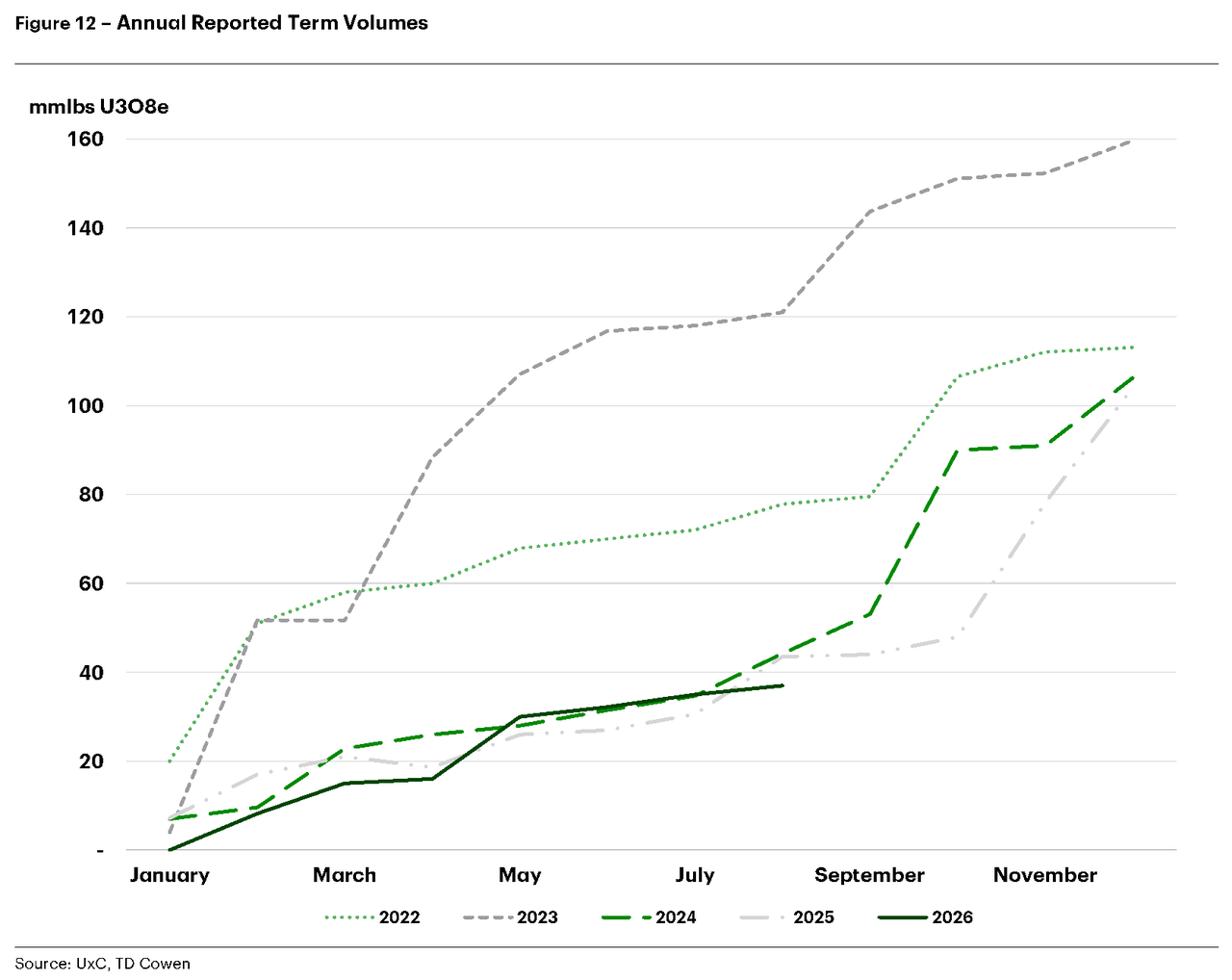
TD, to its credit, is not fazed and argues that “it is not a question of if term contract volumes pick up, it is a question of when,” since utilities keep contracting below replacement rates. The chart below shows what that looks like: 2026 cumulative term volumes are tracking at the bottom of the past five years, well below 2023’s ~160Mlb blowout and behind both 2024 and 2025 at the same point in the calendar. Utilities can put off buying fuel for a while. They can’t put it off forever, because reactors don’t run on “we’ll revisit in Q1.”
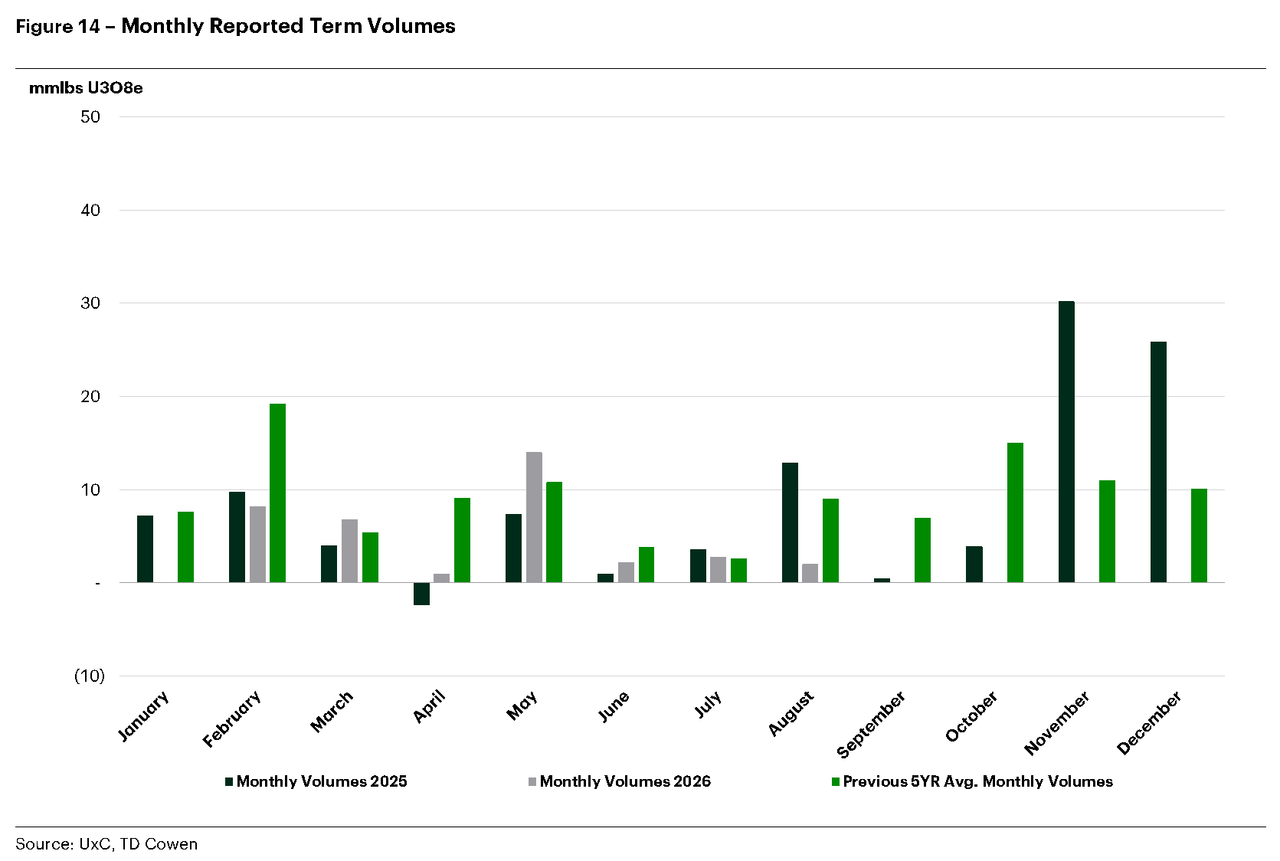
The monthly breakdown shows the same thing: outside a decent May, 2026 has undershot the prior five-year average almost every month, and last year’s big November/December catch-up (~30Mlbs and ~26Mlbs) is a reminder of how lumpy, and how late in the year, utility procurement tends to be.
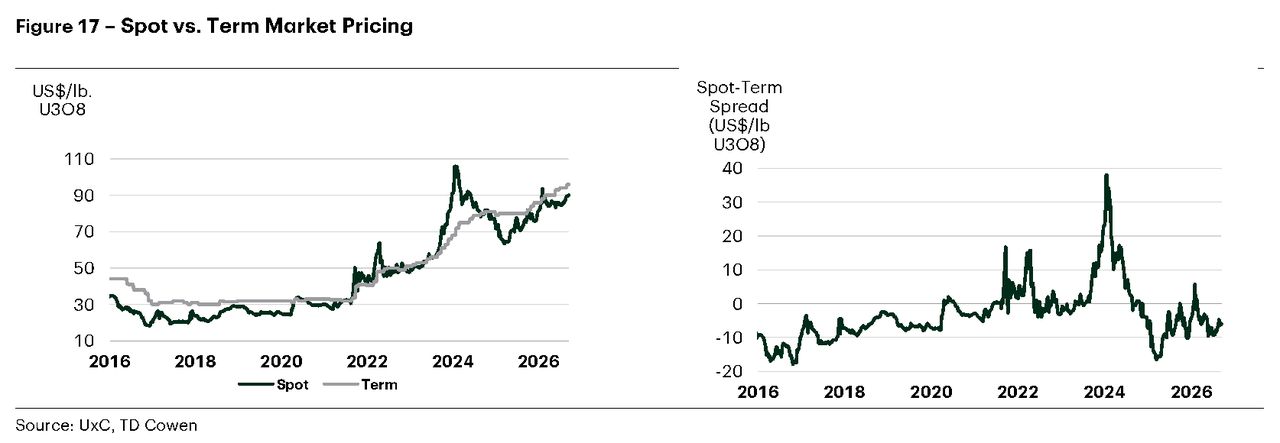
Spot, meanwhile, is a bit livelier. Cumulative 2026 spot volume reached 38.6Mlbs across 377 transactions as of Sep 15 (+12% y/y), though TD concedes this is “largely attributable to SPUT’s sizable purchases earlier this year.” The encouraging part is that September activity picked up, with weekly volumes topping 1Mlb and “participation broadening beyond SPUT,” helped by the usual post-summer seasonal pickup, near-term utility needs and “more aggressive pricing strategies from major producers.” Translation: Cameco and Kazatomprom are not in the mood to discount.
Note also where the spot/term spread sits: spot at a ~$6/lb discount to term, a far cry from the 2023-24 squeeze when spot traded at a $30+ premium. This is a market where end users are pricing long-dated scarcity but are not panicking about near-term delivery, which is the exact opposite of a blow-off top.
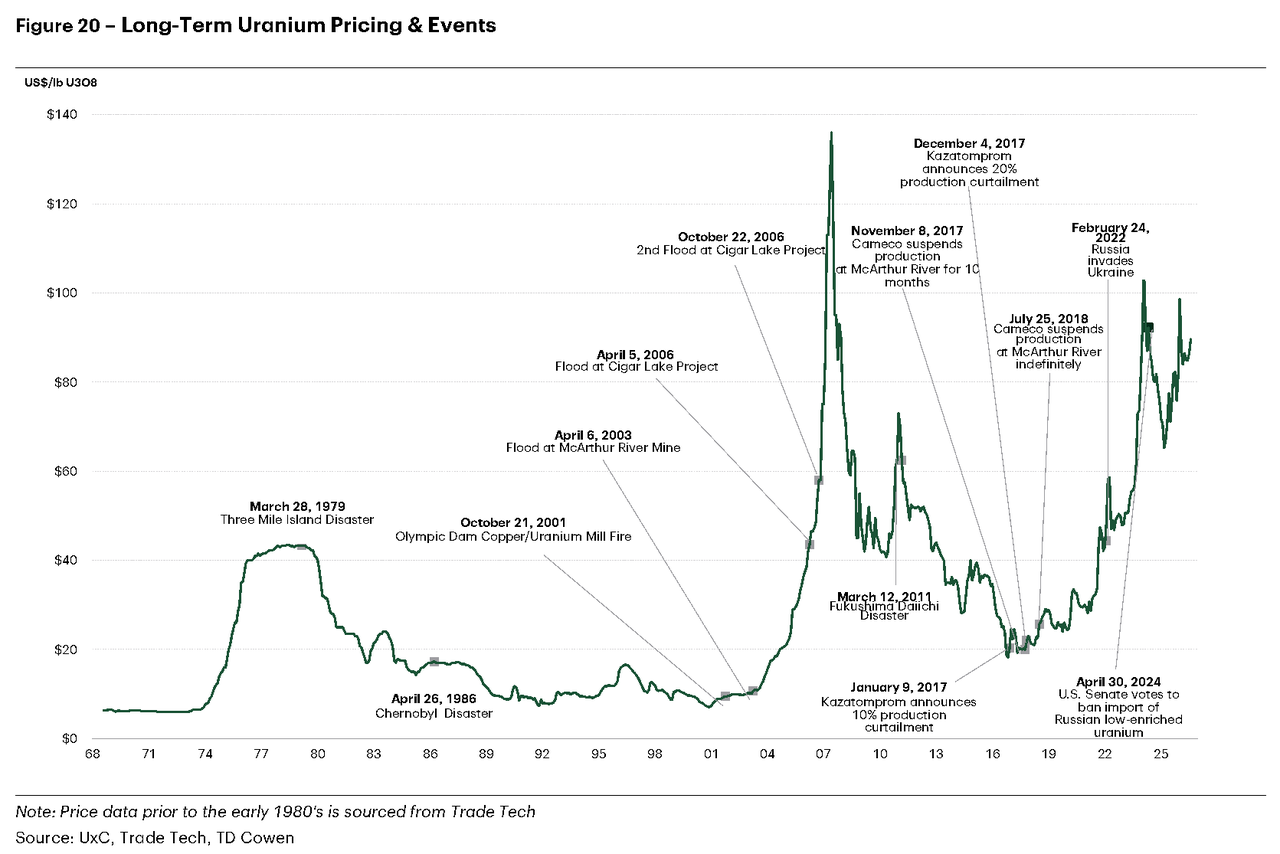
And for those wondering how “record” a record really is: $95 in 2007 is roughly $150 in today’s dollars. Or, as TD put it, “considering the significant inflationary pressures since 2007, there is considerable room for the term and spot price to run.” In other words, in real terms uranium is nowhere near its prior peak, as the long-term chart makes clear.
Meanwhile, in equity land…
While the fuel price grinds higher, the stocks go the other way, and fast. Comparing TD’s two performance tables, here’s what happened in the two weeks between Aug 31 and Sep 14, right around the WNA Symposium that was supposed to be a catalyst:
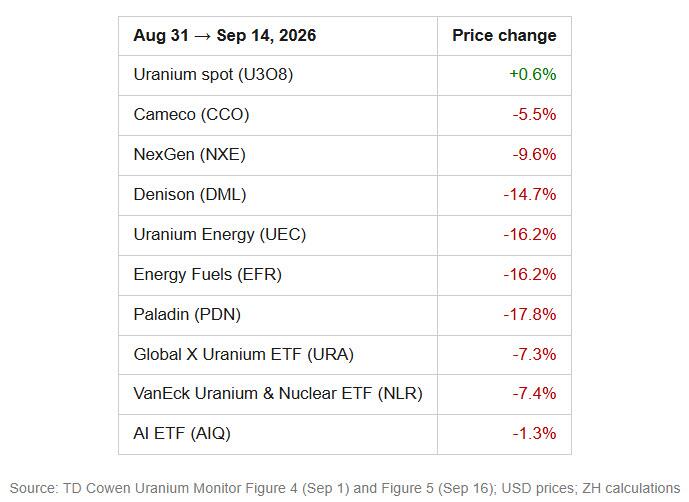
On a longer lookback the picture is just as odd. NLR, the broad nuclear ETF, is down 12% YTD and ~35% below its 52-week high, while the AI ETF (AIQ) is up 25% YTD. So for all the talk about nuclear as the “AI power trade,” the market has clearly separated the two: investors still want AI, but they’re no longer paying up for the power plants that are supposed to run it.
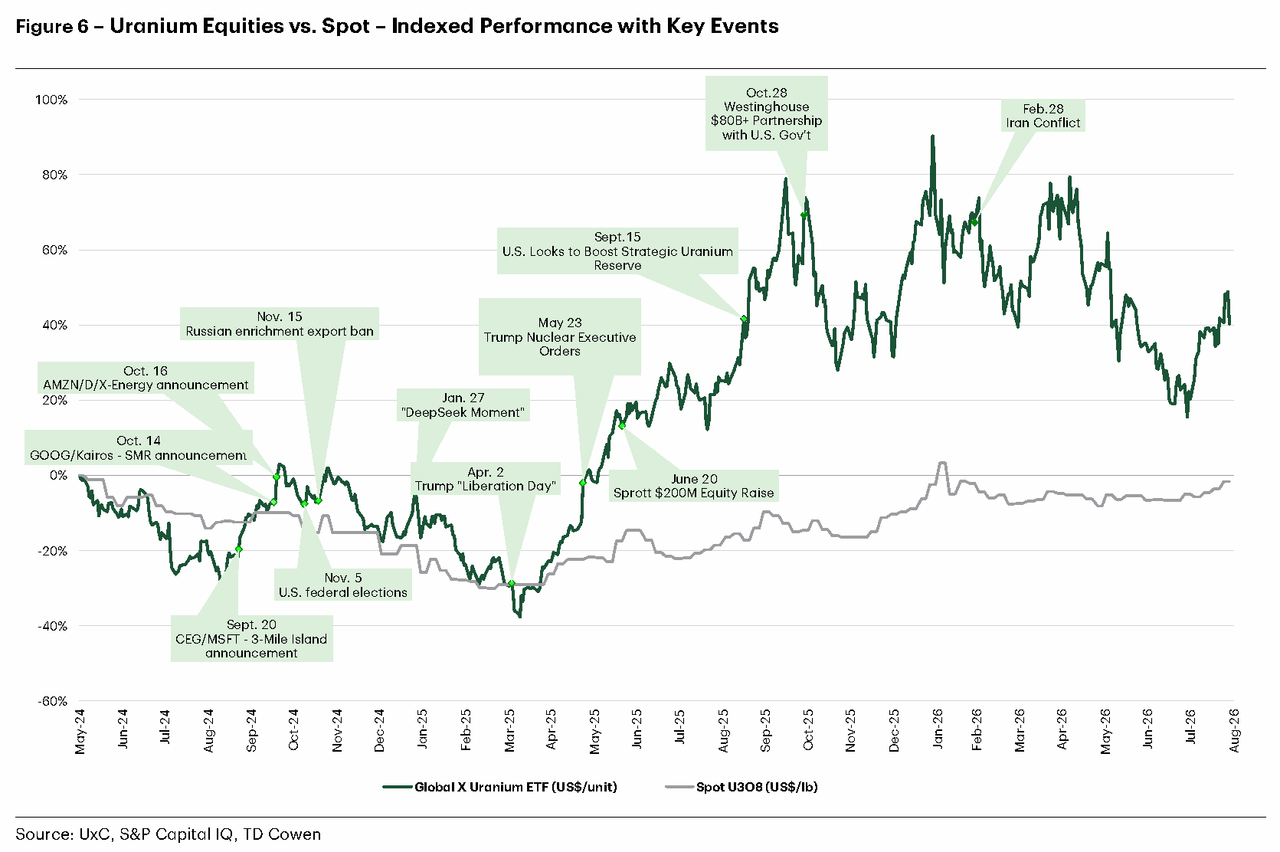
TD’s indexed chart shows the round trip: URA surged roughly 80-90% above its 2024 starting point on the Oct 2025 Westinghouse/US government $80BN partnership and again into the spring of 2026, before a vicious drawdown into July. Spot uranium, meanwhile, barely moved through all of that, which is a good reminder of which part of this complex was driven by fundamentals and which part was driven by momentum.
The carnage has been even worse further out on the risk curve. NuScale and Oklo are each down roughly 50% YTD. Holtec pulled its ~$10BN IPO last week, with CEO Kris Singh blaming “a recent market correction and cooling investor enthusiasm for the AI trade,” after the recent class of nuclear debutantes (X-Energy ~37% below its April IPO price, Standard Nuclear 20%+ below its July debut) showed what happens to public investors who pay for the promise. And this week, Oklo lost its PJM interconnection queue fight after FERC said its application was deficient, which is not the first time a regulator has sent Oklo’s homework back for “missing information.”
Even the policy headlines, which used to be good for a double-digit pop, now fade within hours. The House passing the Ratepayer Protection Act on Sep 17, which would make data centers pay for their own generation and grid upgrades (effectively the “behind the meter” framework we have long argued should be mandatory), sent NuScale +10% and Oklo +13%… and then both gave back most of it the next day. And the South Korean “$100BN+ for up to eight US reactors” headline that TD flagged as a potential catalyst has, for now, turned into a $22.3BN gas plant in Texas (with no customers), with the nuclear portion reportedly on hold amid the tangle of the Westinghouse/KHNP IP settlement, Korea’s talks about a stake in Westinghouse, and tariff negotiations. You can’t make this up.
Goldman: “inbounds have been extremely light”
So what does the sell side hear from actual investors? Goldman’s Energy, Natural Resources & Utilities sector specialist (Sep 18) gave a blunt read:
“To level set – inbounds have been extremely light on the nuclear front over the last couple of weeks – though we think is likely just a reflection of the current tape (rates, inflation, broader AI concerns).”
What makes the Goldman take useful is the distinction it draws between the long run and the near run. On the long run, “there is less doubt in the longer-term role of nuclear in the power stack.” On the near run, though, “there’s more focus on time to power (recips, turbines, fuel cells, batteries) and the cost profile for most projects remains a sticking point for investors.” In other words, hyperscalers need megawatts in 2027, not gigawatts in 2037, and the market is pricing nuclear accordingly. GS also pointed to an NEI survey showing +7 GWe of new capacity planned via uprates, restarts, longer refueling cycles and other output increases since the prior survey, which is the unglamorous, cheap and fast way to add nuclear power, and which also happens to burn more uranium.
That brings us to the more important point for the fuel.
The supply side isn’t getting any easier
While equity investors worry about rates and AI capex, the physical side of the market keeps getting tighter at the margin:
- Kazakhstan’s acid problem: Kazatomprom (roughly the Saudi Arabia of uranium) delayed commissioning of its TQZ sulfuric acid plant by 6-12 months (from Q1/27 to Q3/27-Q1/28) after a regulatory suspension, raised capex guidance on acid and cost inflation, and warned that the delay will be reflected in 2027 production guidance. TD thinks “a downward revision of uranium output in 2027 is possible.”
- Then Russia made it worse: Moscow banned sulfuric acid exports through year-end. As we noted on Sep 15, Kazakhstan relies on Russian acid for ~20% of its needs, and without a waiver the ban could cut ~3Mlbs (~4%) from Kazatomprom’s 2027 output. Goldman’s sector specialist flagged the same risk: “Kazakhstan is a major taker of Russian sulfuric acid as an input for uranium production.”
- The Red Book reality check: The NEA/IAEA’s latest Red Book (Sep 14) showed only a 2.1% increase in economically recoverable resources and emphasized rising mining costs, depletion of low-cost deposits, and the higher cost profile of new discoveries. At the same time, the IAEA raised its long-term outlook to 696 GWe (low) to 1,284 GWe (high) of nuclear capacity by 2060, i.e. +85% to +241% vs 2025.
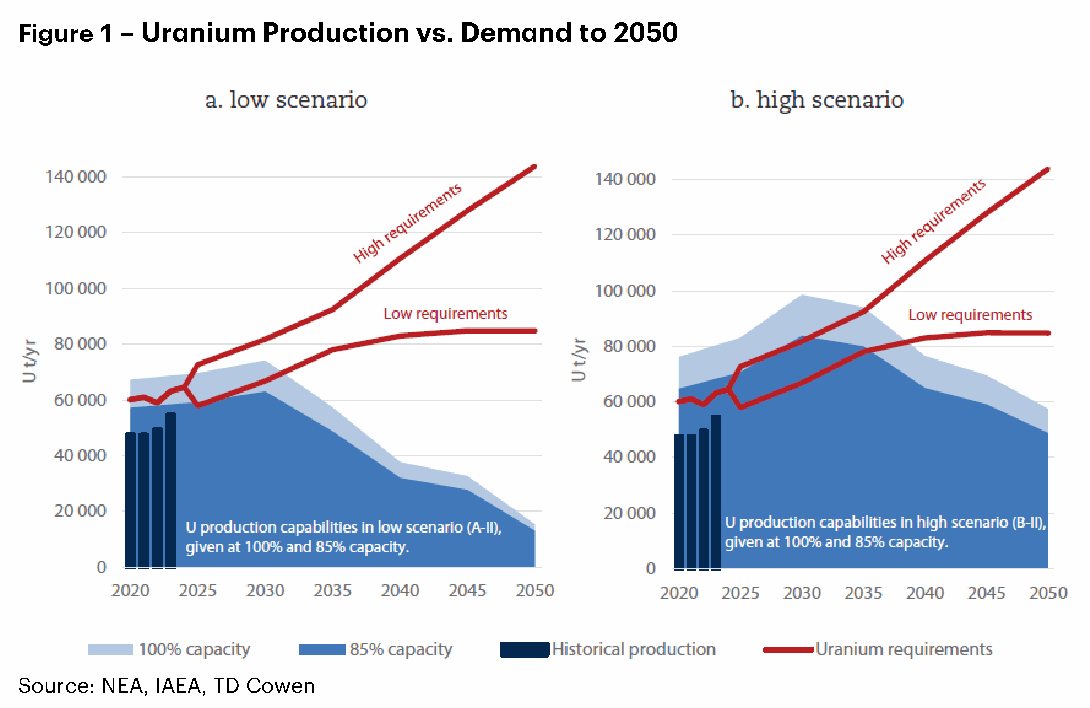
The chart above is what the long-run bull case looks like: even in the high-production scenario, existing and expected capacity peaks around 2030 and then declines, while requirements climb under both demand cases.
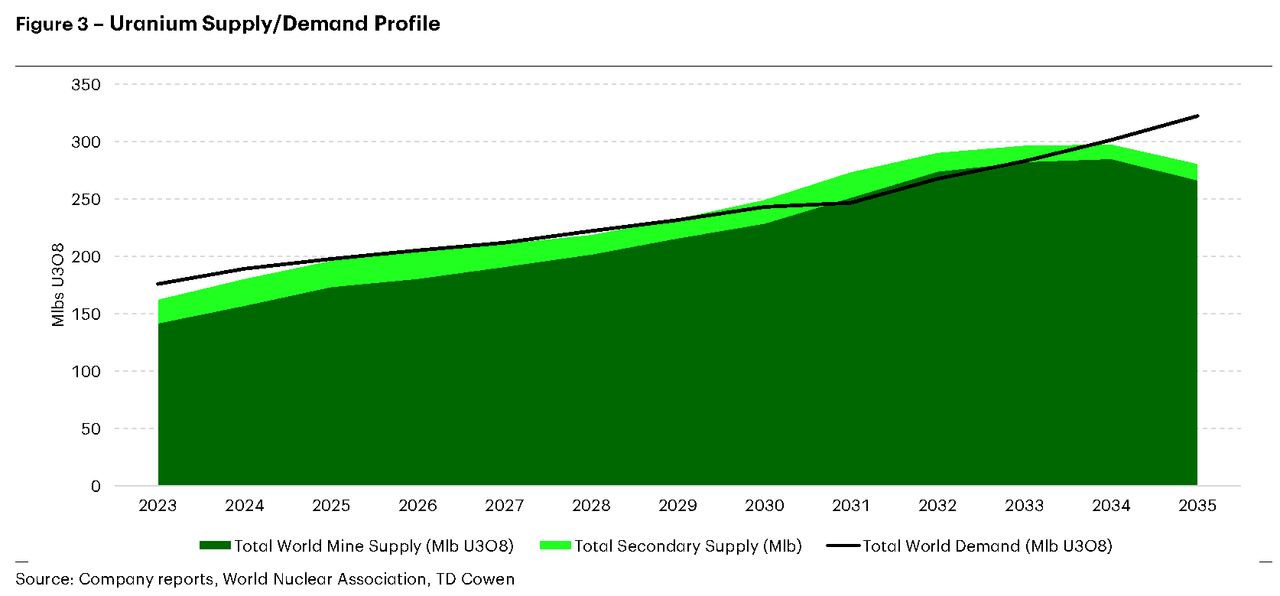
To be fair (and balanced), TD’s own model is less apocalyptic in the medium term than the bulls often are. It shows the market roughly balanced near term (-1Mlb in 2026 and 2027), then moving into a surplus from 2030-2033 as Western mine supply ramps (peaking at +27Mlbs in 2031), before the deficit comes back hard: -4Mlbs in 2034 and -42Mlbs in 2035, when total demand hits 322Mlbs vs 281Mlbs of supply. Put differently, the thesis rests on utilities having to lock in 2030s supply today, which is exactly the contracting they’re currently putting off because of “sticker shock.”
Throw in India opening its nuclear sector to private build-own-operate for the first time (draft SHANTI Act rules released Aug 14, a story we’ve been tracking since July), the DOE adding 13 more projects to its Nuclear Energy Launch Pad, and Washington’s push for faster enrichment buildout, and it becomes clear that policy hasn’t turned against nuclear. What has changed is how much equity investors are willing to pay for it.
The mood in London: positive, “albeit perhaps slightly less bullish”
TD hosted its 1-on-1 uranium conference in London alongside the WNA Symposium (which we will discuss in a subsequent post), which drew a record 1,300 attendees. The read: tone “positive, albeit perhaps slightly less bullish than last year,” no major announcements, and investors “continue to view progress on the deployment of new nuclear reactors in the U.S. as one of the key near term catalysts.” Which, given the Korean deal’s detour into Texas natural gas, may take a bit longer to show up.
Still, the picture on actual reactor builds outside the US hasn’t changed: 37 reactors are under construction in China alone. The US? Zero.
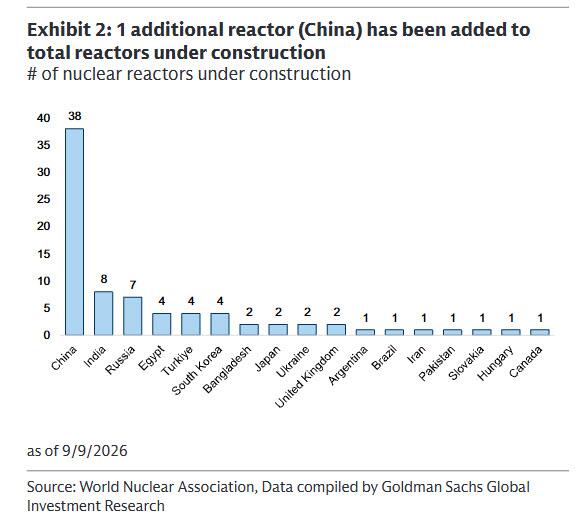
Meanwhile, in Japan, TEPCO just restarted Unit 6 at Kashiwazaki-Kariwa, the largest power plant in the world: And that’s after the public mood against nuclear in the country of Fukushima is, as one can imagine, negative to quite negative.
Bottom line
The fuel market and the equity market are telling two different stories, and history suggests the fuel market usually wins. The same UBS analysts who in late August warned that the market is “tightening structurally” were pointing to the same combination we see now: firm term prices, long mine lead times, and sustained utility need. The difference today is that equity investors have stopped paying ahead of the utilities. Once utilities get over their “sticker shock” and resume contracting, likely in the traditional Q4 rush if last year is a guide, the question is whether the stocks will still be trading as if nuclear were just another AI-capex casualty.
For those who want to front-run the catch-up, TD keeps Cameco as its top pick among uranium equities and Denison Mines as its top small/mid-cap name (DML is down ~15% in two weeks, so it’s cheaper than it was when TD last said so). And Goldman, in a note published just yesterday, reiterated its Buy on Uranium Energy (UEC) after FQ4 revenue came in ahead of expectations “reflecting solid uranium price environment,” citing sharply ramping production, falling unit costs, and medium-term catalysts from “US-origin needs (e.g. NNSA)” and a potential move into conversion.
Or, to put it differently: uranium hit a record high and nobody cared. Historically, that’s not how the bull market ends; it’s what the middle of one looks like.
* * *
More in the full TD Cowen Uranium Monitor notes (Sep 1 link here and Sep 16 link here) available to pro subscribers.
Tyler Durden
Wed, 09/30/2026 – 22:38