


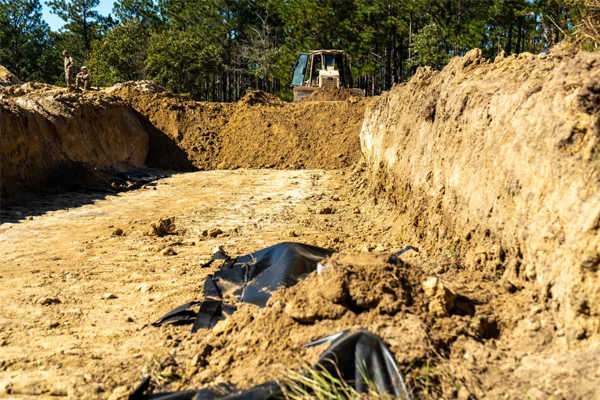
The Army is preparing for the grim possibility of burying fallen soldiers on the battlefield, testing how fast it can dig temporary graves while preserving remains for eventual identification and return to families after the end of a conflict.
During an exercise in North Carolina, engineers, preventative medicine teams, chaplains and fatality management specialists prepared for mass temporary interment not used on a large scale since the Korean War, the Army announced in a release last week.
For more than twenty years during wars in Iraq and Afghanistan, U.S. air superiority allowed the quick evacuation of remains back to the United States through mortuary affairs channels. Future conflicts — especially those with large-scale combat operations, or LSCO — may not have the same capabilities.
Phase II of Operation Dragon Covenant challenged troops to test and validate temporary burial operations and remains preservation at a large scale. Engineer soldiers involved had to use their equipment to excavate and then fill burial trenches without damaging mock remains, made of skeletal models and water containers, so that hypothetical future forensic teams could unearth and repatriate them after the end of a conflict.
The U.S. Army is doing drills for digging MASS GRAVES in an operation called “DRAGON COVENANT”. 🚨🚨🚨⚠️⚠️⚠️
Yes, you read that correctly…DRAGON. COVENANT.
Why is this alarming?
This is the first time since the Korean War that the U.S Military has conducted such a drill like… pic.twitter.com/brMvISd796
— The Patriot Voice (@TPV_John) October 29, 2026


The U.S. Army is training soldiers to dig mass graves, per a US Army release and reported by @HormuzLetter. The exercise reportedly involved preparing burial trenches capable of accommodating 2,400 bodies in less than 24 hours.
Army engineers, medical personnel, chaplains and…
— ThePatrioticBlonde™🇺🇸 (@ImBreckWorsham) October 30, 2026
🚨🇺🇸 AFTER 70+ YEARS, THE U.S. ARMY IS AGAIN PRACTICING HOW TO BURY THOUSANDS OF SOLDIERS IN A DAY
Army units are practicing mass temporary battlefield burials for a high-casualty war in Fort Bragg, North Carolina.
A standard burial plot holds 100 casualties.
With eight… pic.twitter.com/5889BIqkEb
— Mario Nawfal (@MarioNawfal) October 30, 2026
“This exercise allowed us to take a critical look at how we respect, honor, and systematically manage our fallen in a high-intensity conflict,” said Sgt. 1st Class Delbert Ruede, the senior fatality management leader for 3rd Corps Sustainment Command (CSC), in the release. “If we went to war tomorrow, we would be making this up as we went along. What we are doing here is taking a scientific, field-tested approach so that we can maintain positive control and respectfully care for our fallen.”
The U.S. requires the evacuation of human remains when operations in wartime situations permit, but U.S. joint service guidance authorizes temporary graves during mass casualty incidents in war, where decedents cannot be safely moved due to safety, lack of transportation, or if the deaths are a result of chemical, biological, radiological or nuclear weapons.
Soldiers, civilians or enemy combatants buried in temporary graves must be treated with dignity and their information — if available — preserved, the military dictates.
The Geneva Conventions require that even the bodies of enemy forces be recorded and that identifying information be collected. Cremation is rarely authorized, save for hygiene or religious grounds.
Army doctrine prescribes that temporary interment plots consist of five parallel trenches to hold 100 bodies, with ten bodies lining each side of the trenches. In previous trials, units using standard backhoes could excavate only one trench — and thus ten remains — per three hours. According to the service’s release, operators during the most recent exercise used D6 bulldozers to excavate a trench large enough for 20 remains in an average of one hour and 15 minutes.
Based on that, commanders can plan for an engineer company with the requisite equipment to dig and cover trenches for up to 2,400 bodies every 24 hours, if operating nonstop.
Operators also learned that published instructions on trench standards did not reflect current Army equipment. The service said that doctrine called for seven feet between rows, which the team found too narrow to drive a dozer without disrupting the burial trenches. This discovery, and any others, will be reflected in future Army doctrine.
Beyond the physical trenches, the exercise also gave religious specialists and chaplains an opportunity to prepare for LSCOs by developing sensitive protocols.
“In a high-intensity, contested combat environment, fatality management teams cannot stop a 24-hour interment operation for individualized religious gravesite services,” Lt. Col. Ruska, chaplain for the 3rd CSC, said in the release. The team, he added, also may be unable to determine an individual’s faith after death.
“We consulted with Chaplains from various low density faith groups for advisement,” he said. “The consensus was that by consecrating the site before remains are placed in the ground reassures families that their loved ones are treated with reverence, dignity and honor despite the inability to provide a memorial ceremony in a contested combat environment.”
The exercise will continue, the Army said, with Phase III of Dragon Covenant in Spring 2027, integrating security, medical facilities and a mortuary affairs collection point.
In Case You Missed It:


For breaking news from one of the most over the target and censored names in the world join our 100% Free newsletter at Newsletter, The best way to get the information you want.
Also follow us at Gab
Follow us on Gab.com , Like, comment, and subscribe.
Telegram, Join our Telegram chat
Shop Patriot and Detox the Deep State by shopping with our sponsors.
RedPillLiving.com, Home of Sleepy Joe – the world’s most powerful all natural sleep formula.
The Serapeum.com, The Hidden History of Man & The Mystery Babylon Religion of The Deep State.