

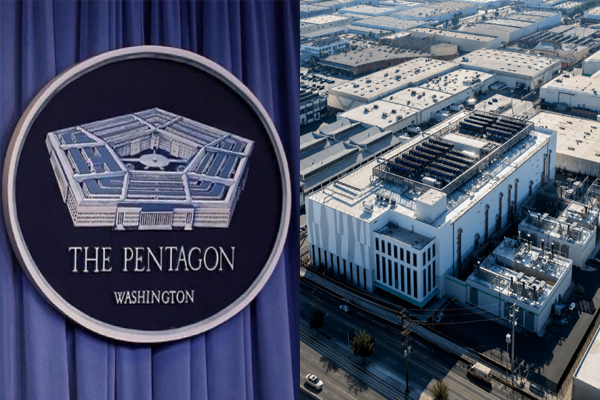
At Dugway Proving Ground in Utah, on ground the Army’s own contracting documents describe as previously used for grazing, a company owned by two of the largest investment firms in the world is preparing to build a data center.
It is one of at least a dozen military installations the Army and the Department of the Air Force have opened to commercial data center developers over the past year and a half. Two of those deals are real; the rest are still proposals.
JUST IN: The Pentagon is building AI data centers on at least a dozen military bases across the US, per AP.
The Army and Air Force are opening federal land to commercial developers in exchange for access to computing power.
Fort Bliss in Texas will host the Pentagon's first… pic.twitter.com/wnu7HjDlst
— Coin Bureau (@coinbureau) July 29, 2026
Land-for-Computing
In late March, the Army conditionally selected two companies to enter exclusive negotiations to build and operate commercial hyperscale data centers on Army land.
Carlyle, the global investment firm, was picked for roughly 1,384 acres at Fort Bliss, Texas. CyrusOne, a data center operator jointly held by funds managed by KKR and BlackRock, was picked for the parcel at Dugway. Each project is estimated to cost about $2 billion, according to the Financial Times.
The companies will be responsible for financing, building, operating, maintaining and eventually decommissioning the facilities, the Army said, on what it called “underutilized but non-excess Army land at no upfront cost to taxpayers.” In exchange for the land, the service gets access to computing power.
It all runs through the Army’s Enhanced Use Lease program, driven by a Trump executive order directing agencies to open non-excess federal land to data center development. The U.S. Army Corps of Engineers is handling lease negotiations and environmental review.


Which Bases and How Close to Housing?
Only Fort Bliss and Dugway have been awarded so far, and even those remain conditional, pending negotiation. Beyond them, federal contracting documents show the Army considering data centers at Fort Hood, Texas, and Fort Bragg, N.C.
The Department of the Air Force put out its own call in 2025 for private AI data center projects on unused land at Arnold Air Force Base, Tenn., Edwards Air Force Base, Calif., Joint Base McGuire-Dix-Lakehurst, N.J., Davis-Monthan Air Force Base, Ariz., and Robins Air Force Base, Ga.
More recently, it sought bidders for facilities at Joint Base Elmendorf-Richardson, Eielson Air Force Base and Clear Space Force Station in Alaska. Acreage varies enormously; for example, Fort Hood has 207 acres on offer. Fort Bliss has nearly seven times that.
Proximity to the population is what has made data centers a heated topic in the civilian world. Nearly $156 billion in projects nationwide have been delayed or canceled after local opposition, according to Data Center Watch.
In Virginia, which holds the world’s highest concentration of the facilities, a state-funded study found residents’ monthly energy bills could rise by $14 to $37 by 2040.
Army Officials Say They’re Ready
“So I think the difference between us, the Army, doing a data center, and say Meta or Google, is we’re part of the communities that are there, and we are going to engage with them on a routine and regular basis to look for solutions that work for everyone, right?” Col. John Oliver, executive officer for Deputy Army Under Secretary Dave Fitzgerald, told Defense One. “Because, yes, we understand that there’s been consternation with data centers.”
Two requirements attached to these projects do not apply to commercial builds off base. Proposals must include net-zero water usage and a power plan that does not draw on the local electrical grid. Bidders were also required to describe plans for “local outreach and engagement” and to assess “any risks or opposition” to the project.
Army officials want the project to be a net contributor rather than a net drain. In the spring, Fitzgerald traveled to Fort Bliss for a listening session with the commander of the 1st Armored Division, community members, El Paso Water, El Paso Electric and Carlyle. One idea on the table is having the developer drill a new well to feed the city’s desalination plant, offsetting what the data center uses.
“We are encouraging Carlyle to do that, so actually make it net-positive,” Oliver told Defense One. “We don’t know if that’s an engineering solution that we can actually get to yet, but we’re actively working toward that as a part of the process.”
Darrell M. West, a senior fellow at the Brookings Institution who studies data center development, said the approach is sound, and that communities which have accepted the facilities tend to be the ones told the full details in advance.
Donald Trump is literally using taxpayer money to build big AI data centers on public land in America, and on our military bases, for a foreign country [Israel]. That's high treason in book.
He needs to be impeached, removed and prosecuted before he completely destroys America. https://t.co/zLTEIANYT2
— Kentucky Statesman (@ky_statesman) August 4, 2026
Congress Not Settled
Rep. Cory Mills, a Florida Republican, secured a provision in the House version of the fiscal 2027 defense authorization bill. This bill bars the Defense Department from leasing land for data centers unless developers agree not to install equipment containing components made in China, Russia, Iran or North Korea. The restriction covers certain printed circuit boards, advanced semiconductors and chipsets the department considers a security risk.
“Honored to pass this amendment to protect our military installations from Chinese components being used in data centers on our installations,” Mills wrote on X.
The Army objected. The measure would create a “federal land penalty,” a service official told Federal News Network, imposing rules on companies building on installations that would not apply to identical projects built anywhere else. “We want Congress to incentivize companies to build on secure federal land, rather than creating barriers that drive them away,” the official said.
“We’re not opposed to data centers,” Garamendi said. “We just want to make sure that if we’re going to put a data center on a federal facility, that federal facility is not going to be degraded by the data center.”
His questions were installation questions. “Is there encroachment on training and operations and the physical and supply chain of security?” he asked.
Senate Armed Services Republicans defeated a separate Democratic amendment that would have blocked leasing until the Pentagon finalizes a data center strategy. House appropriators, meanwhile, adopted language acknowledging that data centers “place significant strain on energy and water resources and communities have resisted such projects.”
Available Information
For anyone stationed at or living near one of these installations, several things are known for sure. Only two projects have been awarded, and both remain conditional. Fort Hood, Fort Bragg and the Air Force sites are solicitations, not commitments.
The Army Corps of Engineers is conducting the environmental review at both awarded sites. Developers must build independent power that does not tap the local grid and meet net-zero water usage. Excess power generated on base could potentially be sold back to civilian grids.
The Association of Defense Communities has scheduled further discussion of military data center development at its Installation Innovation Forum in October 2026.
In Case You Missed It:


Flock Cameras and the Watchers: The Bible Prophecy Warning I Can’t Ignore
For breaking news from one of the most over the target and censored names in the world join our 100% Free newsletter at Newsletter, The best way to get the information you want.
Also follow us at Gab
Follow us on Gab.com , Like, comment, and subscribe.
Telegram, Join our Telegram chat
Shop Patriot and Detox the Deep State by shopping with our sponsors.
RedPillLiving.com, Home of Sleepy Joe – the world’s most powerful all natural sleep formula.
The Serapeum.com, The Hidden History of Man & The Mystery Babylon Religion of The Deep State.