
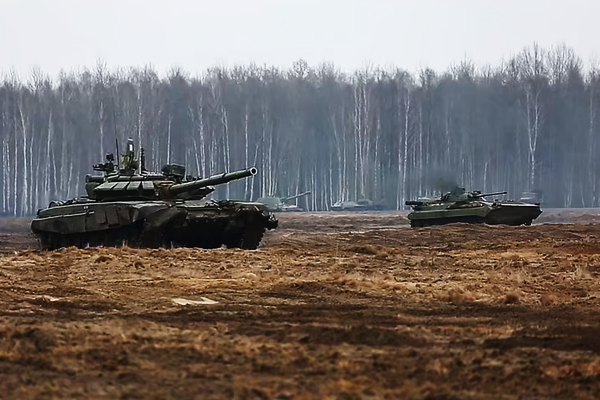
The plans were passed on to Biden’s government and discussed in a series of secret briefings with NATO allies.
They are said to contain specific routes that might be taken by individual Russian units and detail what roles they might play in the conflict. Der Speigel suggests the US is mulling whether to make the plans public in a bid to undermine them.


But the West’s fears of a war were today branded ‘alarmist’ and a symptom of American ‘hysteria.’
Russia’s foreign ministry spokeswoman Maria Zakharova wrote on Telegram: ‘The White House’s hysteria is more revealing than ever. The Anglo-Saxons need a war. At all cost.
‘The provocations, disinformation and the threats are their favourite method for resolving their own problems.’
The White House confirmed that Biden and Putin would discuss the crisis by phone today – just hours after thousands of Brits and Americans were warned to get out of Ukraine while they still can, as tensions reached boiling point.
The warning came amid fears that Putin could launch an ‘aerial bombardment’ of Kiev, risking a high civilian death toll.
Several other countries have now told their citizens to leave the country, including Belgium, who on Saturday warned there would be ‘no guarantee of evacuation’ following a ‘sudden deterioration’, as ‘communication links including internet and telephone lines could be seriously affected’ and air travel hampered.
US Secretary of State Antony Blinken today warned that the crisis had reached a ‘pivotal moment’, adding that there continues to be ‘very troubling signs of Russian escalation’, including new forces arriving around Ukraine’s borders.
Images released Saturday show Russian and Belarusian forces testing multiple rocket launchers mounted on snow camouflaged trucks, while a major Russian sea drill was launched in the Black Sea.
But despite the sabre-rattling drills, Russia’s ambassador to the US Anatoly Antonov told Newsweek magazine that the US warnings of an invasion were ‘alarmist’ and repeated that his country was ‘not going to attack anyone.’
Tobias Ellwood, however, the chairman of the Defence Select Committee, branded the Ukraine crisis ‘our Cuban missile crisis moment’ as he called for British-led NATO divisions to be in the country.
The Conservative MP told Times Radio on Saturday: ‘An invasion is imminent. Once that happens, because of the grain the comes out of Ukraine for the world, (that will) affect food prices across the world.
‘Oil and gas prices will be affected as well, and European security will then be threatened further, so we have to ask ourselves, what should we do instead?
‘What are the calculations, and yes, there is this looking Putin in the eye wondering what would happen.
‘This is our Cuban missile crisis moment’.
He said the consequences of allowing Ukraine to fall would see a ‘new era of instability with a Russia and China axis developing’ while the West is ‘shrinking in size’ and authoritarianism is on the rise.
He added that he was ‘really concerned about what’s going on in No 10’ over the Ukraine crisis.
He criticised an absence of international leadership, saying: ‘Where is the United Nations Security Council resolutions? Where is the determination not to put Nato troops around the country as we’re doing at the moment, but actually inside the country as well…?
‘I know this is something that the MoD (Ministry of Defence) would like to do, but they are hampered by political resolve, by a political appetite to lean into this’.
He added that it would be ‘misguided’ to think sanctions against Russia would work, and that: ‘We haven’t understood the bigger strategic picture.’
‘I’m again really concerned about what’s going on in No 10,’ he said, ‘We’re playing catch-up and I’m afraid it’s all too late.’
It comes after the Foreign Office this week updated its advice to tell UK nationals to ‘leave now while commercial means are still available’ amid mounting concerns they could get caught up in fighting – including a deadly ‘aerial bombardment of Kiev’ – should Putin give the go-ahead to his 130,000 troops currently massed near Ukraine’s borders.
The urgent government update came less than 24 hours after the US also issued an evacuation order, as western analysts raised the alarm that Vladimir Putin was about to send in his forces.
The European Union also told non-essential staff from its diplomatic mission in Ukraine that they should leave the country, but stopped short of issuing a full evacuation order.
Meanwhile, armed forces minister James Heappey today said British troops helping with training in Ukraine will be leaving the country this weekend.
Having sent UK personnel to train Ukrainians on the anti-tank missiles supplied by Britain, Mr Heappey said: ‘All of them will be withdrawn. There will be no British troops in Ukraine if there is to be a conflict there.’
He said he hoped assurances from Moscow that Russia is not planning to invade remain true but noted the country could now launch an attack ‘very, very quickly’.
He told BBC Breakfast: ‘That’s not to say what Ben Wallace heard in Moscow yesterday may not be true. Clearly the only route to a peaceful outcome is if talks continue and I think if talks continue there has to be a willingness to believe what each side says to each other.
‘But my point is not mutually exclusive to observe there are now weapons systems and combat aircraft in place that could mount an attack very, very quickly and therefore we are doing what is appropriate to allow UK citizens in Ukraine to plan for the worst.’
Mr Heappey suggested sending British troops to Ukraine would play into the Kremlin’s hands, as he ruled out the prospect in event of war.
He added: ‘Putin and his colleagues would very much like to be able to say what they may do is a consequence of Western aggression in Ukraine.
‘So it’s very important to us, to everybody frankly involved, that we’re very clear we won’t play an active part in Ukraine.’
Pressed if there will be no UK combat troops in Ukraine in the event of war, he said: ‘It’s absolutely essential that people in Moscow hear that, yes.’
Tory MP Tom Tugendhat said the Ukrainian military is ‘increasingly capable to defend themselves’ and advised that Britain training them up is better assistance than sending troops.
The chairman of the Commons Foreign Affairs Committee told BBC Radio 4’s Today programme: ‘We’re enabling them to have the ability to fight themselves, and having served in combat in countries around the world I can tell you that training local forces to fight for themselves is a significantly better defensive technique than putting troops in.
‘The reality is that the Ukrainians already have some 145,000 in their army, they have another – depending on how you count – 100-odd thousand border guard reserves and people like that so they have a significantly larger army even than we do and they are increasingly capable to defend themselves.’
But looking to assuage fears of World War Three, former cabinet minister Sir Malcolm Rifkind said he is ‘sceptical’ that Russia will launch a full-scale invasion of Ukraine.
He told Times Radio: ‘I look at Putin not as a wild fanatic; he’s not an Adolf Hitler about to launch all-out war just for the sheer nastiness of it.
‘He’s a cool, calculating politician who resents the fact that Ukraine is independent; he would like to regain control, either physical control or political control of that country.
‘But he knows that he has to carry Russian public opinion with him, and why I’m sceptical as to a full-scale invasion.
‘That would involve, even if the Russians were to win, that would involve not just immediate but ongoing, serious casualties of Russian forces as the Ukrainians fought back.’
The former Tory foreign secretary and defence secretary added that there was ‘still a serious possibility’ that Russian President Vladimir Putin might send troops into part of the country, which would most likely be the land bridge between Donbas and Crimea.
US Secretary of State Antony Blinken said he would speak to Russian counterpart Sergei Lavrov on Saturday in a last-ditch attempt to head off a possible invasion.
‘We continue to see very troubling signs of Russian escalation, including new forces arriving around Ukraine’s borders,’ Blinken said in a press conference in Fiji.
‘If Russia is genuinely interested in resolving this crisis of its own making through diplomacy and dialogue, we’re prepared to do that,’ he said.
‘But it must take place in the context of de-escalation. So far, we’ve only seen escalation from Moscow,’ he said.
‘This is a pivotal moment. We’re prepared for whatever should happen,’ he said.
The top US diplomat reiterated that Washington and its allies will ‘swiftly’ impose punishing sanctions on Russia if it invades Ukraine, which he said could now start ‘at any time’.
‘We don’t know whether President Putin has made that decision,’ he said.
‘But we do know that he has put in place the capacity to act on very short notice.’
On Friday, U.S. National Security Adviser Jake Sullivan said Washington believes Vladimir Putin could invade Ukraine any day, and issued a warning to Americans in the country: Get out immediately because the U.S. will not be coming back to rescue anyone.
‘We encourage all American citizens who remain in Ukraine to depart immediately,’ Sullivan said.
‘We want to be crystal clear on this point.
‘Any American in Ukraine should leave as soon as possible and in any event in the next 24 to 48 hours.
‘The risk is now high enough and the threat is now immediate enough that this is what prudence demands.
‘If you stay you are assuming risk, with no guarantee that there will be any other opportunity to leave and there is no prospect of a U.S. military evacuation in the event of a Russian invasion.’
Further to this, PBS reporter Nick Schifrin tweeted on Friday: ‘US officials anticipate a horrific, bloody campaign that begins with two days of aerial bombardment and electronic warfare, followed by an invasion, with the possible goal of regime change.’
And late on Friday night, Kyiv Mayor Vitali Klitschko urgently warned the city’s citizens about the danger of a Russian attack.
The former heavyweight boxing champion’s statement – the first serious warning to the city’s population- was issued late last night on social media.
The mayor released a statement on Telegram about preparations underway in case of attack.
They included securing communications in case the internet or phone network went down, increasing bomb shelter capacity, stockpiling fuel & agreeing plans for evacuation.
Prime Minister Boris Johnson voiced fears ‘for the security of Europe’ during a call with world leaders, including US President Joe Biden, whilst in a sign of the increasing tensions, Foreign Secretary Liz Truss was yesterday involved in testy exchanges with Russian counterpart Sergei Lavrov in Moscow.
British Defence Secretary Ben Wallace, who is currently in Russia, warned an invasion could come ‘at any time’, echoing Washington’s warnings that the Kremlin has amassed enough troops at the border to call an attack.
Meanwhile, videos purportedly showing atomic canons being moved towards Ukraine sparked fears Putin may be sending nuclear armed military hardware within striking distance of major cities.
The video – showing huge 2S7 Pion guns – was captured in Vesela Lopan, Bolgorod in Western Russia and just 10 miles from the Ukrainian border, according to The Sun.
Known as the ‘Soviet atomic cannon’, the devastating weapon is one of the most powerful artillery cannons ever built.
It can carry up to four 203 mm nuclear shells, which have the potential to annihilate large areas.
In a chilling press conference earlier this week, Putin warned that were Ukraine to join NATO, the risk of nuclear war would increase.
Russia has demanded that the alliance completely rules out Ukraine from ever joining.
In the FCDO’s updated advice, the government has said: ‘British nationals in Ukraine should leave now while commercial means are still available.
‘Since January 2022, the build-up of Russian forces on Ukraine’s borders has increased the threat of military action.
‘The Embassy remains open but will be unable to provide in-person consular assistance. British nationals should leave while commercial options remain.’
A Foreign Office spokesman said: ‘The safety and security of British nationals is our top priority, which is why we have updated our travel advice.
‘We urge British nationals in Ukraine to leave now via commercial means while they remain available.’
According to The Guardian, sources said the UK is not preparing an emergency airlift for British citizens because there are still commercial flights operating daily and the land border with Poland is open.
It is believed that the number of British citizens in Ukraine is in the low thousands, but many have strong ties to the country and are unlikely to leave.
The Foreign office’s advice comes a day after US President Joe Biden urged all American citizens to leave the country.
Australia, New Zealand, Japan, Latvia, Norway and the Netherlands also told their citizens to leave Ukraine immediately, while Israel said it was evacuating relatives of embassy staff.
The White House said Friday that a Russian invasion of Ukraine could come within the week, possibly within the next two days, and urged Americans to leave the country now.
A call between Biden and Putin will take place on Saturday, a US official said Friday night, as top US General Mark Milley spoke by telephone with his Russian counterpart General Valery Gerasimo.
The pair ‘discussed several security-related issues of concern,’ an official said.
Meanwhile, a senior official said that the US is sending 3,000 more troops to Poland, as President Biden met with Canadian Prime Minister Justin Trudeau and other world leaders on Friday to brief them on developments.
The new wave of US troops join 1,700 who already are assembling there to support NATO allies.
The official, who provided the information on condition of anonymity before an official announcement, said the additional soldiers will depart their post at Fort Bragg, North Carolina, over the next couple of days and should be in Poland by early next week.
They are the remaining elements of an infantry brigade of the 82nd Airborne Division. A further 8,500 U.S. troops are already on alert.
It also emerged on Friday that U.S. and European officials are finalising an extensive package of sanctions if Russia invades Ukraine that targets major Russian banks, but does not include banning Russia from the SWIFT financial system, according to U.S. and European officials.
A diplomatic source said the strategy now was to intensify efforts to spell out the cost to Putin of invasion.
‘The message has to be that he cannot win,’ the source told DailyMail.com.
US national security adviser Jake Sullivan said the United States did not have definitive information that an invasion has been ordered by Russian President Vladimir Putin.
But he said all the pieces were in place for a major military operation that could start ‘rapidly’.
‘The risk is high enough and the threat is now immediate enough that prudence demands that it is the time to leave now,’ Mr Sullivan said.
‘We are not saying that a decision has been taken by President Putin,’ Mr Sullivan added.
‘What we are saying is that we have a sufficient level of concern based on what we are seeing on the ground, and what our intelligence analysts have picked up, that we are sending this clear message.’
He added that the possibility of an invasion taking place before the end of the Winter Olympics on February 20 is a ‘credible prospect’ and a ‘very, very distinct possibility’.
He said new Russian forces were arriving at the border and they are in a position to ‘mount a major military operation in Ukraine any day now’, which could include a ‘rapid assault on the city of Kyiv’ or on other parts of the country.
Speaking from the White House, Mr Sullivan said Russia could choose ‘in very short order to commence a major military action against Ukraine’, but stressed the US does not know whether Mr Putin has made a final decision.
Mr Sullivan said the ‘threat is now immediate enough’ to urge Americans to leave Ukraine ‘as soon as possible and in any event in the next 24 to 48 hours’.
He did not mince words for those who choose to remain: ‘The president will not be putting the lives of our men and women in uniform at risk by sending them into a war zone to rescue people who could have left now but chose not to.’
Sullivan spoke shortly after Biden and six European leaders, the heads of NATO and the European Union held talks on the worst crisis between the West and Russia since the end of the Cold War.
In a call lasting around 80 minutes, Downing Street said Mr Johnson urged Nato allies to make it clear to Moscow there is a ‘heavy package of economic sanctions ready to go’.
‘The Prime Minister told the group that he feared for the security of Europe in the current circumstances,’ a No 10 spokeswoman said, in an account of the call that included French President Emmanuel Macron, German Chancellor Olaf Scholz and Nato secretary-general Jens Stoltenberg, as well as EU leaders Ursula von der Leyen and Charles Michel.
Mr Johnson warned that the penalties would be ‘extremely damaging’ to Russia’s economy and urged that allies must reinforce Nato’s eastern frontiers.
Russia is holding massive war games in neighbouring Belarus and insisting that the highly strained relations is not its fault.
Moscow denies planning to invade Ukraine, but says it could take unspecified ‘military-technical’ action unless a series of demands are met, including promises from NATO never to admit Ukraine and to withdraw forces from Eastern Europe.
The West has said those main demands are non-starters. The EU and NATO alliance delivered responses this week on behalf of their member states.
Russia’s Foreign Ministry said it wanted individual answers from each country, and called the collective response ‘a sign of diplomatic impoliteness and disrespect’.
The U.S. is set to send 3,000 more troops to Poland in the coming days to try to reassure NATO allies, fource U.S. officials told Reuters news agency on Friday.
Earlier, Mr Blinken outlined what he said were ‘very troubling signs of Russian escalation.
‘We’re in a window when an invasion could begin at any time – and to be clear, that includes during the Olympics,’ he said.
Britain’s Defence Secretary Ben Wallace today warned Russia that an invasion of Ukraine will have ‘tragic consequences’ as he continued the diplomatic blitz in Moscow.
He stressed the importance of keeping lines of communication open as he held talks with counterpart Sergei Shoigu.
At a press conference after the meeting Mr Wallace said he had been assured that Russia has ‘no intention’ of invading – but pointed out that the huge military build-up on the border meant it could do so ‘at any time’.
‘I heard clearly from the Russian government that they had no intention of invading Ukraine,’ Wallace told reporters in Moscow. He added: ‘We will judge that statement on the evidence.’
He said he was becoming less optimistic about defusing the situation, observing that the ‘direction of travel’ was against a diplomatic resolution.
But Mr Wallace also insisted there was ‘absolutely no deafness’ in his discussions, after Moscow’s foreign minister swiped about his ‘deaf and mute’ conversation with Liz Truss yesterday.
The trip is the latest effort to turn down the temperature on the crisis and persuade Vladimir Putin to step back from the brink.
Talks in Berlin between Ukraine and Russia, joined by France and Germany, at first held hope for some progress as they lasted into Friday morning, but at the end, nothing palpable emerged.
‘Unfortunately, almost nine hours of talks have ended without any significant results,’ Russian deputy chief of staff Dmitry Kozak said. It remained unclear when and how the next attempt at a breakthrough would be made.
President Biden said the situation ‘could go crazy quickly’ and US troops will not be sent to help because that risks triggering a world war.
The head of Norway’s military intelligence service said on Friday that Russia’s forces are in position and ready to invade Ukraine.
The Russians ‘have all they need to carry everything out, from a minor invasion in the east to minor attacks here and there in Ukraine, or a complete invasion, with, possibly, an occupation of all or parts of Ukraine’, vice admiral Nils Andreas Stensones said.
‘Now, it is up to President Putin to choose if he wants to proceed or not’, he added.
Stensones made his remarks at the presentation of the Norwegian intelligence services’ annual threat assessment report.
According to him, Russia has ‘more than 150,000 combat troops’ massed at the Ukraine border, along with the country’s ‘most advanced weapons’ and all the necessary logistics.
‘It’s very difficult to say if (an offensive) is likely or unlikely, because it is solely up to the Russian president to make the decision’, he said.
U.S.-based Maxar Technologies – which has been tracking the buildup of Russian forces – said satellite images taken on Wednesday and Thursday showed large new deployments of troops, vehicles and warplanes at several locations in western Russia, Belarus and Crimea, which Russia annexed from Ukraine in 2014.
According to the Military Times, 500 troop tents and hundreds of armoured vehicles were shown at Oktyabrskoye airfield – an abandoned airfield found north of Simferopol, the Crimean peninsula’s second largest city.
Other images showed training activities, artillery deployments and a new deployment in Slavne, also in Crimea.
And north of Ukraine in Belarus, military vehicles and helicopters were also identified at an airfield near Gomel, about 15 miles from its border with its southern neighbour.
Troops are also stationed near Rechitsa in Belarus, some 28 miles from Ukraine.
The satellite images also showed additional equipment had arrived at a Kursk training area in western Russia – a new development since Maxar began releasing images of Russia’s military build-up in December.
Conflict has been festering in eastern Ukraine since 2014 between Russian-backed separatists and Kyiv forces.
Meanwhile, NATO Secretary General Jens Stoltenberg on Friday warned again of the ‘real risk for a new armed conflict in Europe’.
Moscow has announced sweeping drills in the Black and Azov seas in the coming days and closed large areas for commercial shipping, drawing a strong protest from Ukraine on Thursday.
Russian naval forces and troops, including units brought in from all over the vast country, now surround Ukraine to the south, east and north.
Ukrainian Foreign Minister Dmytro Kuleba voiced hope that the West would react to the Russian move, saying that ‘we have engaged our partners to prepare a coordinated response.’
Ukraine’s military chief, Valerii Zaluzhnyi, reported to President Volodymyr Zelenskyy Friday that the authorities plan to quickly engage 1.5 million to 2 million people in training for the army reserve.
Russia’s troop concentration includes forces deployed on the territory of its ally Belarus for massive joint drills involving firing live ammunition.
The UK has put 1,000 troops on standby in case of a humanitarian crisis in the east if the current Russian military build-up leads to war.
It has also pledged extra help for NATO allies, with 350 Royal Marines arriving in Poland to coincide with the Prime Minister’s visit on Thursday.
Russia has insisted it has no plans to invade Ukraine but NATO is alarmed by the build-up of more than 100,000 troops on the borders with its neighbour.
Mr Wallace told a press conference on Friday afternoon: ‘I was clear about the tragic consequences that any invasion of Ukraine could have for all people – both Ukrainian, Russian and the security of Europe.
‘We listened to the assurances given by minister Shoigu that they would not invade Ukraine and we urged dialogue as a way through to address any concerns the Russian Government may have.’
But Mr Wallace said: ‘The disposition of the (Russian) forces that we see, over 100,000 in both Belarus and Ukraine, obviously gives that size of force the ability to do a whole range of actions, including an invasion of a neighbouring country at any time.
‘Mainly because of the readiness it is now at, it is an active, obviously, exercise, certainly in Belarus, and of course that is an option that those forces could have.
‘We obviously have made it very clear in Nato that an invasion would have tragic consequences, and we are here and I’m here today, for example, to seek a way of whatever we can to de-escalate that tension.
‘I heard clearly from the Russian government that they had no intention of invading Ukraine.’
In a downbeat assessment, Mr Wallace said: ‘I think the direction of travel has been against the direction of the diplomatic travel over the last few weeks.
‘We’ve seen continued build-up of forces as we’ve seen a build up of diplomacy, and you would hope that, actually… one goes up, one goes down – and I think that is why my optimism is not as (optimistic) as I used to be, or can be.
‘And I’m hoping that the beginning today is an effort to try and see if there is a way forward to make sure we do de-escalate.
‘We’ll keep trying. I think the international community is trying very hard – obviously President Macron’s visit, Prime Minister Johnson spoke to President Putin… recently as well. And indeed, I think the new Chancellor of Germany is coming to visit next week.
‘I think it is very important that we give the Russian government, give them all a chance to provide the reassurance they are seeking about the intentions of Nato, but also to give us the airtime to hear from them their assurances that they have no intention of invading Ukraine as well.’
He said there was ‘absolutely no deafness or blindness’ in his talks with Mr Shoigu, characterising them as ‘constructive and frank’ discussions which he hopes will create a better atmosphere between the two sides.
Asked about Mr Lavrov’s characterisation of his meeting with Liz Truss as a conversation between ‘deaf and dumb’, Mr Wallace said: ‘I think minister Lavrov is a master at these types of engagements and making those types of comments.
‘In our discussion there was absolutely no deafness or blindness, we as defence ministers bear the responsibility of the consequences of what happens in conflict.
‘We deal with the facts and we deal with the issues we have because it is in both our interests to resolve that.
‘I think we have had a constructive and frank discussion and I hope it has contributed to a better atmosphere but also to de-escalation, but there is still considerable way to go between the two of us.’
US President Joe Biden announced last week that he was sending 1,000 soldiers to Romania and 2,000 to Poland.
Those arriving in Romania are being transferred from a base in Germany.
France’s President Emmanuel Macron has also said he’s ready to send hundreds of troops to Romania under NATO command.
In Case You Missed It:
1000 peer reviewed studies questioning covid-19 vaccine safety
Nemos News is 100% listener funded.
For breaking news from one of the most over the target and censored names in the world join our 100% Free newsletter at
https://NemosNewsNetwork.com/news
Also follow us at Gab
https://gab.com/nemosnewsnetwork
If you value our work please consider supporting us with our vetted patriot sponsors!
https://NemosNewsNetwork.com/sponsors
Shop Patriot and Detox the Deep State with RedPillLiving.com, Home of Sleepy Joe – the world’s most powerful all natural sleep formula and The Great Awakening Gourmet Coffee for Patriots.
“Our Specialty, is Waking People Up.”
Other Links
Join our Telegram chat: https://NemosNewsNetwork.com/chat
Continue reading Source article: MailOnline